
The Merkava Program; How Israel Indigenously Developed Some of the World’s Most Capable Battle Tanks
Military Watch Magazine Editorial Staff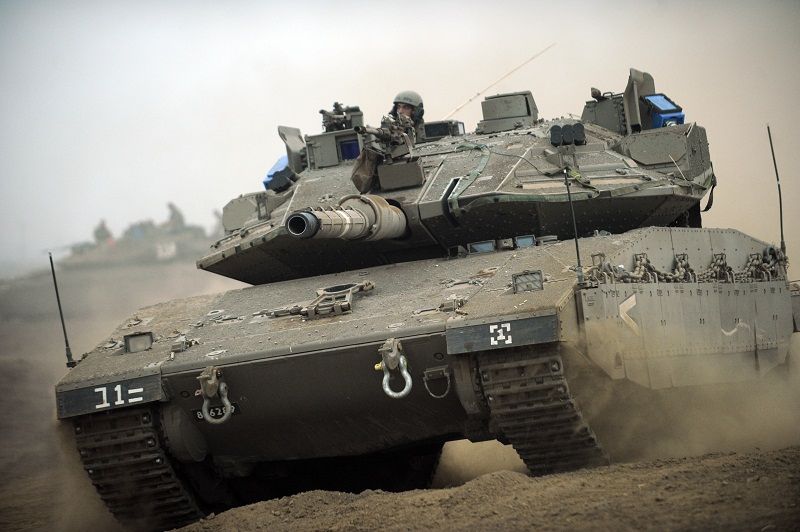
Israeli Merkava IV Battle Tank
Michael Shvadron/ Israel Defense Forces
Since its formation and first war with Arab states in 1948 the Israeli military has proven itself a highly effective fighting force, one which would go undefeated for 58 years despite the extreme regularity with which it found itself at war. While the training of Israeli infantry and special forces and the potency of its air force have long been regarded as the military’s strengths however, the country’s battle tanks have long left much to be desired in comparison. During the 1973 Yom Kippur War Israel’s U.S. made M-60 and M-48 battle tanks left much to be desired against Egyptian and Syrian Soviet made T-62 tanks and 9M14 anti tank guided missiles. While the T-62 was a new and cutting edge combat platform, the M-60 was an upgrade closely based on the M-48 - a platform dating back to 1953. Israeli tank divisions had to rely heavily on their superior training and morale, and when possible support from the air, to counter more sophisticated Soviet battle tanks against which the U.S. was unable to provide an analogue.
As a result of the failure of U.S. battle tanks and of the Western bloc to design a platform capable of matching those of the USSR, Israel in 1973 began its Merkava program to design an indigenous main battle tank for its future wars. The Merkava I entered service five years later in 1978, a second generation platform far surpassing the capabilities of the U.S. M-60 and comparable if not superior to the Soviet T-62. Weighing 63 tons compared to the M-60’s 51 and T-62’s 37, it was a far heavier and more costly platform tailored to the needs of Israel’s ground forces.
The Merkava saw its first action in the 1982 Lebanon War, where they were fielded alongside U.S. made M113 armoured personnel carriers (APCs). The M113 proved highly vulnerable and an almost complete failure, and platforms were quickly withdrawn from the warzone. With Israel seemingly wholly unable to rely on American armour to fulfil its requirements, the country succeeded in modifying several of its Merkava I platform into both APCs and armoured ambulances, creating internal space by removing internal ammunition storage allowing up to ten soldiers, walking or wounded, to enter through the rear door. While the Merkava proved a highly successful design, surpassing the capabilities of its Western analogues as well as the T-62, they suffered losses when deployed against the latest Soviet tank platforms - the T-72 operated by the Syrian military. This new Soviet platform, widely in service until today and one of the most effective battle tanks ever designed, was referred to by Syrian President Hafez Al Assad as ‘the best tank in the world’ as a result of its success during the Lebanon War.
While the Merkava I was outmatched by the T-72, the Israeli program was still a major success. The small state had in an extremely short period developed a battle tank capable of outperforming any produced by Western states. Without the Merkava Israel’s ground forces would likely have been left to rely on the M-60, M113 and other similar performing Western platforms in Lebanon which would have led to far greater losses. Following the end of the war Israel began extensive modifications to its design both to upgrade its existing platforms and to be able to design more capable battle tanks in future. The critical advantage of the Merkava program over battle tanks developed by the Western bloc was that Israel was capable of drawing extensively on combat experience to adapt its platforms to real combat situations. New Israeli designs could be regularly tested against the most advanced Russian platforms in service - providing the military with invaluable information and forcing Israel refine its design. Most Western developers by contrast had not engaged in any major tank battles since their limited encounters with North Korean armour in the Korean War, and until today have an extremely limited experience of armoured warfare due to their overwhelming reliance on air power to neutralise enemy armour in Iraq, Korea and other theatres.
Continued in Part Two
