
The Largest Stealth Fleet Ever Assembled; U.S. Air Force Conducts Massive Show of Force with New F-35 Jets
Military Watch Magazine Editorial Staff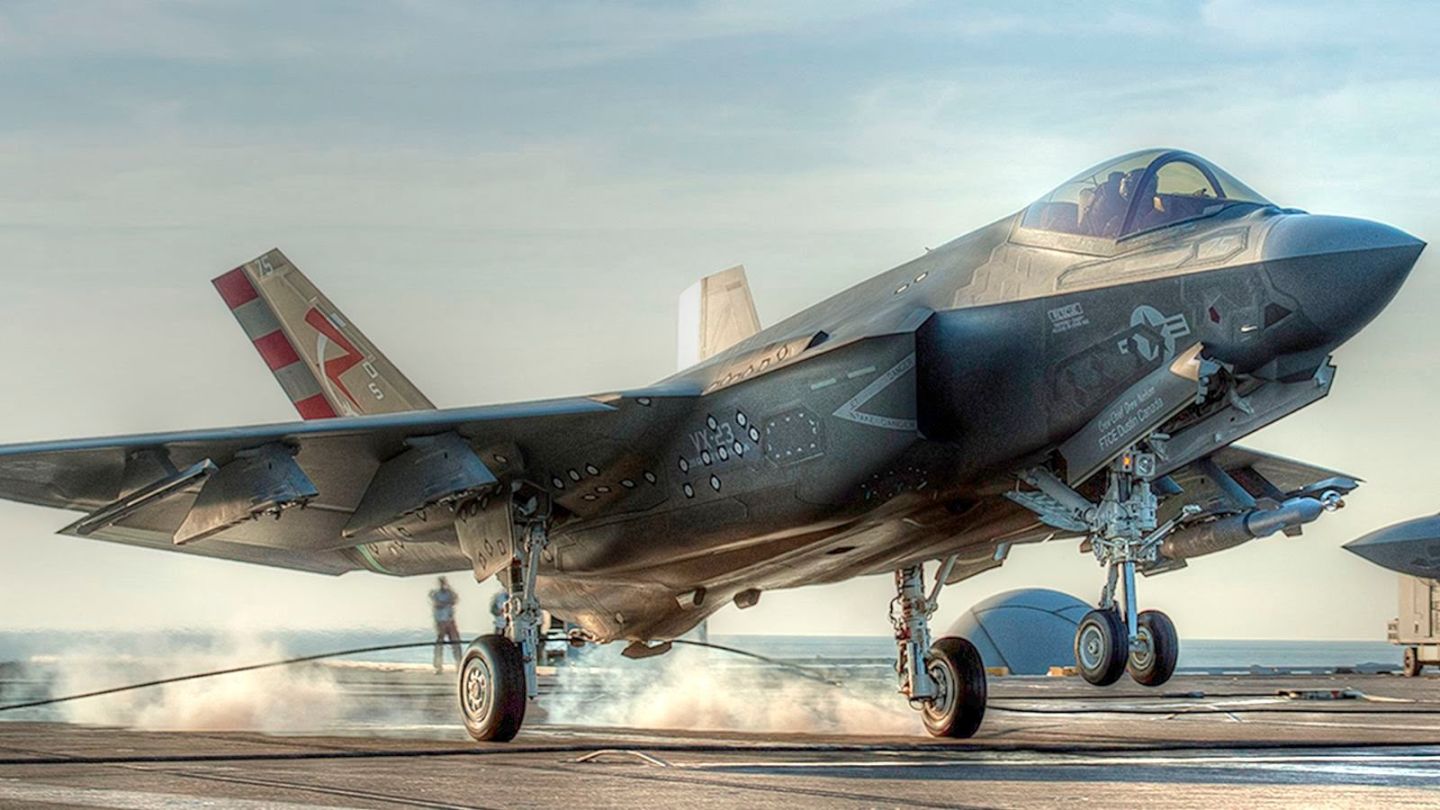
F-35 Stealth Fighter
The F-35 Lightning II fighter program represented the first time a radar evading stealth profile was applied to a lightweight multirole fighter aircraft, and the United States military's fourth program to develop a radar evading combat aircraft following the F-117 Nighthawk strike fighter, the B-2 Spirit heavy bomber and the F-22 Raptor twin engine air superiority fighter. A year after the F-35B was declared combat ready for use by the U.S. Marine Corps, the F-35A entered service with the U.S. Air Force. With over 2,500 of the jets planned, the aircraft has proven highly cost effective due to considerable economies of scale - and as a result it is considerably less costly than older and less sophisticated European fourth generation fighters such as the Eurofighter Typhoon and Dassault Rafale - which though less capable are produced on far smaller scales. The F-35A is set to replace the F-16 Fighting Falcon as the mainstay of the American fighter fleet, heavily tailored towards an air to ground role and capable of carrying out the vast majority of combat missions required by the Air Force. The F-22 Raptor and F-15E Strike Eagle will meanwhile continue to provide complementary support in air superiority and strike roles respectively.
As the only Western fifth generation fighter currently in production, and with rival powers rapidly deploying their own next generation combat jets - namely the Russian Su-57 and Chinese J-20 and J-31, the F-35’s role is particularly critical for the U.S. military and the entire Western Bloc. As such, amid growing tensions with both Russia and China, the U.S. Air Force has carried out a considerable show of force - the first ever "Elephant Walk" exercise to include the F-35. These exercises demonstrate the ability of large numbers of a particular aircraft to operate in unison. The drills were carried out by the U.S. Air Force's 388th Fighter Wing and Air Force Reserve 419th Fighter Wing at the Hill Air Force Base in Utah, which demonstrated the strength and readiness of the combat-ready F-35A units.
35 F-35A jets took place in the exercise, taking off at 20-40-second intervals. Having multiple squadrons take off near simultaneously is a key capability for large scale operations simulating a real wartime requirement, and according to Air Force officials it allows the units to better assess potential issues. Majour Caleb Guthmann, 34th Fighter Squadron assistant director of operations, stated regarding the exercise: “We are ready to fight tonight, and exercising with multiple squadrons of F-35s can demonstrate our ability to defeat potential adversaries wherever they may arise.” Col. Michael Ebner, the vice commander of the 388th Fighter Wing, stated that the short notice drill was a historic moment for the F-35 program, since it included the highest number of Lightning II jets to be simultaneously launched. He referred to the fighter as a "global deterrent" against conflict.
While the F-35A is lighter, slower, less manoeuvrable, shorter ranged and carries less munitions than its elite twin engine counterparts from the fifth generation - namely the F-22, Su-57 and J-20 - the fighter is considerable less costly than any of these aircraft. The F-35 is set to be fielded in far larger numbers - possible nearing an order of magnitude more in the quantities which are manufactured. The aircraft ultimately will not be relied on for frontline operations against the elite air superiority jets fielded by U.S. adversaries, a role reserved for the F-22, F-15C and future air superiority fighters currently under development. The light fighter's ability to hold its own against most adversaries in long range air to air engagements however, combined with its radar evading capabilities, sate of the art sensors and payload of high end munitions such as the recently tested GBU-49 precision guided bomb and the latest tactical nuclear bombs, makes it a potentially lethal addition to the American inventory. Should the U.S. military see through its plans to acquire the full number of F-35 fighters currently planned, it will be, by a considerable margin the largest stealth fleet, ever assembled.
