
The Japanese Air Force's Decline From the Leading Regional Power of the 1980s to an Outmatched Service Today; What Japan Can Do to Regain its Advantage in the Air?
Military Watch Magazine Editorial Staff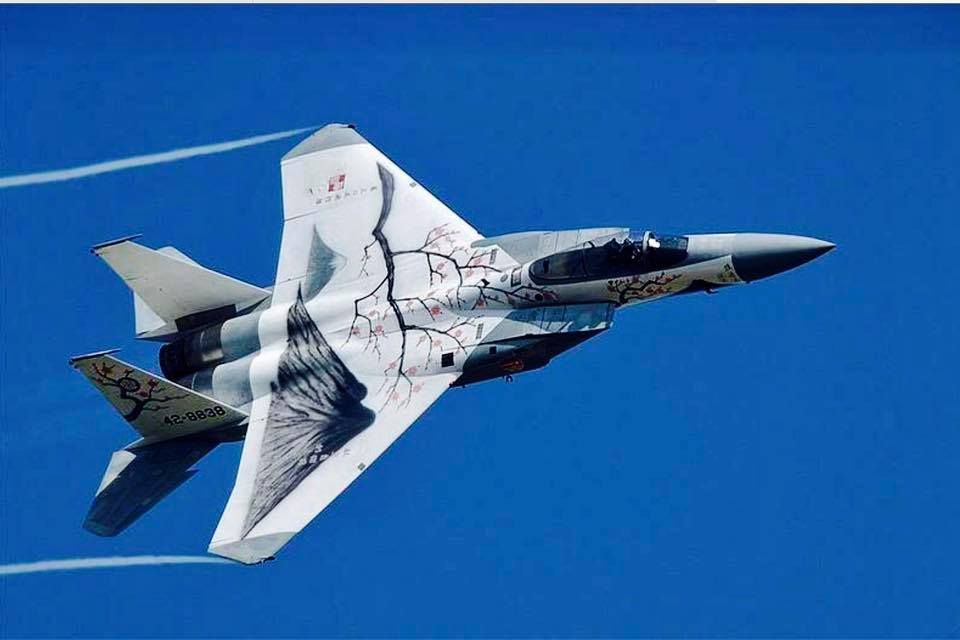
Japanese Air Self Defense Force F-15J Air Superiority Fighter
From 1981 the Japanese Air Self Defence Force began to take delivery of the F-15J, an advanced fourth generation air superiority platform which guaranteed the country air superiority over any potential adversary other than the USSR. The fighters were closely based on the U.S. Air Force's F-15C, but further incorporated several indigenous technologies. With 200 of the fighters inducted into service they formed the backbone of the Japanese aerial combat capabilities and made the Japanese Air Force by far the most potent in the world at the time other than those of the United States and Soviet Union. Today however Japan's strategic advantage has declined significantly. While the country has since the 1980s inducted the F-2 light multirole fighter into service, an advanced domestic variant of the American F-16, it has been faced with increasingly modern rival air superiority capabilities in neighbouring countries while failing to sufficiently upgrade its own.
Challenges to Japan's regional aerial supremacy have been manyfold, and its air superiority capabilities have since been surpassed by both China and India - leaving it in fifth place globally. The induction of modern air superiority platforms based on the Russian Su-27, many of which surpass the capabilities of the F-15, posed the first great challenge to Japan's position. With India, Malaysia, Vietnam and Indonesia all inducting Su-30 air superiority fighters into their air forces in the 1990s, the latter which has also ordered the more advanced Su-35, Japan has largely lost its technological edge. China meanwhile has not only inducted several hundred Su-27, Su-30 and Su-35 fighters into service since the 1990s, but it has also gone on to produce hundreds of its own platforms based on the same design, the J-11, which are a close match for the F-15 but fielded in far greater numbers. The country is also currently developing the J-11D, an advanced variant of the J-11 with '4+' generation capabilities similar to those of the Su-35 and far surpassing those of the F-15J.
Japan's inability to acquire fifth generation air superiority platforms due to the United States' export ban on the F-22 Raptor meant that is has been forced to rely on its F-15 fleet long after their technological edge had expired. Unlike the United States' other two foreign F-15 customers, Israel and Saudi Arabia, Japan faces near peer aerial powers fielding advanced air superiority platforms on all sides - whereas in the Middle East the are no such platforms whatsoever other than those sold by the United States itself. Not only has its inability to obtain the F-22 meant that Japan's Air Force has been matched by others through proliferation of fighters based on the Su-27 airframe, but it has increasingly left Japan outmatched as neighbouring countries induct 4+ and even fifth generation fighters into service. The entry of China's J-20 into service in early 2017, with several hundred fighters expected in the coming years, and with Russia's Su-57 set to enter service in 2018, Japan is finding itself not only matched but severely outmatched both technologically and numerically. Vietnam has also indicated that it is willing to acquire the Su-57 in the near future - and other countries may well follow suite.
Japan's quandary is a result of over reliance on technology from the United States - and many other U.S. clients have suffered from and seen their military positions compromised as a result of politics in Washington and the prohibition on the Raptor’s export. Not only has the U.S. failed to provide Japan with fighters to match those of its rivals, but it has also failed to provide more capable missiles for the Japanese F-15 fighters already in service to keep up with those fielded by other states. Japan's longest ranged missile currently in service is the 75km AIM-120B, which pales in comparison to the capabilities of the 100km range PL-12, 110km range R-77 and 130km R-27 in Chinese service. China is also developing the PL-15 and new ramjet engines which is expected to give its new missile a range of over 300km - while Japan appears set to remain restricted to the 75km range of its AIM-120B unless the country develops an indigenous missile or looks to sources other than the United States in the near future.
Unable to acquire the F-22, and with the only alternative sources of air superiority fighters being China and Russia, Japan has several options to regain some form of parity in the composition of its fleet. One would be further investment in the Shinshin X2 fifth generation fighter program with the aim of producing an indigenous air superiority platform. While designing such a platform would be extremely complex and expensive, Japan's large economy and potent technological base may well be up to the challenge. Indeed, such a platform would be welcome among many U.S. allies which, unable to acquire the F-22, would suffer far less reprimand from Washington should they buy a Japanese alternative rather than a Chinese or Russian one. Israel, Saudi Arabia and possibly even South Korea would among others be likely customers. Japan's other option would be to invest in a joint fighter program with Russia to counterbalance China's J-20 program. With Russia already involved in such programs with India and the United Arab Emirates, both countries with negligible military industrial bases and questionable strategic allegiances, Japan could very easily embark on such a program and gain highly favourable terms. This is of course provided that it is willing to weather the inevitable backlash from Washington. Ultimately unless Japan takes serious measures to develop such a platform, its F-15 fighters will increasingly be outmatched by the air superiority capabilities of the country’s modernising neighbours.
