
The Indian Navy's Next Generation Weapons System; Mach 6 Electromagnetic Railgun Successfully Tested
Military Watch Magazine Editorial Staff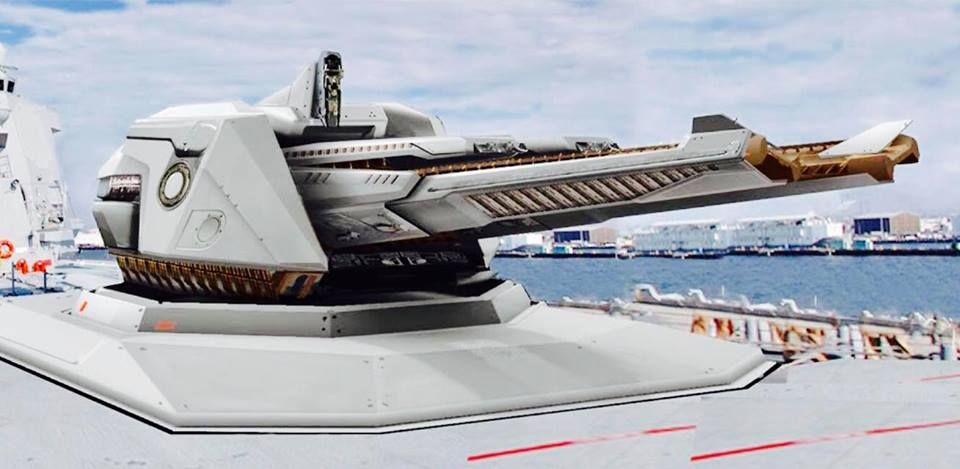
U.S. Navy Railgun Concept Design
India has joined the United States, Russia and China in seeking to develop a potent next generation weapons platform for its Navy - an electromagnetic railgun. These weapons use kinetic and laser energy instead of controlled explosives to fire projectiles at hypersonic speeds - impacting with devastating effect. Traveling at Mach 6, possibly faster, the weapons fire with such force that projectiles fired in the air by railgun would be able to escape the Earth's atmosphere. Such weapons will have an extremely long range and high accuracy. Railguns are likely to make their debut as naval weapons, and warships which deploy such weapons will be at a distinct advantage against those which do not - hence why all major powers have invested heavily in developing such systems.
In November 2017 Indian defense scientists successfully developed electromagnetic railguns able to fire projectiles at 4,600 miles per hour. According to the country's Defense Research and Development Organization, a 12 mm square bore EMRG was successfully tested and preparations are underway for testing of a more powerful 30 mm type. The military aims to accelerate a one kilogram projectile to a velocity of more than 2,000 m/s. Such a weapon would give the country's naval forces a significant advantage - allowing it to launch devastating strikes on both land targets and surface naval vessels. With India's Mach 3 Brahmos cruise missile already capable of cutting a warship in half upon impact due to its sheer speed, the impact of a Mach 6 railgun will be truly formidable. One shot kills against enemy surface vessels at extreme ranges will become the norm.
An Indian military scientist involved with the railgun project stated in an interview: "A simple single pulse driven railgun launcher was developed with a minimum of metal components in proximity to the bore to maximize the inductance of the launcher and to improve the launch efficiency. The launcher has a 12 mm square bore cross section. The launcher was fabricated with lengths ranging from 1 to 2 meters." India's Institute for Defense Studies and Analyses missile technology expert Rajiv Nayan stated regarding the future of railgun technology in Indian service: "As handling will be very easy, the armed forces can deploy it at any location in an emergency situation. It will be a very tactical weapon for the naval forces." Whether India's Navy will gain technological assistance from the United States or Russia, the former being more likely due to their growing relationship, remains to be seen.
