
The F-5 in Singaporean and Taiwanese Service; Modernising a Second Generation Fighter for the 21st Century
Military Watch Magazine Editorial Staff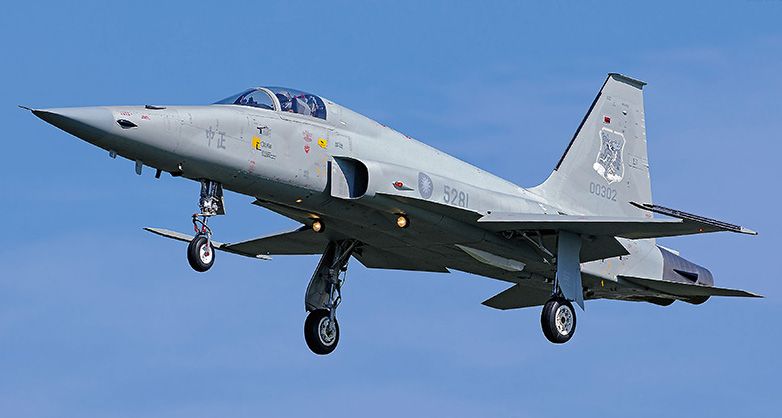
Taiwanese (ROC) F-5 Light Fighter
In service for almost 70 years, the F-5 second generation light fighter remains widely in service today and has been extensively modernised to allow it to contend with modern fourth generation combat aircraft. Much like its Soviet counterpart the MiG-21, the F-5 today is widely derided as obsolete due to the design’s age. The extent of upgrades applied to the fighter however have made it a highly capable asset to several modern military powers, while its lower maintenance requirements relative to fourth generation equivalents such as the F-16 and F-18 have made it a highly attractive combat platform. Indeed, the Swiss Air Force notably rejected the F-16 in favour of a modernised F-5 due to the latter’s comparable combat capabilities and far lower maintenance needs - which alone says a great deal regarding the fighter’s viability as a modern combat platform.
While the original F-5 was equipped with capable engines allowing it to reach supersonic speeds and giving it the high thrust:weight ratio needed to contend with manoeuvrable enemy platforms in a dogfight such as the MiG-17, a platform it engaged on several occasions over Vietnam, the U.S. fighter left much to be desired in its beyond visual range combat capabilities. This has changed remarkably, and several modern variants of the F-5 in service today are able to in many ways outperform early variants of the F-16 and F-18 in beyond visual range combat. By equipping the F-5 with advanced avionics, radars and long range air to air missiles among other upgrades, the platform can reliably engage adversaries at extreme distances. The fighter’s small size, high speed and manoeuvrability meanwhile enhance its survivability in beyond visual range engagements against enemy air to air missiles.
For beyond visual range engagements Singapore and Taiwan have both equipped their respective variants of the F-5, the F-5S and ROCAF F-5E, with AIM-120B air to air missiles. Developed in the late 1990s, the missiles are among the most advanced in the world and can reliably target enemy aircraft at distances of up to 75km. This makes the F-5 one of the most capable platforms in the world in air to air combat, augmenting its already formidable dogfighting capabilities with advanced U.S. beyond visual range capabilities originally developed to modernise its fourth generation fighters - which have had a significant effect when applied to modernise second generation platforms. Taiwan's fighters have also been equipped with indigenous Sky Sword II air to air missiles, platforms capable of targeting enemy aircraft at distances of up to 100km. Ultimately, much like modernised variants of the MiG-21 in service today, the F-5 fighters in Singaporean and Taiwanese service remain a force to be reckoned with - and the phasing out of obsolete components and integration of state of the art weapons systems have ensured that it will remain a viable and lethal platform for modern warfare.
