
The F-16’s Future; At 40 Years Old the Fighting Falcon Still Has a Key Role to Play in the U.S. Air Force
Military Watch Magazine Editorial Staff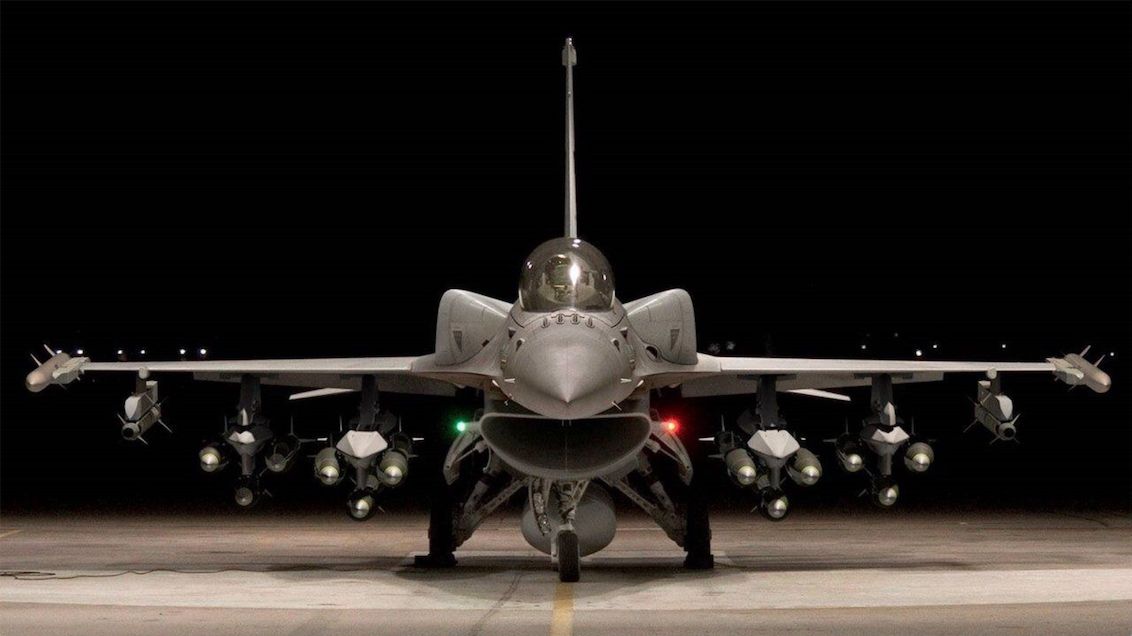
F-16 Fighting Falcon
Forty years after it first entered service in 1978, designed as a fourth generation replacement for the F-5 Tiger and a lighter and less costly complement to the cutting edge F-15 Eagle first commissioned two years prior, the F-16 Fighting Falcon looks set to continue to serve in the U.S. Air Force for many years to come. While the Air Force is reportedly considering retiring its fleet of approximately 200 F-15C/D light fighters, and with the U.S. Navy’s F-14s retired in 2006 and the F-18C on the way out, the F-16 appears set to outlast other fourth generation fighters in its service life. Indeed, with approximately 1000 of the fighters in service, they are key to maintaining the U.S. Air Force’s numerical advantage over near peer adversaries in a major war - while their versatility and low operational costs, particularly when compared to the F-35, make them an ideal workhorse for the service in the vast majority of combat situations.
With the F-35 program continuing to stall, and the feasibility of seeing the program through to full production being put to serious question, it will likely be well over a decade, possibly two, before enough of the F-35A fighters are put into service to phase the F-16 out of service entirely. Should the military fail to considerably lower the operational cost of the F-35, a task great efforts have been made to see through, the Air Force could benefit from retaining some F-16s long after the F-35 enters full service. Against Taliban insurgents or Al Qaeda militants, there is little need for stealth capabilities the fifth generation fighter offers while the F-16 can carry many of the same munitions in greater quantities, fly faster and deliver sorties at a considerably higher rate due to its lower maintenance needs.
Should the F-15C be retired, which a number of reports suggest is a considerable possibility, then the F-16 could see new emphasis placed on its capabilities to support more advanced specialised fighters such as the F-22 and F-15E in air superiority and strike missions. While the F-16 lacks the capabilities of either a specialised air superiority fighter or a strike fighter, it is more than capable of playing a supporting role for either of these - with the highly versatile platform able to integrate a wide variety of air to ground and air to air munitions. While restricted by its short range, high radar signature, low operational altitude and low speed, the aircraft’s advanced munitions and ability to integrate cutting edge avionics makes it an invaluable support platform - one which can remain viable long after the F-15 it was initially intended to support is retired. One key role the platform could fulfil, as noted by a number of U.S. experts, is to support the Air Force’s F-22 fleet in countering enemy stealth fighters - a growing threat to U.S. air superiority.
Unlike the Chinese J-20 and Russian Su-57 fifth generation air superiority fighters, which are equipped with advanced infra red search and track (IRST) systems capable of effectively detecting enemy stealth aircraft at intermediate ranges while operating radar silently (without a radar signature), the F-22 Raptors lack IRST sensors and are thus faced with a considerable disadvantage against enemy stealth fighters. While the Russian Su-57, which appears to retain a considerable radar cross section, can most likely be detected by the F-22’s advanced AN/APG-77 radar, the Chinese J-20 and J-31 stealth fighters appear to have radar evading capabilities comparable to those of American aircraft. These are set only to improve as China continues to invest heavily in developing more advanced stealth technologies for future variants of its fighter - which will also be integrated onto its stealthy attack drones and heavy bombers. Future variants of the Su-57 could also see enhancements made to their stealth profiles. The F-16 could fulfil an invaluable role in countering these potential threats using its external IRST sensor, the Lockheed Martine Legion Pod, the detect enemy stealth aircraft. Multiple Fighting Flacons can use data links to generate weapons quality tracks on enemy stealth fighters, and pass targeting data to accompanying F-22 Raptors which can use it to effectively engage the enemy stealth platforms. This potentially lethal combination could be key to countering aircraft such as the J-20 and J-31 in the Pacific.
While the F-16 is relatively slow and unsurvivable relative to the Raptor, or even the F-15C, lacking the advanced radar absorbent coatings, thrust vectoring and AESA radars of other single engine light fighters such as the J-10C, it still remains a somewhat viable support platform for the Raptor to engage emerging threats to American air superiority. Though the U.S. Air Force’s upcoming sixth generation air superiority fighter, the successor to the F-15C and the Raptor, will likely be more than capable of ensuring an advantage against enemy fifth generation platforms unsupported, the F-16 can provide a key boost to the existing air superiority fleet until then in a supporting role. Should it be upgraded with the latest air to air missiles such as the AIM-120D, the Fighting Falcon will be able to more than double its engagement range and thereby provide key supporting firepower in an air campaign. Even without further upgrades, the aircraft remains perhaps the best suited platform in the U.S. inventory for theatres such as Afghanistan and Somalia where a complex high fighter is not required and a lighter and simpler aircraft remains preferable. These factors combined with its low operational cost and high reliability, and a consideration for the snags currently plaguing the F-35A’s development, mean that the F-16 is likely to see continued deployments for some years to come - and could very likely pass its 50th year in active service with the U.S. Air Force.
