
The Capabilities of Russia's Iskander Ballistic Missile System; Can U.S. Air Defences Intercept Them?
Military Watch Magazine Editorial Staff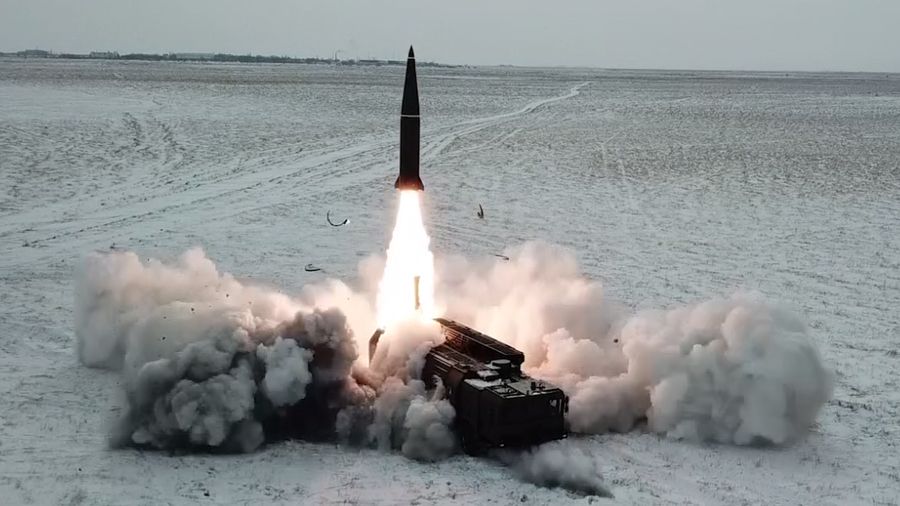
Iskander Missile System
The 9K720 Iskander first entered service in 2006 as Russia's latest short range ballistic missile platform, and was developed as a replacement for Soviet the SS-21 Scarab (OTR-21 Tochka) series which itself replaced the Scud series of the early Cold War. The Iskander incorporates a number of advanced technologies developed for the OTR-23 Oka, a Soviet ballistic missile with similar capabilities which entered service in 1980 but was scrapped by the end of the decade by Chairman Mikhail Gorbachev in a gesture of goodwill to the Western Bloc. The missiles were designed with a maximum range of 500km, the upper limit on short range ballistic missiles under the Intermediate Range Nuclear Forces (INF) treaty which limits the types of missiles deployed by Russia and the United States. Like the Scarab and the Oka the Iskander uses solid fuel, making it far easier to maintain and reducing the time it takes to deploy to approximately 15 minutes - a 75% reduction on the launch time of the Scud series. The missile improves significantly on the range and accuracy of its predecessors, while integrating more advanced evasion capabilities to counter hostile air defences. Capable of deploying nuclear, chemical and a variety of conventional warheads, the missiles are controlled along every stage of their flight path to maximise precision. This also allows the missile to be retargeted during flight to more effectively engage mobile targets.
The Russian Defence Ministry plans to completely phase out the Scarab and equip all its ground units with the Iskander by 2020. The system can coordinate with satellites, aircraft, intelligence centres, artillery observers and even aerial photos scanned into a computer system to locate its target. One of the Iskander's key capabilities is the ability to perform evasive maneuvers in its terminal flight stage and release decoys, which combined with its speed of over Mach 5 makes them near impossible to intercept. This versatility ensures that early strikes on Russian satellites and the inability to deploy reconnaissance aircraft will not significantly impede the weapon's operations. While lacking the range and payload of platforms such as the North Korean Rodong-1, the Iskander's high accuracy and advanced evasive capabilities make it a world leading missile with a almost exclusively tactical role.
The Iskander's advanced capabilities have made it cause for particular concern among Russian's potential adversaries - namely Western powers with which tensions have escalated considerably in recent years. Head of Russia's Federal Service for Military Technical Cooperation Dmitri Shugaev stated in regards to this: "Naturally, Iskander's deployment in the Russian Armed Forces seriously livens up those who consider us as their adversaries. This speaks to the fact that we have a very serious weapon, undoubtedly." Sweden has notably sought to acquire U.S. made Patriot Missile batteries at a cost of $3.1 directly in response to the Iskander's deployment in Russia's Western province of Kaliningrad, which gives the Russian platform coverage over much of northern Europe as well as north east Germany. The Swedish military was highly concerned that the Russian forces could swiftly eliminate airbases and military facilities across the country with rapid strikes using Iskander missile batteries - against which the European state would otherwise be effectively defenceless. Disabling airfields with early strikes could well be key to allowing Russia to quickly gain air superiority with minimal resistance.
Given the poor combat record of Patriot missile batteries, they are highly unlikely to prove capable of intercepting the Iskander system - leaving NATO targets effectively defenceless against the Russian platform. The American House Government Operations Subcommittee on Legislation and National Security themselves reported on the performance of the Patriot against Scud B missile during the Gulf War: "There is little evidence to prove that the Patriot hit more than a few Scud missiles launched by Iraq during the Gulf War, and there are some doubts about even these engagements." Later military reports reached similar conclusions regarding the Patriot's ineffectiveness. Considering that the Scud B, dating back to 1965, is an extremely primitive platform relative to the Iskander which should have been an easy target for the Patriot, this bodes ill for the prospects of the U.S. made missile battery against the Russian missile. The failures of the Patriot to intercept even extremely primitive makeshift missiles deployed by Yemen's Ansurallah coalition as recently as 2017 further indicates the platform's inability to counter the Iskander.
