
The Bear’s New Claws; Game Changing New Kh-101 Missiles to Be Deployed by Russia’s Tu-95 Bombers - Part One
Military Watch Magazine Editorial Staff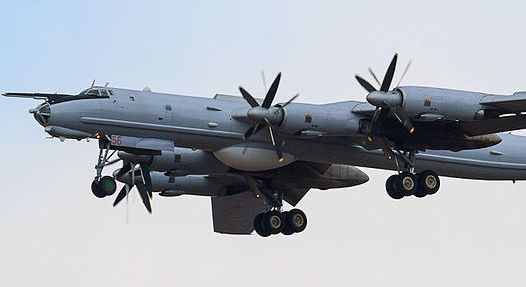
Tu-95
One of the oldest aircraft still serving with a modern Air Force, the Tu-95 was commissioned under Soviet leader Joseph Stalin and saw its first flight in 1952 - a year before his death. While a number of prominent and highly promising Stalin era weapons programs were cancelled or otherwise stalled under the governance of Nikita Khrushchev, who succeeded Stalin as the leader of the Soviet Union, the Tu-95 Bear was see through to completion. Powered by eight contra rotating turboprop engines, the Bear remains one of the few propeller driven combat aircraft in service anywhere in the world - and it shows no signs of being retired in the near future. Upon entering service the aircraft was among the most effective means of nuclear delivery in the world, and its induction prompted the United States to develop the revolutionary F-4 Phantom twin engine heavy fighter with the specific goal of intercepting the aircraft away from American shores.
The Soviet Union and later Russia applied a series of modernisations to the Tu-95 airframe allowing it to remain viable as aerial warfare has evolved, most recently materialising as the Tu-95MSM which relies on some of the most sophisticated cruise missiles in the world to deliver precision strikes at extreme ranges. As one of three heavy bombers forming the air arm of Russia’s nuclear tried, a complement to the country’s ballistic missile and nuclear armed submarine capabilities, the Bear is also capable of deploying nuclear arms through in the form of nuclear tipped cruise missiles. While the Tu-95 originally entered service as one of the world's first intercontinental range bombers, designed to drop heavy strategic nuclear payloads onto the United States mainland, its role has evolved considerably over more than half a century in service - and the Bear today serves largely as a strategic platform designed to deploy the latest cruise missiles for precision and nuclear strikes at standoff ranges. While the bomber can still deploy a nuclear payload, these are tactical rather than strategic platforms with payloads several orders of magnitude smaller - designed for strikes on targets such as troop formations and command centres rather than the destruction of entire cities. Russia today has shifted to a reliance on its ballistic missile and submarine assets to deploy its strategic nuclear arsenal, with its Air Force relegated to an overwhelmingly tactical role.
The Tu-95MSM builds on the already considerable modernisations of the MS variant, which entered service in large numbers in the 1980s and saw a range of equipment, from radar and avionics systems, replaced. The key change with the greatest implications for the new enhanced variant of the Bear however was that it was capable of operating a wide variety of state of the art standoff munitions - essential to keeping the aircraft viable. While most aspects of the Bear’s design were highly favourable, older variants of the bomber could not be modified to deploy standoff cruise missiles - resulting in the restarting of production lines during the 1980s, over 30 years after the first Tu-95 airframes were produced, to manufacture modified bombers as the new MS variant. This makes many of the airframes deployed by the Russian Air Force today newer than most Western made combat aircraft in service today. With production of the Bears having continued until 1993, the turboprop powered bombers entered service after the majority of the U.S. Air Force’s fighter fleet, from its F-15C Eagles to its F-16C Fighting Falcons. The fact that the Soviet Union and even the cash strapped Russian Federation continued to manufacture the aircraft 41 years after it first flew is testament to the potency and reliability of the design.
Continued in Part Two
