
Taking A2AD Under Water; China’s Plans for a Submarine Hunting ‘Death Star’ Satellite
Military Watch Magazine Editorial Staff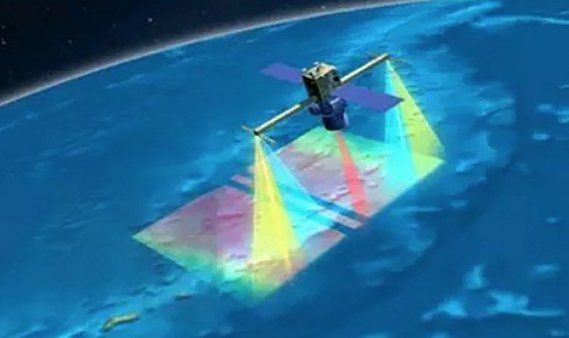
Anti Submarine Satellite - concept design
As the United States announced the commissioning of its latest nuclear powered submarine, China’s People’s Liberation Army (PLA) has revealed plans to develop an new type of anti submarine asset - a submarine hunting laser equipped satellite. The new platform will reportedly be capable of locating enemy submarines up to 500 meters below the surface, and if deployed with coverage over the East and South China Sea this weapons system could well successfully deny hostile submarines access to strategically critical waters claimed by Beijing. While the PLA has invested heavily in anti access area denial (A2AD) in the aerial and surface domains, from the PL-21and S-400 missile systems designed to target hostile aircraft at extreme ranges to the DF-21D ‘carrier killer’ cruise missiles meant to keep hostile warships away from Chinese coasts, acquiring a new submarine hunting weapons system appears potentially set to plug the last hole in the country’s defences and shift the balance of power at sea in East Asia further in the country’s favour.
According to the Pentagon's Defence Advanced Research Projects Agency (DARPA), the deepest a laser device has been able to penetrate into ocean water and report reliable results is 200 meters - meaning China’s new weapons system will be unprecedented and will considerably enhance the PLA’s submarine hunting capabilities. While a number of parties have invested heavily in anti submarine warfare since the Cold War era, from the Soviet Union’s nuclear armed anti submarine helicopters to heavily specialised British and Japanese submarine hunting warships, the new Chinese weapons platform remains unparalleled in its ambition.
Plans to develop a submarine hunting ‘Death Star’ satellite were launched by the Pilot National Laboratory for Marine Science and Technology in Shandong Province, with an additional 20 institutes and universities involved in the program. The satellite's laser beam is intended to zero in on a submarine and shoot back pulses to the satellite that would be analysed to pinpoint the vessel's location, three dimensional shape and speed. Used in conjunction with microwave radar technology, these laser beams would theoretically be able to scan areas as wide as approximately 100 kilometers - or focus on areas as small as 1 kilometer. Due to its highly ambitious specifications, it could well be several years before the weapons system is operational, with Zhang Tinglu, a researcher involved in the project, noting: "there's still heaps of problems that we need to solve."
