
Switzerland Set to Modernise Air Defences with Elite Fighter Jets and Anti Aircraft Missiles
Military Watch Magazine Editorial Staff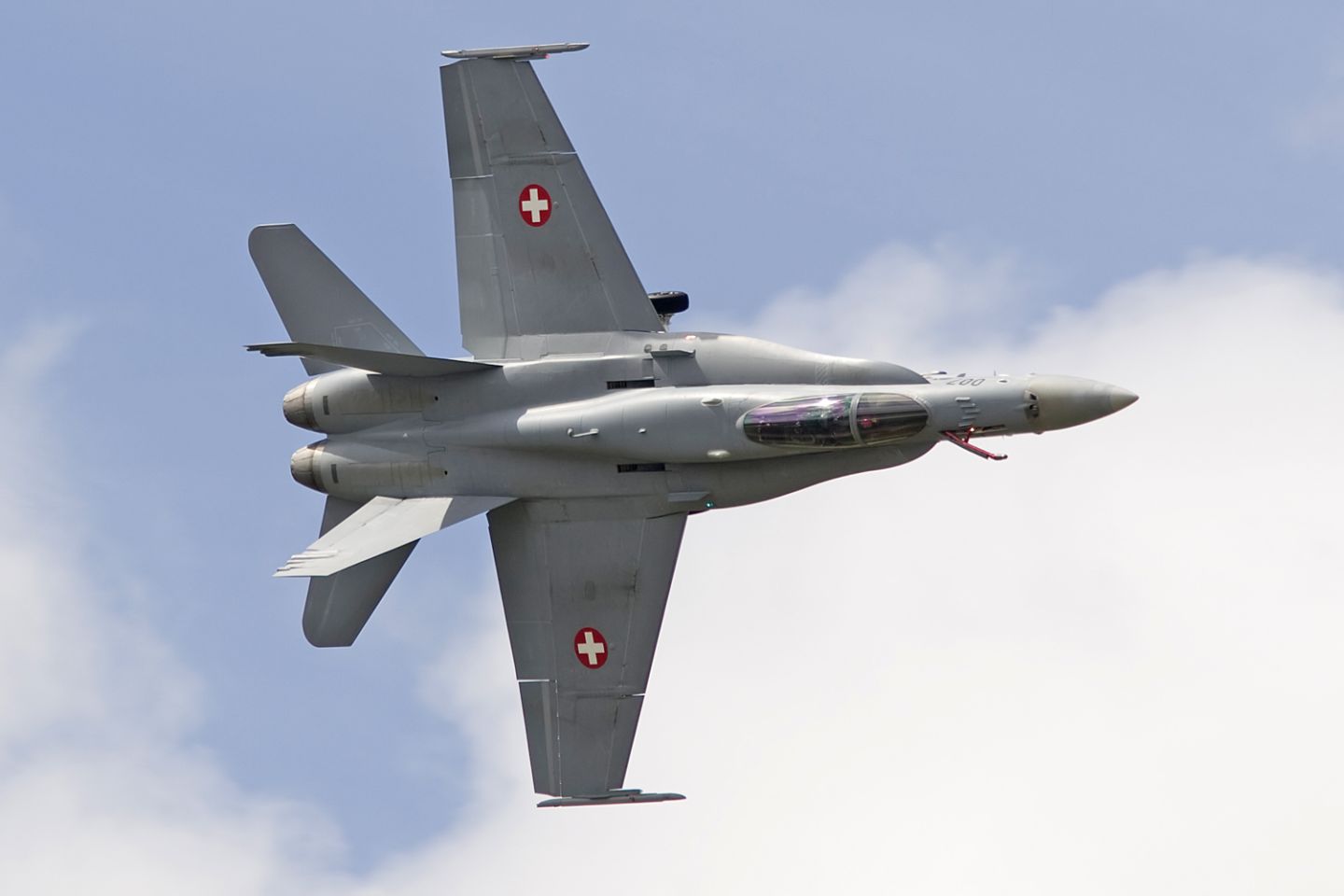
Swiss Air Force F-18 Hornet Twin Engine Light Fighter
In November 2017 Switzerland's the Federal Council announced its intention to spend CHF8 billion ($8.4 billion) to modernise the military's aerial warfare capabilities. This would include the acquisition of both new fighter jets and air defence platforms. The Swiss Defence Ministry was thus tasked with exploring suitable aircraft for acquisition, and despite officially being a neutral state and non NATO member the country is set to continue to exclusively consider Western designed weapons systems. The ministry has thus begun talks with France's Airbus and Dassault, the United States' Lockheed Martin and Boeing and Sweden's Saab for information on new available weapons systems.
Switzerland currently retains negligible surface to air missile capabilities, while its Air Force deploys a number of sophisticated U.S. made combat aircraft. Alongside a small fleet of older F-18 Hornet fourth generation twin engine light fighters, the Air Force also operates large numbers of F-5 Freedom Fighter twin engine light platforms. While the F-5 is widely considered an obsolete combat platform, Switzerland is one of many states which as proven otherwise by extensively modernising the fighter's radar, avionics and weapons systems to allow it to contend with more modern light platforms. Indeed, the Swiss military expressed a preference for the F-5 over the F-16 due to its lower maintenance requirements, and when the former is adequately upgraded it is comparable in its combat performance to the fourth generation fighter. Significant commonalities in the design of the F-5 and F-18 were also likely a factor in the military's decision, as this would further reduce maintained costs compared to fielding two entirely different platforms. Whether new fighters are set to fly alongside the F-5 in the fleet, or to replace the older platforms, remains to be seen.
Switzerland's move to modernise its aerial warfare capabilities comes as part of a growing trend among U.S. aligned Western non NATO states to strengthen defence cooperation with Washington and particularly to acquire U.S. made air defence systems. Similar moves by Sweden and Finland have closely coincided with those of the Swiss Federal Council. Ultimately the acquisition of new fighters will still require a nationwide vote, and voters will have a say on whether or not to proceed with the acquisition but not what type of jets to acquire or how much will be spent on the acquisition. Should the vote pass however, Raytheon's Patriot missile batteries and Boeing's F-18E Super Hornet fighters are likely choices for Switzerland's modernisation program. The Super Hornet's combtability with existing Swiss weapons systems and the Air Force's familiarity with similar platforms is a significant factor in its favour, while the Patriot is without peer among Western made air defence systems in its capabilities. These platforms will significantly enhance Switzerland's aerial warfare capabilities, which currently leave much to be desired with both negligible air defences and a reliance on older and lighter fighter jets. Whether Switzerland will be able to acquire the F-18E Super Hornet Block 3, the most advanced variant of the Super Hornet recently offered to India for export, remains to be seen based on the aircraft's extremely high cost. Should the Air Force acquire the platform it will field one of the most capable combat fighters in the world, armed with Raytheon's highly capable AIM-120D air to air missiles few adversaries can match, and this will have a transformative effect on the Swiss military's standing in Europe.
