
Sukhoi: Russian Air Force Will Receive its First Batch of Su-57 Fighters 'Very Soon'
Military Watch Magazine Editorial Staff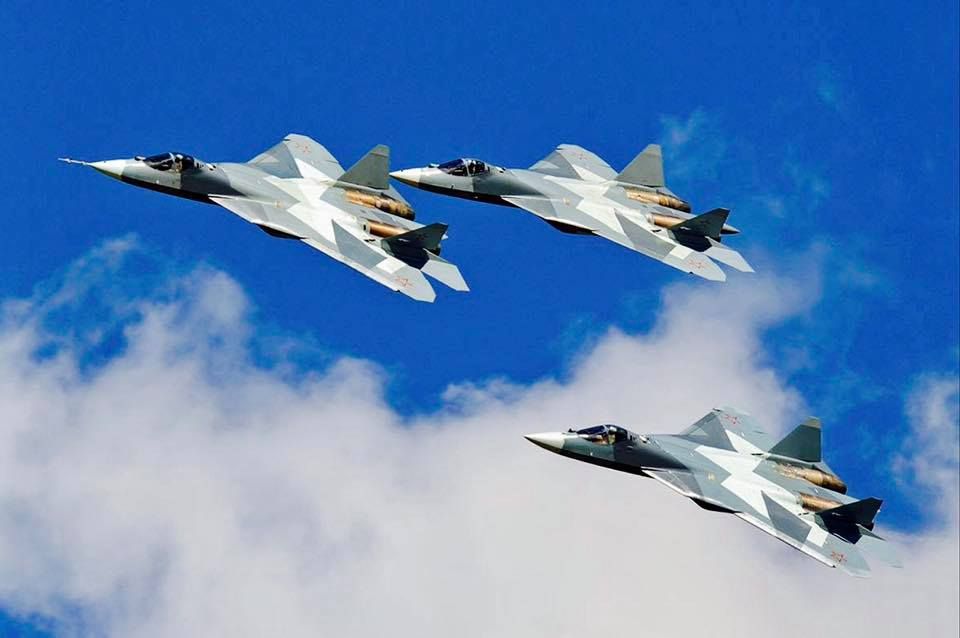
Russian Su-57 Fifth Generation Air Superiority Fighters
The Russian Air Force is set to receive its first batches of two major new fighter platforms in 2018 - the Su-57 fifth generation air superiority fighter and the MiG-35 '4++' generation light multirole fighter. According to a statement from Russia's Joint Aviation Corporation, the first batch of Su-57 fighters are set to enter service in the Russian Air Force 'very soon.' Upon their induction, they would make Russian the third country to successfully develop a fifth generation fighter after the United States (2005) and China (2017).
While the MiG-35 is in many ways a lighter and lower maintenance equivalent to the Su-35 already in service, incorporating many of the same technologies on a smaller airframe and with a shorter range, the Su-57 stands out as the first of a new generation incorporating a number of new technologies never before seen on any other platform. The fighter is the first in Russian service to incorporate advanced stealth capabilities and is set to change the face of the Russian Air Force in a way no other has since the induction of the Su-27 in 1985. Much like the Su-27, the Su-57 was designed with significant potential for modernisation, and can even incorporate sixth generation technologies. More advanced and specialised variants of the platform are likely to enter service in future - just as the fourth generation Su-27 was developed into the Su-30, 33, 34 and 35. The fifth generation platform is also set to be upgraded into one of the world's first sixth generation fighters once the necessary technologies are developed.
Early batches of the Su-57 are set to be relatively small, until the fighter's early production AL-31F engines can be replaced by the more capable Saturn AL-41 closer to 2020. The Su-57 is likely to be the last land based fifth generation air superiority fighter to enter service on a new airframe - as only China, Russia and the United States have ever been able to develop such heavy modern platforms due to their cost and complexity. The fifth generation fighter programs of other countries such as South Korea and Turkey have notably focused heavily on developing lighter multi role platforms which are much less costly to develop. With the United States' F-22 out of production and blocked from export, and China's willingness to export its J-20 as of yet unknown, the Su-57 has the potential to see major sales abroad which would give clients a technological advantage over potential adversaries - at least until the first sixth generation fighters enter service which is unlikely in the near future. The U.S. F-35, while retaining fifth generation capabilities and widely exported, was never designed as an air superiority fighter and would struggle to match such a heavy platform in air to air combat - much as in the fourth generation the light F-16 was never designed to engage the Su-27. It will be a number of years before Russia's new fighters are made available for export, while Russia will in the meantime focus both on providing for its own defence needs and on marketing its '4++' generation Su-35 air superiority fighter for export.
