
Su-57 Reportedly To Enter Service on Schedule; Final Trials of Russia's Next Generation Fighter Underway
Military Watch Magazine Editorial Staff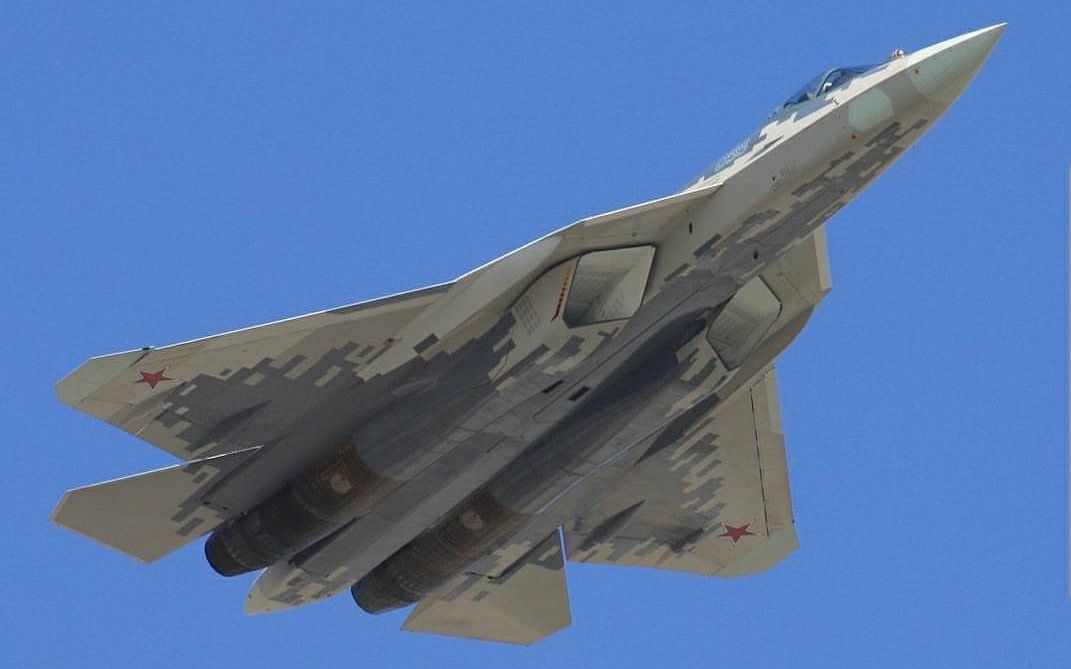
Russian Su-57 Next Generation Fighter
The Russian Air Force is expected to receive its next generation Su-57 air superiority fighters on schedule, alongside their lighter counterparts the MiG-35, with preliminary orders already having been placed for both platforms by the service. Trials for the Su-57 reportedly continue to be carried out with promising results, and with advanced prototypes of the aircraft having been deployed to a warzone for combat operations over Syria in February 2018 their entry into active service appears imminent. Russian Deputy Defense Minister Alexei Krivoruchko stated regarding the development of the new aircraft: "The delivery of multirole Su-57 fighter jets to aviation units of the Russian Aerospace Forces will be carried out in line with the state arms procurement program until 2027.”
While mass production of the Su-57 has been postponed until the late 2020s, with Russia confident in the capabilities of its high end fourth generation fighters such as the Su-30 and Su-35 to match rival platforms fielded by the Western Bloc, as new technologies continue to be developed for the new fighter it is slated to enter service in a far more advanced form and in larger numbers. Early orders for less advanced variants of the fighter will be key to familiarising the Russian Air Force with operating the aircraft and fine tuning its design, before it eventually takes its place as the mainstay of the country’s air superiority fleet. It has been widely speculated that upon its entry into mass production, the Su-57 will be among the world’s first sixth generation fighters - with the technologies currently being tested on prototype airframes considerably more advanced than those deployed by fifth generation jets.
The Su-57 is expected to deploy a number of next generation munitions such as the K-77 air to air missile, the K-37 ramjet powered anti aircraft missile, the Drel guided bomb and the Kh-59MK2 fire and forget cruise missile. While the platform does not prioritise a low radar cross section to the same extent as American next generation fighters - with the Russian jet having stealth built onto the airframe rather than an airframe built around stealth - the Su-57 nevertheless fields a reduced radar cross section relative to older fighters and will make use of radar absorbent coatings. The aircraft will be able to carry an arsenal of eight air to air missiles internally, double that of the U.S. F-35 and the same as that of the F-22 Raptor, which are potentially lethal at extreme ranges making full use of the fighter’s powerful AESA radar. While early prototypes of the fighter have made use of advanced fourth generation engines, Russia has also worked to develop a next generation engine comparable to the Chinese WS-15 or U.S. F135 to power its new fighter - with the first photos of the state of the art Izdeliye 30 having been released in November 2017.
