
Su-30 Coming to Iran? Elite Russian Fighters in Iranian Hands Set be a Game Changer for the Middle East
Military Watch Magazine Editorial Staff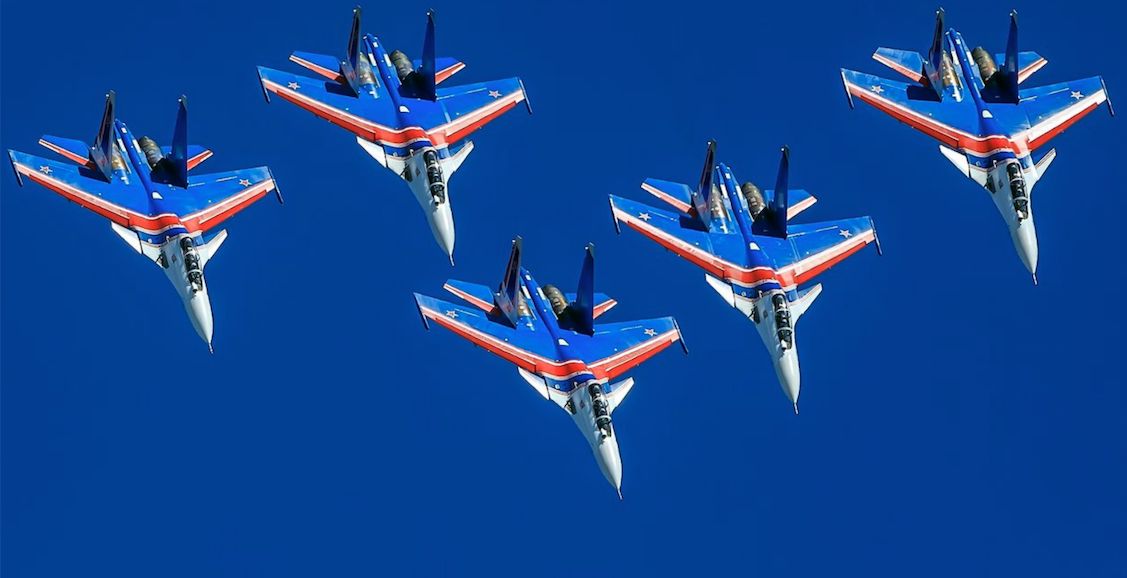
Su-30 Air Superiority Fighters in Formation
Following Iran's entry in the Joint Comprehensive Plan of Action (JCPOA) nuclear deal with the United States, Russia, China, Britain France and Germany, and the resulting withdrawal of United Nations economic sanctions against the country in 2015, a number of sources have reported that Tehran has shown interest in acquiring advanced Russian made air superiority fighters to modernise its aerial warfare capabilities. While the JCPOA deal, which still stands despite the withdrawal of the United States, bans countries from exporting offensive weapons to Iran without the express permission of the United Nations Security Council, this restriction is set to expire in 2020. Allowing Iran to freely acquire weapons from abroad has been strongly criticised by a number of Western parties and by Tehran's longstanding adversary Israel, and could have significant implications for the balance of power in the Middle East.
The Iranian Air Force's inventory today is far from remarkable. The service fields ten squadrons of Vietnam War era U.S. made F-4E and F-5E fighters, between then comprised of around 130 fighters, and two squadrons of the more formidable American F-14 Tomcat heavyweight air superiority fighters between them boasting approximately 45 combat capable jets. These fighters were relied on heavily to wage an eight year war with Iraq from 1980 to 1988, after which Iran was able to acquire a sizeable contingent of early variants of the Soviet MiG-29A medium fighters and two dozen Chinese J-7M light fighters. The country also received a number of older Soviet aircraft from Iraq in 1991 during the Gulf War, with pilots fleeing to the safety of Iranian airfields to escape Western bombardment of their own. These included some additional MiG-29 fighters, French built Mirage F1 jets, and dozens of swept wing Su-22 and Su-24M strike platforms. Iran has since inducted some indigenous light platforms such as the Saeqeh and Kowsar twin engine light fighter, a platform analogous to the U.S. F-20 Tigershark and similarly based on the same original F-5 design. As a result of the sourcing of its fighters the Air Force today fields a somewhat ragtag force of over ten different combat aircraft types. Of these only the Su-24M, MiG-29A and F-14 are considered fourth generation aircraft, and the F-14 is the only Iranian fighter equipped with active radar guided long range air to air missiles.
With the partial exceptions of the F-14 and Su-24M, Iran's fleet is poorly suited to carrying out operations beyond its borders which has relegated the Air Force to an almost purely defensive role for decades. Although Iran has vastly expanded its influence across the Middle East, most recently sending military advisors to Syria to oversee the ever expanding deployments of a number of militias aligned with Tehran, the country lacks power projection assets from which to project force directly from Iranian territory itself. By contrast the country's regional rivals Israel and Saudi Arabia, the Western Bloc's primarily defence partners in the region, both field sizeable fleets of F-15I and F-15SA strike fighters ideal for projecting power, and Israel in particular has used these to undermine Iranian interests in the past by conducting airstrikes far from their own borders.
In regards to the extremely limited capabilities of Iran's Air Force today, Israeli Air Force Brigadier General Israel Baharav stated: "The Iranian Air Force is basically comprised of old U.S. planes and aircraft that the Iranians managed to obtain later. I believe that the Iranian Air Force could be taken into account only if (the Israeli Military) has to operate in Iranian airspace (i.e. the Iranian Air Force is incapable of effective power projection.)" The general further stated regarding the underwhelming expeditionary capabilities of the Iranian Air Force and their inability to conduct operation near or into Israeli territory: "Great distance and other factors play a role. They of course could try, but they capabilities of their aircraft are extremely limited in case of accomplishing such a task. Their missiles pose a greater threat to us than their aviation." Given the current capabilities of the Iranian Air Force, this remains a highly realistic assessment.
Continued in Part Two
