
Still Need the F-35? What Russia Can Offer for Turkey's Indigenous Fifth Generation Fighter Program
Military Watch Magazine Editorial Staff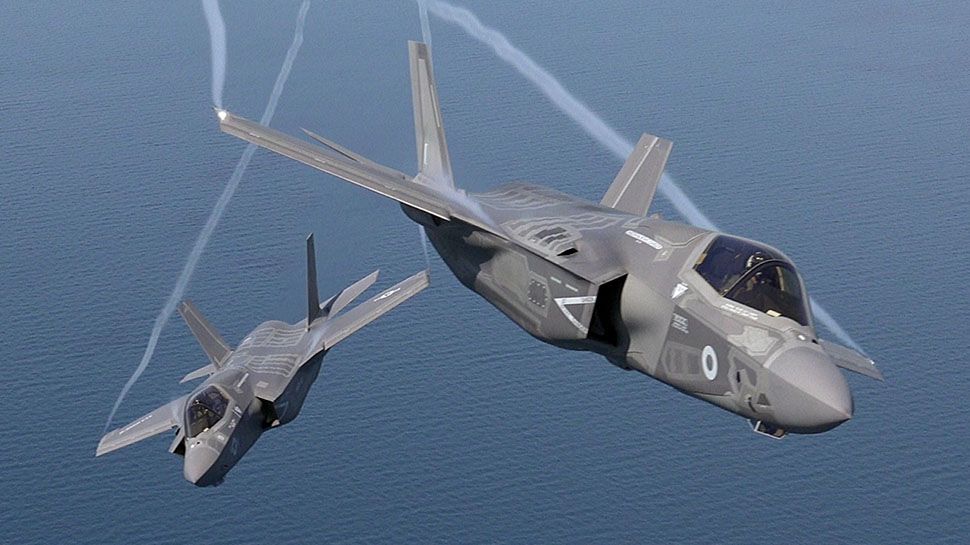
F-35 Fifth Generation Light Fighters
Amid a growing military partnership between Turkey and Russia, Ankara has in recent months increasing found itself at odds with the Western bloc over its close relations with Moscow. Turkey's decision to purchase Russian arms over their Western counterparts, and in particular to purchase the Russian made S-400 air defence system over the American made MIM-104 Patriot, has been meet with warnings and even threats from Europe and the United States. With Turkey set to acquire a large fleet of up to 120 F-35A stealth fighters from the United States to modernise its aerial warfare capabilities, several key figures within the U.S. leadership have threatened Ankara with economic sanctions and the suspension of F-35 deliveries should the country fail to cancel the acquisition the Russian S-400 in line with the Western bloc's demands. Having signed the Countering American Adversaries Through Sanctions Act (CAATSA) into law in August 2017, under which the United States was to apply economic sanctions to all states making major arms transactions with Russia, Iran or North Korea, the ground is set for such measures to be taken against Turkey should it proceed with the S-400 contract rather than acquire a Western made weapons system.
Steps by the Western bloc to pressure Ankara have the potential to further alienate the country and push it further into a partnership with Russia, China, South Korea and possible even Iran. With Turkey already having reduced its reliance on U.S. and German battle tanks, the latter which proved highly ineffective, by acquiring far more capable South Korean made platforms, and with the NATO member state set to acquire a wide variety of Russian made hardware from Kornet anti tank missiles to the S-400, steps to cancel the F-35 could well lead Ankara to instead acquire the elite and less costly Russia Su-35 or perhaps China's J-31 stealth fighter - platforms which appear far more promising than the troubled American stealth fighter. The major attraction of the F-35 is that several of its components are being produced in Turkey, and its developed Lockheed Martin has declared that Turkey's licence production of components for the widely operated stealth fighter is set to earn Ankara $12 billion - while also contributing substantially the country's technological base. It is this economic loss, rather than the loss of highly replaceable fighters, which has been of greatest concern for Ankara.
While Russia is unable to offer Turkey joint production of a fighter with the same economic promise of the F-35, a program estimated to cost $1.6 trillion, Moscow could potentially do much to aid Ankara in offsetting the consequences of the F-35's potential termination by providing the country with assistance to develop its own fifth generation fighter under the TAI TFX program. While the TFX was designed with a complementary role to the F-35, and was never intended to be an elite frontline fighter due to the country's relatively limited technological base, with Russian assistance the platform could well become a highly capable light stealth platform which could fulfil a similar role to the F-35 in the Turkish Air Force. Such a joint program, possibly alongside sales of elite Russian heavy fighters to Turkey such as the Su-35 or Su-57, could very likely more than compensate for the loss of the F-35. This would hardly be the first time Russia has offered to jointly develop a fifth generation fighter with an emerging military partner, with Moscow offering India a stealth variant of the Su-35 and currently jointly developing a fifth generation light fighter with the United Arab Emirates - potentially based on the MiG-35.
Signs of Russian interest in aiding Turkey in its fighter program have already surfaced, with Russian aerospace corporation Rostec offering to aid in the development of the TFX's engine. With the F-35's engine one of the most advanced in the world, which Turkey has little chance of contending with if relying on indigenous technology alone, this could well go a long way towards enhancing the TFX program and alleviating the repercussions of any future loss of the F-35. Speaking regarding the Russian offer, a Turkish diplomat stated that as political ties between the two countries were 'excellent', they were likely to pave the way for deeper military and procurement cooperation in future. While Turkey's fighter program still awaits presidential endorsement, the country's fast deteriorating relations with the Western bloc, which President Erdogan has repeatedly accused of supporting terrorism and aiding the Islamic State terror group and the Kurdish YPG, which Ankara considers a terror group, could well speed up the program's commencement. With Russian assistance, Turkish military aviation could well see a significant boost to its technological base without the F-35. As Turkey is unlikely to forego its defence ties with Moscow to appease the West, particularly as much of the Turkish leadership holds the Western bloc partially responsible for an military attempted coup attempt in 2016, and with President Erdogan indicating that the country will seek to make further purchases of Russian equipment in future including the more advanced S-500 air defence system when it becomes available, the potential for a further deterioration in relations and application of U.S. sanctions remains very real indeed. Russia is poised to benefit substantially, and could well win over Turkey as a major military client as a result of this schism.
