
South Korea’s Leading Opposition Party Leader Says Nuclear Weapons Acquisition Must Be Considered: What Are the Potential Implications?
Military Watch Magazine Editorial Staff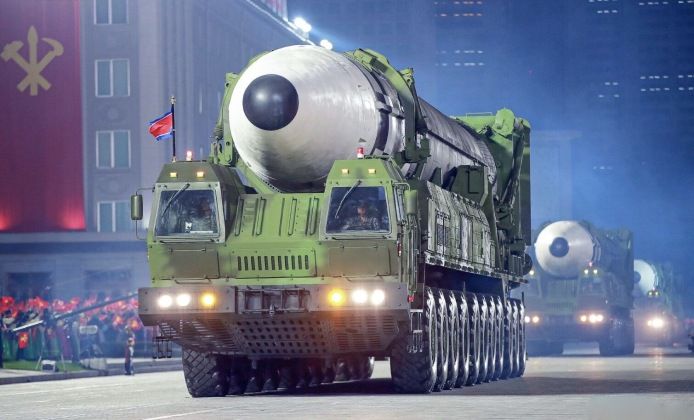
North Korean Nuclear ICBM Unveiled October 2020 (unnamed)
The leader South Korea’s main opposition party the People Power Party (PPP), Kim Chong In, has stressed that the country needs to consider acquiring nuclear weapons if North Korea refuses to surrender its own nuclear arsenal. In what was widely interpreted as a hard line on national security, the official made the statement while speaking to the Seoul Foreign Correspondents’ Club at the Korea Press Center in Seoul on November 24th, when asked to state his position on the argument made by many on the South Korean right wing that the country should develop a nuclear arsenal. “It’s true that there are some conservatives who think that South Korea should proceed with nuclear armament if North Korea doesn’t denuclearize. If North Korea never gives up its nuclear weapons, South Korea may need to reconsider the option of nuclear armament,” Kim stated in response. North Korea tested its first nuclear warhead in 2006, had has since developed the capability to deliver miniaturised thermonuclear warheads to the United States mainland using at least two classes of intercontinental range missile.
North Korean officials have given assurances on multiple occasions that the country’s nuclear arsenal is intended to prevent American attacks and is aimed solely at the United States, and not at neighbouring countries. The arsenal was developed in response to ongoing American threats against the country, with the two having been technically at war since 1950. The U.S. was notably the first country to nuclearise the Korean Peninsula, deploying over 900 warheads to South Korea the first of which were stationed there in 1957. While the U.S. claimed to have removed these weapons in 1992, later investigations found that they were still in South Korea five years later, with North Korea highlighting that their removal had never been verified by any international inspections. A statement from the U.S. Strategic Command in November 2017, at a time of high tensions, appeared to confirm Pyongyang’s worst fears by confessing that the U.S. Military maintained maintained 'secret silos' of nuclear hardware at undisclosed locations in South Korea. These were later denied, but heightened pre existing concerns in Pyongyang that the U.S. maintained nuclear warheads in the south aimed at its cities and military facilities. It remains uncertain how the U.S. would respond to a South Korean nuclear weapons program, which could reduce Seoul’s dependance on American protection and potentially facilitate a more independent foreign policy and a strengthening of calls to remove U.S. forces from Korea.
