
South Korean Military Upgrades its Vulcan Anti-Aircraft Guns With Thermal Imaging Systems to Counter North Korean Stealth Incursions
Military Watch Magazine Editorial Staff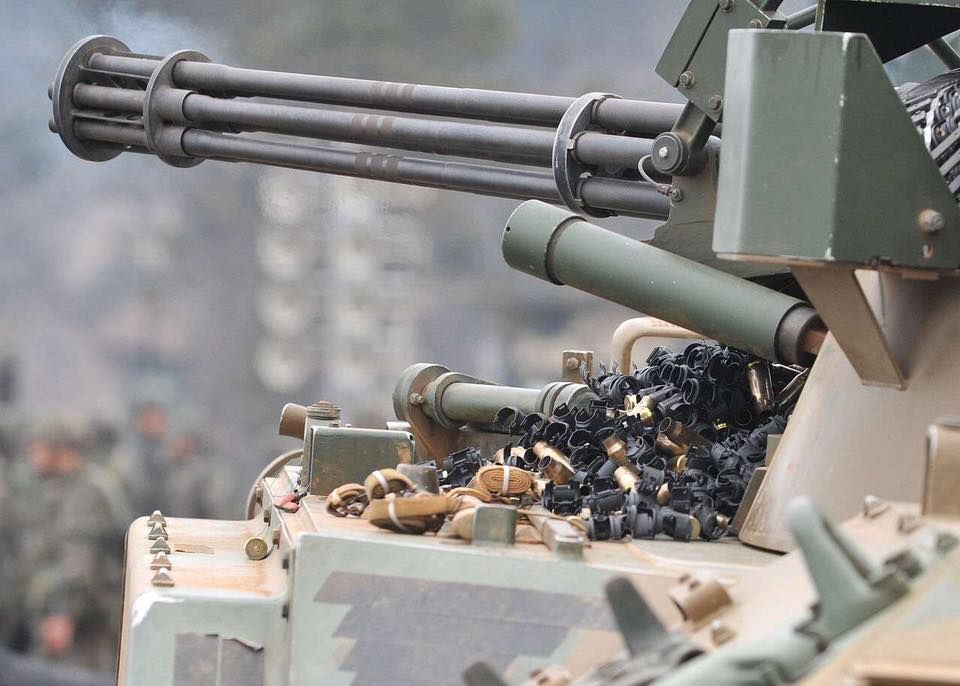
South Korean Vulcan Air Defence Cannon
The South Korean military is responding to North Korea's growing capabilities to send forces across the DMZ using small manned and unmanned radar evading platforms. The north's Korean People's Army (KPA) has developed such infiltration methods to deliver Special Forces to South Korean territory, conduct surveillance and carry out airstrikes. Infiltrators have in the past dropped leaflets near U.S. military facilities in the south to demonstrate the extend of their reach. As a countermeasure to this growing threat the South Korean armed forces have begun upgrading their antiquated Vulcan air defense systems with modern thermal targeting systems and laser rangefinders. The Vulcan is a U.S. made platform which has been in service since 1967, and provides the lowest tier of air defense in the field. It uses a cannon with a maximum rate of fire of around 3,000 rounds per minute (50 per second.) North Korea has in recent years developed potent forces capable of deploying across the 38th parallel and into southern territory should a war break out - and these forces are near impossible to detect by radar. They include small An-2 bi planes with extremely low radar cross sections used to deploy special forces and small reconnaissance and attack drones. Special forces units in particular, training to cross the border by biplane and glider, have proven to be highly lethal even when deployed in small numbers. These North Korean elite troops can once they reach southern territory sabotage key military and civilian infrastructure. The lessons of the havoc just three North Korean special forces members can wreak behind enemy lines, as per the 1996 Gangneung submarine infiltration incident, are not easily forgotten. Three personnel alone managed to evade a vast South Korean military search party for 49 days, meanwhile causing 39 military casualties among southern forces. With these elite troops training to cross into the south in their tens of thousands, stopping them at the border has become one of the South Korean military's highest priorities.
While their primary means of infiltration in the past has been by submarine, development of more sophisticated means to infiltrate into the south by air only increases the potency and effectiveness of North Korean special forces. North Korean drones have frequently been detected in South Korea, and their capabilities have advanced rapidly. With the north maintaining close military cooperation and technology sharing with Iran, which itself has access to U.S. stealth drone technology and has produced advanced stealth drones based on the American RQ-170 Sentinel, it is highly possible that North Korea does have access to the technology needed to produce advanced stealth drones itself. These drones can, alongside reconnaissance, potentially be used to deliver weapons of mass destruction and attack South Korean and American military installations. The result of these advanced unmanned vehicles and Special Forces' potential to infiltrate its territory with little difficulty is that South Korea will be hard pressed to defend its airspace, and reliance on radar alone to detect incursions will not be feasible. The military has thus invested in upgrading its short range air defenses which can detect, and neutralize small targets with negligible radar signatures, potentially including stealth drones depending on their success in reducing heat emissions, by relying on thermal imaging. Upgrading the Vulcan short range air defense systems with a thermal targeting capabilities is an inexpensive but effective countermeasure to handle this threat.
