
Sixty Years of Effective Deterrence; The Anniversary of the World's First Intercontinental Ballistic Missile
Military Watch Magazine Editorial Staff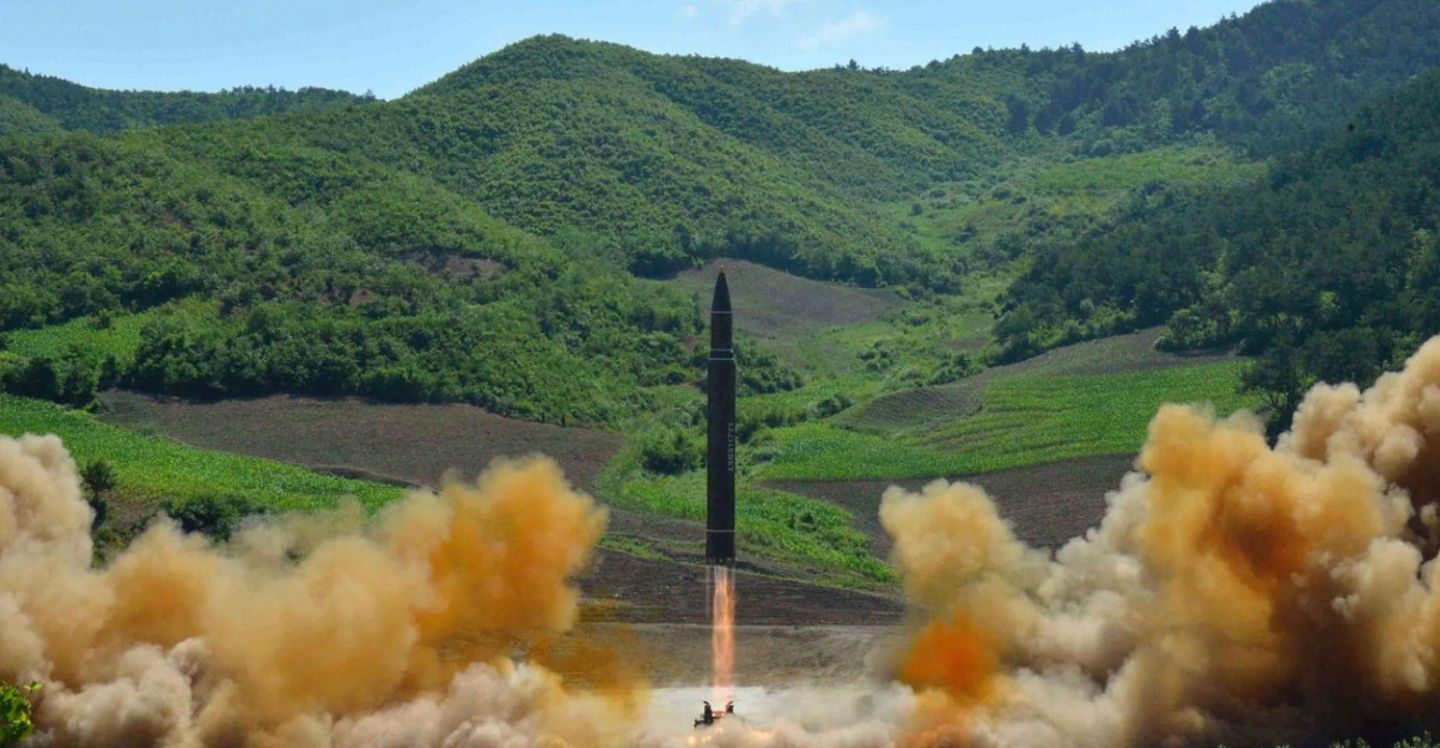
The World's Latest ICBM - North Korea's Hwasong-14
This week marks sixty years since the first successful launch of an intercontinental ballistic missile (ICBM) in August 1957. The USSR's R-7, referred to by NATO as the SS-6, travelled 5,600 km and accurately delivered a warhead to the Kura Test Range in Russia's Far East - traveling the breadth of the Soviet Union. On August 27th, six days after the successful test, the USSR announced that it had successfully developed an ICBM - the first country to achieve this capability. With the ability to reliably deliver nuclear weapons to the United States mainland this significantly changed the course of the Cold War and threatened the U.S. with retaliation in a way no power had ever before been able to. The nature of warfare and particularly of nuclear deterrence was thus changed forever.
While the United States had in the waning months of the Second World War made plans for nuclear strikes on Soviet cities, their loss of air superiority capabilities as demonstrated during the Korean War, followed by the development of Soviet nuclear weapons, fighters which proved their ability to effectively intercept the United States' most advanced strategic bombers during the Korean War, and finally the development of a delivery system unparalleled in the rest of the world - the world's only ICBM - made such plans impossible. Though the United States could have potentially risked retaliation from Soviet nuclear bombers in the 1950s, which aircraft such as the F-4 Phantom were developed specifically to intercept, it would be a number of decades before technology allowing the United States to potentially intercept enemy ballistic missiles would be developed. In that time the concept of mutually assured destruction - based on each party's undisputed capability of destroying the other - held well. While the United States had long been able to strike the USSR with nuclear weapons from its bases in Europe, it would soon afterwards successfully test its own ICBM and thus set a trend that remained for the rest of the Cold War - in which both parties devoted significant resources to expanding and enhancing their arsenal of nuclear tipped ICBMs to deter the other from launching a war.
Due to the tensions between the two superpowers and the significant resources devoted to nuclear delivery systems there was a very high turnover for ICBM technologies. The R-7 would remain in service for just eleven years until 1968, though it's capabilities were quickly surpassed and it became outdated very shortly after its first test due to the rapid technological advancement in the field. The R-7's launcher would however become the basis for the Sputnik 1 launcher - used to perform the world's first satellite launch. Today both Russia and the United States continue to improve their missile defences, an arms race which has escalated since America's unilateral withdrawal from the Anti Ballistic Missile Treaty in 2002. Of the world's nine nuclear powers meanwhile all but France, Britain and Pakistan, for which medium range missiles provide sufficient range to reach their primary adversaries in Moscow and Delhi, have attempted to develop ICBM systems. Several nonnuclear nations such as Ukraine and Saudi Arabia have also acquired ICBM technology. Russia however continues to have a lead in its ICBM capabilities with its latest missiles currently under development having advanced evasion systems to counter enemy air defences, as well as the potential to impact their targets at hypersonic speeds at which they are near impossible to intercept. The RS-28, another Russian missile announced in 2016 and currently under development, carries multiple warheads and can deliver a payload approximately 2000 times that of Fat Man - the nuclear bomb used by the United States against Nagasaki. A single missile will be able to wipe out an area the size of Texas or France according to Russian government sources, while it will incorporate the most advanced technologies for evasion of enemy air defences. As ICBM systems remain unmatched as a means for nuclear weapons delivery, with the potential exception of space based weapons, the technology will continue to advance and significant resources will continued to be devoted to research and development - with North Korea, China, the United States and Russia all today devoting significant resources to their ICBM programs and seeing considerable advances in their capabilities.
