
Serbia Receives Russian MiG-29 Fighters; A Gesture of Friendship and Slavic Brotherhood
Military Watch Magazine Editorial Staff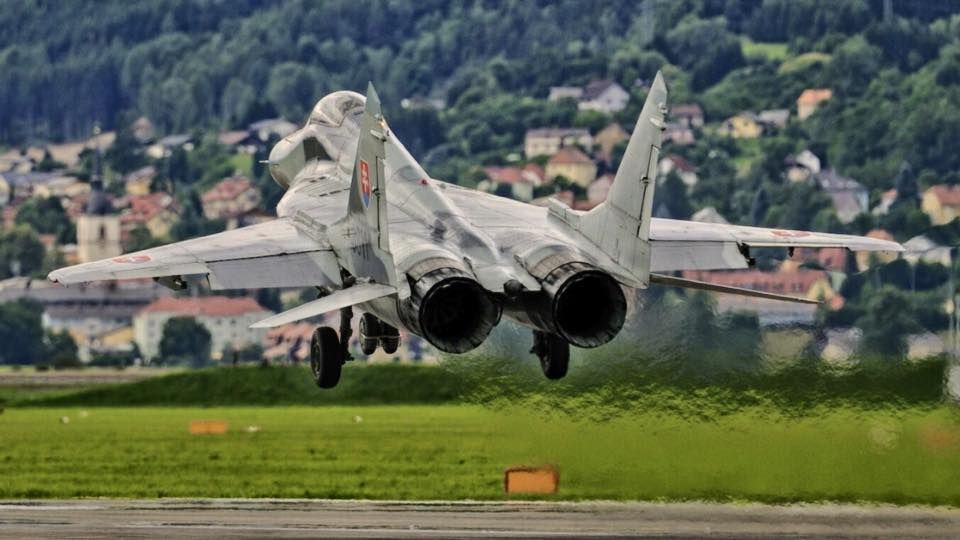
MiG-29 Multirole Fighter
On October 2nd 2017 Serbia received the first of six MiG-29 multirole fighters on order from Russia. With the country's Air Force and air defence systems having formerly relied on dated technology comprised primarily of 1960s S-125 surface to air and second generation MiG-21 fighters, the country's capabilities have long been in need of modernization. The former Yugoslav state experienced heavy aerial bombardment and the destruction of much of its infrastructure in the 1990s at the hands of NATO forces, and though many other former Yugoslav nations have since joined the NATO alliance Serbia remains one of the few European nations to maintain close military ties to Russia. It's participation in the Slavic brotherhood drills alongside Russia and Belarus as well military purchases from the two countries have cemented these ties.
In the 1990s Serbia made effective use of its early Cold War era technology against U.S. forces, successfully targeting two F-117 stealth fighters with S-125 missiles - platforms widely considered invulnerable at the time by the U.S. military. Serbia's lack of more modern technology, and the scarcity of arms in general, left its airspace extremely vulnerable to NATO's air campaign however. Having experienced bombardment of its population centres from the air, the country inevitably places great importance in its air defence capabilities. Today growing military ties to Russia have facilitated a military modernisation program in the country's Air Force and Air Defence Force. Russia has sold the MiG-29 fighters to Serbia, usually worth over $100 million, for just $20 million. As Serbian Defense analyst Miroslav Lazanski noted: "In other words, Russia is planning to give us approximately $80 million as a gift." For a country with an annual defense budget of just $500 million, this was a very meaningful gesture.
While a small contingent of light MiG-29 fighters are unlikely to make a significant difference to the country's ability to defend its airspace, particularly against potent adversaries such as NATO which deploy advanced air superiority platforms such as the F-15 and F-22, modern SAM systems will pose a potent threat to even the most advanced enemy aircraft. Russia is set to deliver advanced BUK MB SAM systems to the country, while Serbia has also shown interest in acquiring the longer range S-300 SAM system. Serbia's small military budget remains a significant constraint to purchasing this longer ranged weapons system however, though there are signs that the country could attempt to purchase older S-300 variants second hand from Belarus as the country phases them out of service. The Serbian military had already proven itself to be highly adept at using anti aircraft missile systems, and due to its low defence budget it will likely be forced to rely far more heavily on the less costly SAMs to deny enemy forces access to its airspace as an alternative to building high performance air force of its own - a far more costly prospect. The transfer of the MiG-29 fighters, though they will have a negligible military impact, are largely a gesture of goodwill by Serbia's military partners. With the MiG-29 set to be retired from Russian service in the near future, and in any case having a negligible impact on the potency of the Russian Air Force which relies far more on specialised platforms, sparing some fighters to built goodwill and give the Serbian military some semblance of a modern air force remains a meaningful gesture that will cost Russia little.
Serbian President Tomislav Nikolic stated that Russia's decision to deliver the MiG-29 fighter jets to Serbia were a sign of "sincere cooperation, mutual trust and friendship" Russia's gesture shows that "Serbia has friends who do not shy away from helping the country. Serbia has friends, who it does not hesitate to cooperate with. Serbia wants to be friends with everyone in the world. It will not help anyone hate anyone else. We will not attack anyone, but we will protect our country and our people." Russia's gesture therefore appears to have succeeded in cementing the countries' friendship.
