
Russian Su-35s Escort Tu-22M3 Bombers with Latest Anti-Ship Missiles Into Eastern Europe
Military Watch Magazine Editorial Staff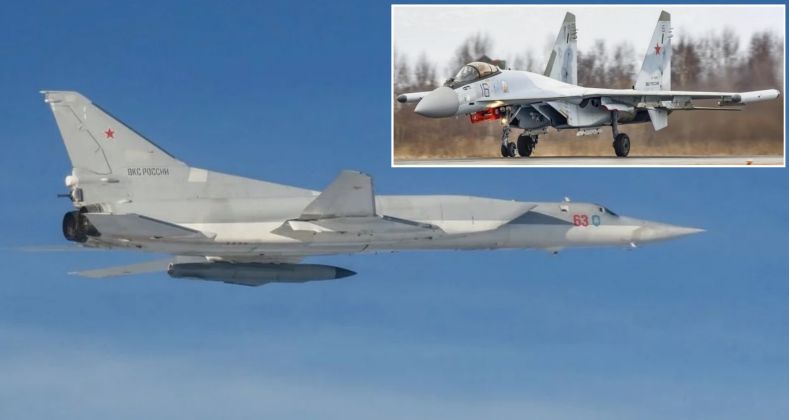
Tu-22M3 Bomber Over the Baltic Sea and Su-35 Fighter
The Russian Aerospace Forces have deployed Su-35S air superiority fighters to escort Tu-22M3 strategic bombers for a long range flight over the Baltic Sea. The flight was considered a significant show of force aimed at NATO, and saw the bombers armed with Kh-32 anti-ship cruise missiles remain in the air for over five hours. The Su-35S was developed as an enhanced derivative of the Soviet Su-27 fighter, which had been designed specifically with the goal of escorting Tu-22M strikes across Europe from forward bases in Poland. The disintegration of the Warsaw Pact and absorption of the majority of Eastern Europe into NATO has significantly reduced Russian forward basing options for its fighters and bombers to conduct long range strikes, although the extension of the Tu-22M’s range with the development of the M3 variant, an the integration of longer ranged missiles, has helped compensate for this.
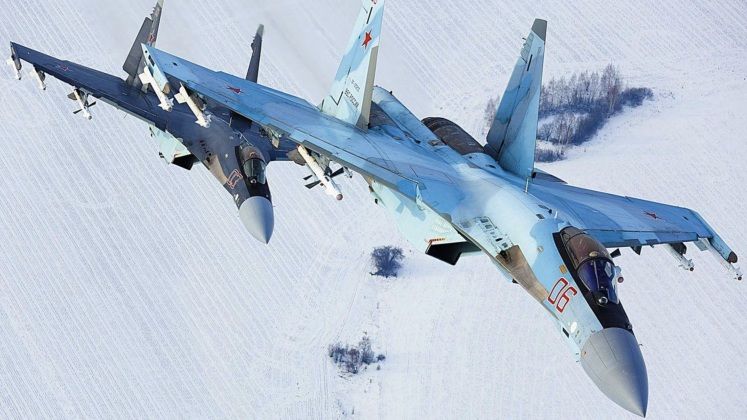
Compared to the Kh-22 anti-ship missile of the Cold War era, the new Kh-32 benefits from upgraded guidance and electronic warfare countermeasures systems, an extended engagement range of up to 1,000 kilometres, and a faster Mach 5 speed. Although plans to modernise the Tu-22M3 fleet to the M3M standard, or to develop the new Tu-22M4 bomber, have been cut due to budget shortages, this new armament provides a revolutionary improvement for the aircraft. The Su-35 is particularly well suited to bomber escort missions due to its very long range of close to 2000 kilometres, which is near double that of advanced Western fighters such a the F-22 and F-35. The fighter integrates a particularly large radar, the Irbis-E, which has a 400 kilometre detection range against large aircraft, allowing it to provide an early warning against possible threats to the bomber fleet. Like the Tu-22M3, it is also capable of sustained cruising at supersonic speeds, as it does not require engine afterburners to do so.
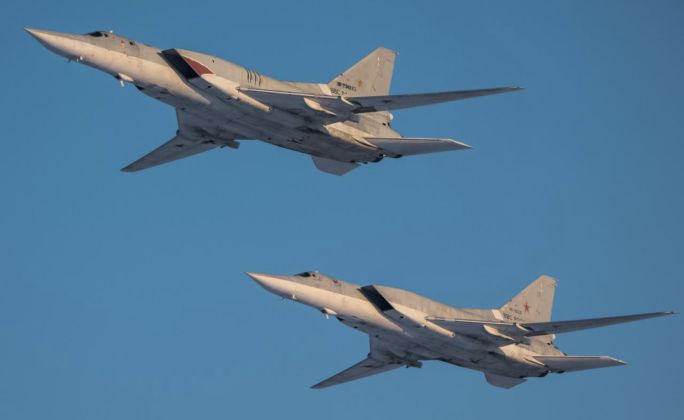
The Tu-22M3 was produced from 1989-1997, at approximately the same time as the Western world’s newest bomber type the B-2, and serves as a lighter counterpart to the intercontinental range Tu-160 and Tu-95MS fleets. In September Tu-22M3 bombers were deployed as part of the Russian-Belarusian Zapad 2025 military drills to simulate strikes on enemy targets, with the attacks launched “with the aim of disrupting the control system and destroying critical facilities.” These strikes included live fire bombings on training grounds. The bombers were first combat tested to strike Western, Turkish and Israeli-backed Islamist insurgents in Syria as part of Russian support for Syrian counterinsurgency efforts. The aircraft have since had a particularly outsized impact in the Ukrainian theatre, with Ukrainian Air Force Command spokesman Yury Ignat having singled out the performances of their Kh-22 missiles, which he stressed were nearly impossible to intercept. Ignat in December 2023 stated that since the escalation of hostilities between Russia and Ukraine in February 2022, Russian Tu-22M3s had fired approximately 300 Kh-22 and Kh-32 missiles at targets across Ukraine, and that Ukrainian air defences had not been able to intercept a single one.
