
Russian Navy Tests its Largest Surface Warship Built Since 1991
Military Watch Magazine Editorial Staff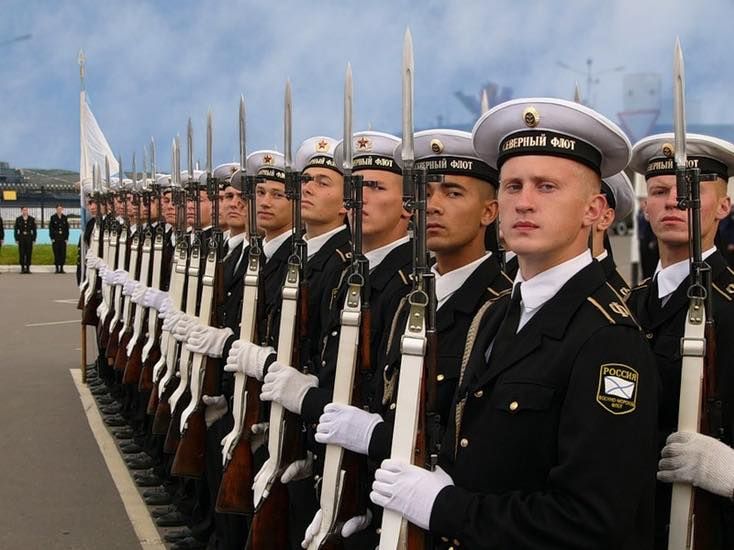
Russian Navy Personnel
Russia's Admiral Gorshkov class stealth missile frigate, the Admiral Kasatonov (not to be confused with the Admiral Kuznetzov aircraft carrier), is the first of its kind to enter service. The ship is set to be inducted into the Navy in February 2018. The project represents a critical part of Russia's 21st century military resurgence, and the ships the first major surface vessel constructed in the country since the fall of the Soviet Union in 1991. Though it is the second ship of its class to begin construction, the Admiral Kasatonov will enter service before its predecessor, the Admiral Gorshkov, due to several delays in the completion of the first ship. The warship's air defense systems, the Polimut Redut missile system, were reportedly responsible for many of the program's delays due to compatibility issues - all of which have reportedly now been solved.
The Admiral Gorshkov class program began in the early 2000s, and represents a new generation of capabilities for the Russian Navy. The frigates are multi purpose platforms designed with potent anti-aircraft, anti-surface and anti-submarine warfare capabilities. They are armed with Russia's potent nuclear capable Kalibr cruise missiles - supersonic platforms with anti-ship, anti-submarine and land attack variants. The Admiral Gorshkov ships also field P-800 Oniks supersonic anti-ship missiles renowned for its over the horizon range and its ability to travel at high supersonic speeds in all stages of flight.
Construction of the Gorshkov class represents a major step for Russia's shipbuilding capabilities, as in the Soviet era Ukraine was responsible for several key sectors of warship construction and housed the USSR's largest shipyards. The Soviet carrier fleet as a result was laid down in Ukraine - making it difficult for the later separate Russian Federation to construct its own large surface vessels. With Soviet era ships relying on the Ukrainian gas turbine engines, the country has had to create indigenous propulsion systems - and this has been among the most significant obstacles for Russia's naval modernisation.
While Russia is more than capable of constructing some of the world's most advanced submarines, the Gorshkov program represents the difficulties the country has faced in developing domestic shipbuilding capabilities for surface vessels from a negligible base. While it is likely that Russia will have enough engines in storage to fit out its two Admiral Gorshkov class ships, as well as its three Grigorovich class vessels under development, induction of future modern warships will require Russia's shipbuilding industry to design a gas turbine of its own matching the capabilities of the Ukrainian made systems. The Russian defense industry is working on a new propulsion system for surface vessels set to be ready for service in the early 2020s, and the Admiral Gorshkov class will as a result be restricted to just two vessels until then. With the Russian Navy planning 4-5 ships overall, ships entering service after the first two will be fitted with domestically manufactured engines. The outfitting of the first Admiral Gorshkov class ships will represent a significant landmark in Russia's Naval history.
