
Russian Ground Forces Near Western Border Undergo Rapid Modernisation and Expansion; 70 New Units Deployed Amid Escalating Tensions with NATO
Military Watch Magazine Editorial Staff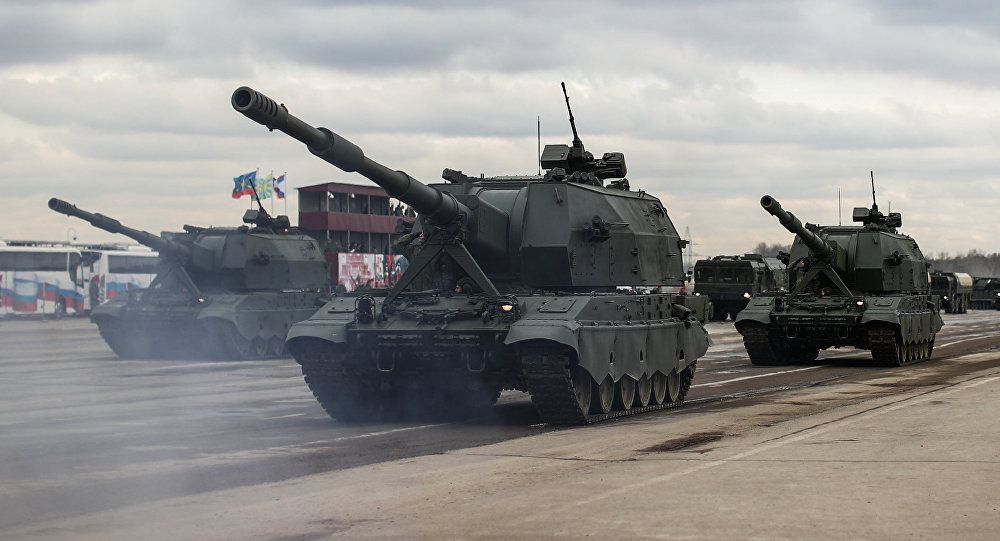
2S35 Koalitsiya-SV Mobile Artillery
The Russia military has deployed over 70 units to the vicinity of its Western borders since 2016, amid hightening tensions with the Western Bloc and growing NATO deployments to Eastern Europe. These units have, according to Defense Minister Sergei Shoigu, received 5000 new and upgraded weapon systems to strengthen their defences. With Russia lacking the valuable European buffer zone it enjoyed in both its war with Nazi Germany and the Cold War, the country has perceived a considerable threat from the proximity of Western forces to key targets such as Moscow and St Petersburg - a stark contrast to the Cold War when NATO assets were primarily deployed West of Berlin. The buildup of Russian forces has been particularly focused around the strategically critical Crimean Peninsula, reclaimed by Russian forces from Ukraine in 2014, where some of the country’s most advanced weapons systems including S-400 air defence batteries, Su-27 and Su-30 air superiority fighters and Iskander tactical ballistic missiles have all been deployed.
Defence Minister Shoigu stated regarding the deployments across the Western front: "The situation developing in the western strategic direction requires us to constantly improve the troops’ combat structure and the system of their stationing. For these purposes, over 70 large units and military formations have been set up, including two divisions and three brigades... About 5,000 new and modernized weapon systems have been delivered to the troops, which has helped to increase their provision with modern armament from 39% to 54%.” He noted that inspections had ensured "the qualitative growth of the troops’ preparedness level and confirmed their readiness for accomplishing assigned missions.” The Minister further noted that the infrastructure necessary was being built to accommodate the surge in troops - with more than 350 facilities set to be put into operation by the end of 2018.
While Russia faces considerable threats on numerous fronts, the Western front with Europe remains the most pressing for its armed forces and its ground forces in particular - moreso even that its far Eastern border with the U.S. territory of Alaska or its Pacific maritime border where Russian assets are deployed in close proximity with U.S. forces in Japan. With the Russian military increasingly investing in capabilities for its fleet in the Pacific theatre, a region of fast growing strategic importance, the enhancement of ground forces in Europe is being complemented by the simultaneous beginning of a sizeable naval buildup in Asia - representing what are likely the military’s two most critical fronts. With the Russian Navy planning to commission new submarines, destroyers, carriers and possibly even supercarriers supported by advanced new hypersonic ship hunting missiles to strengthen its position in the Far East, ground forces on the Western are also fast modernising their capabilities with the planned deployment of next generation T-14 battle tanks, T-15 fighting vehicles, 2S35 Koalitsiya-SV howitzers and Pantsir air defence combat vehicles among other highly formidable new assets.
