
Russia Enhancing Thermobaric ‘Heavy Flamethrower’ Artillery as it Plays Central Role in Frontline Advances
Military Watch Magazine Editorial Staff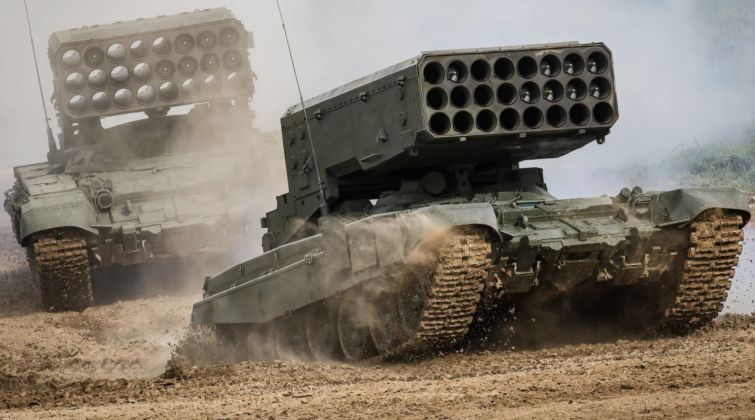
Russian TOS-1A Rocket Launcher
Leonid Faerberg
Russian state sources have reported continued progress in efforts to improve the capabilities of the countries TOS series thermobaric rocket artillery systems, referred to locally as “heavy flamethrower” systems, as they continue to play a central role on the frontlines in the Ukrainian theatre. A significant landmark in these efforts has been the development of the TOS-2 Tosochka system, which has been reported by local sources to have surpassed the scope of an assault weapon, and been able to function as an advanced fire support system. Commenting on the new system’s capabilities, state defence technology corporation Rostec announced: “As a rule, after such a salvo, the assault squad has nothing to do in the area — there’s simply no enemy left to resist. Thus, the TOS-2 retains the thermobaric weapon potential of its ‘big brother,’ the tracked [TOS-1] Solntsepek system.”
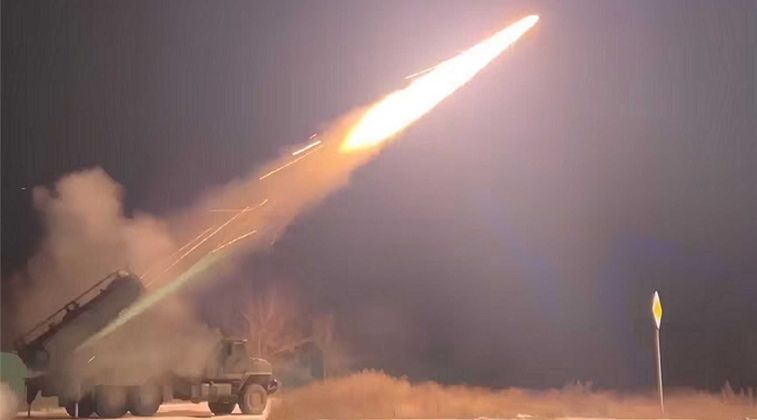
Further elaborating on the new potentials provided by the TOS-2, Rostec stated: “Various enhancements have been made to the Tosochka’s design - it has been fitted with the wheeled chassis, the automated reloading system has been upgraded, and the fire control system has been improved. Thanks to this, the vehicle’s concept has already exceeded the scope of an “assault breacher vehicle.” “It has become a more flexible, mobile, and technologically advanced fire support system, adapted to the demands of modern warfare,” Rostec representatives added. They further noted that the system has improved fire controls which allows it to engage precise targets, while its wheeled chassis allows it to quickly deploy to an unprepared positions, receive targeting information, contact a command post, fire a salvo, and quickly leave the position, contrasting to the heavier tracked TOS-1 system which has lower mobility.
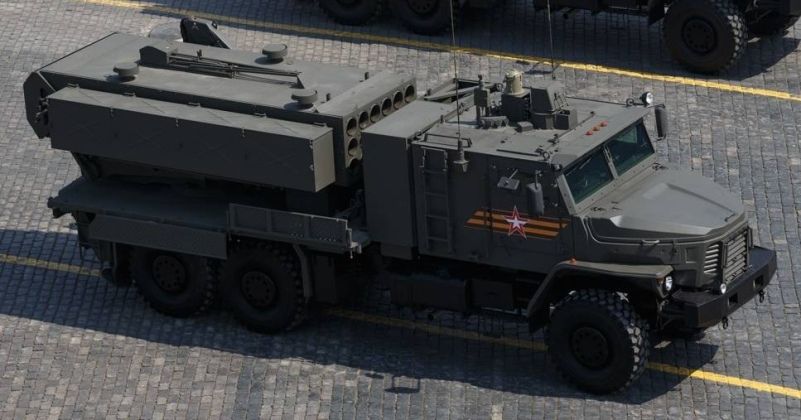
The TOS-2 was first unveiled during a victory parade in May 2020, and is mounted on the 6x6 Ural-63706-0120 all-terrain vehicle. The system first entered service in January 2021, although much more limited numbers were available to participate in hostilities in the Ukrainian theatre than the much more widely operated TOS-1.It was reported in August 2024 that the range of the system has been extended, up to 20 kmContinued work to improve the system’s capabilities reportedly resulted in an extension of its engagement range to 20 kilometres, which was announced in 2024. The TOS-2 provides the Russian Armed Forces with significantly greater flexibility in launching thermobaric attacks, and while lacking the firepower and all terrain capabilities of the TOS-1, its much lower maintenance needs and fuel consumption, far greater mobility, and lighter weight allowing it to be moved by air and sea, make it highly complementary.
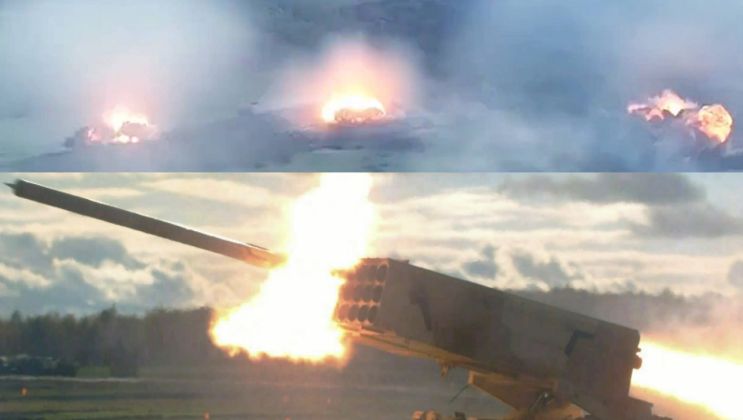
Russian thermobaric artillery systems has gained significant attention due to its combat performances in the Ukrainian theatre, with their ammunition functioning by dispersing a gaseous cloud of chemicals into the air, which are subsequently detonated by a vacuum explosive, releasing a high pressure shock wave that sucks air out of confined areas with tremendous force. The result is the rupturing of the lungs of all present in the vicinity. Footage released from an unknown location on the frontlines between has shown the extensive use of TOS-1A to devastate Ukrainian forces in cover. The systems were previously extensively combat tested against Turkish-backed jihadist insurgent groups in Syria and Iraq.
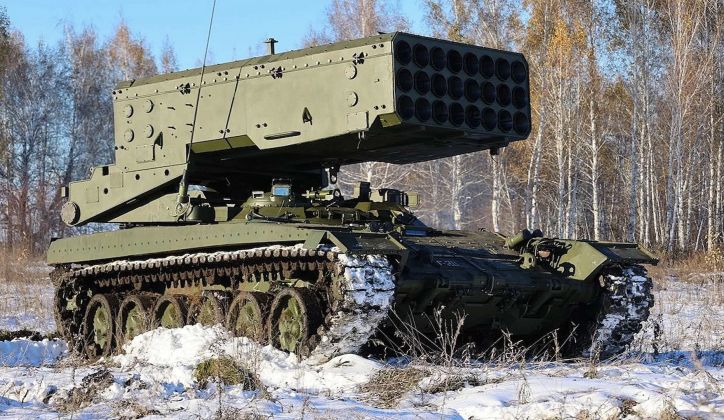
In parallel to the modernisation of the TOS-2, the TOS-1’s capabilities have also been improved significantly, with CEO of the Signal Research Institute Vladimir Pimenov having revealed that a new navigation system for the system had “improved operating accuracy to a few meters.” "CBR [Nuclear, Biological and Chemical Protection] troops asked whether we have research solutions for greater flexibility of Solntsepyok operation at firing positions. We offered our positioning system, which makes it possible to reduce combat time at a firing position without the combat vehicle leaving by a crew and a commander," he elaborated. The system’s advanced performance has led Russian defence conglomerate Rostec to announce the development of a more capable successor in April 2024 under the designation TOS-3, with the next generation variant first seen in June that year.
