
Russian Air Superiority Fighters for Ankara? Turkey Considers Acquiring Su-57 Should U.S. Refuse to Supply F-35
Military Watch Magazine Editorial Staff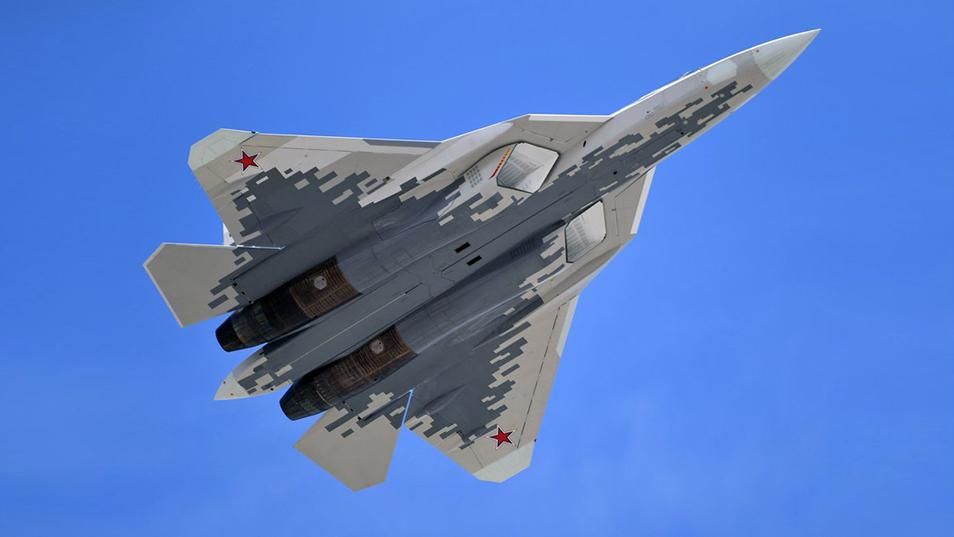
Su-57 Fifth Generation Air Superiority Fighter
Amid growing tensions with the Western bloc, Turkey has recently been threatened with the cancellation of a contract to acquire U.S. made F-35 single engine stealth fighters to modernise its aerial warfare capabilities. Ankara’s conspicuous lack of solidarity with Europe and the United States as tensions between the West and Russia continue to rise, and in particular its decision to purchase the Russian made S-400 air defence system over Western made alternatives, has led to threats of significant reprisals against the country by the United States and by NATO a whole. Calls for economic sanctions on Turkey to bring it into line with the Western bloc have been widespread in the United States, and more recently Washington has threatened to block the sale of the F-35 to Turkey. Denying Turkey the new fighter and reneging on the contract has been pushed for by a number of European and Armenian lobby groups in Washington with some success. On May 24th the U.S. Senate Armed Services Committee released details of its draft of annual defence policy bill, which strongly supports blocking the delivery of the F-35 to Turkey in response to its choice to purchase the Russian air defence system.
With Turkey’s leadership appearing resolute in their decision to acquire the S-400 despite Western pressure, equating it to a matter of national sovereignty, a reversal of this decision remains highly unlikely. Russia for its part has obliged Ankara’s request to alter the schedule of the delivery to provide the Turkish armed forces with the weapons system at an earlier date. While proliferation of the S-400 is considered a major security threat by the Western bloc, not only providing Russia with valuable funds but also seriously limiting Western powers’ freedom to project power by sealing off airspace of the weapons system’s operators to U.S. and European missiles and aircraft, whether the U.S. will proceed to bloc the F-35 sale and thus further compromise relations with a strategically critical Middle Eastern partner remains to be seen.
The cancellation of the F-35 contract would be a significant loss for Ankara, as not only was the Turkish Air Force had planned to induct up to 120 of the light fighters but, more significantly still, the country was also set to become a major producer of parts for the aircraft. The major attraction of the F-35 for Turkey remains that several of its components are being produced domestically, and the fighter’s developer Lockheed Martin has declared that this licence production is set to earn Ankara $12 billion - while also contributing substantially the country's technological base.
In response to the potential cancellation of the F-35, Turkish media has reported that the military is considering acquiring the Russian fifth generation Su-57 air superiority fighter should the deal to acquire the U.S. platform be terminated. While joint production of the Su-57 and similar economic benefits remain unlikely, the Su-57 is a fighter in an entirely different league to the F-35 in its capabilities. While both are fifth generation stealth aircraft, the F-35 was designed as a lightweight single engine multirole platform similar to the F-16 and lacks the cutting edge combat capabilities of heavier elite platforms such as the F-15 Eagle and fifth generation F-22 Raptor. The Su-57 for its part is Russia’s analogue to the U.S. F-22, and its successor to the Su-27 and Su-30 which challenged the F-15 during the Cold War. Much like the Raptor the Su-57 significantly surpasses the F-35’s combat capabilities across the spectrum - including its range, operational altitude, speed, manoeuvrability and payload, while incorporating a number of invaluable high end avionics systems which the F-35 lacks such as infra red search and track systems. While the Su-57 is comparable to the U.S. F-22, these is little comparison between its capabilities and those of the lighter F-35 - indeed the F-35 was never designed to contend with such high end fighters and much like the F-16 before it was conceived as a light and relatively low cost support platform.
Ultimately the cancellation of the F-35 will mean a significant economic loss for Turkey, and integrating the country’s first Russian made fighter into the Air Force could well prove difficult at first for the longstanding Western client. The Su-57 would however fulfil a highly complementary role alongside Turkey’s F-16 fleet, much as the Su-35 and Su-30 fighters in the Indonesian and Malaysian air fleets do alongside American made F-16 and F-18 light fighters respectively. Acquiring the fighter would transform the Turkish Air Force from one which lacks high end heavy fighters to a major aerial power, one unrivalled throughout the Middle East and Europe as a result of the United States’ unwillingness to provide its own defence clients such as Israel and Saudi Arabia with its F-22. Acquiring the Su-57 would likely lead to further reprisals from the Western bloc and further alienate Ankara from other NATO members, but in terms of the impact the fighter would have on the country’s military capabilities it would represent a tremendous asset far surpassing the capabilities of the F-35. Whether Turkey will proceed to become one of the Su-57's first foreign clients is largely based on Washington's decision regarding export of the F-35, which as of yet remains unknown.
