
Russia Unveils its First Ever Combat UAV; What to Expect from the Korsar Attack Drone
Military Watch Magazine Editorial Staff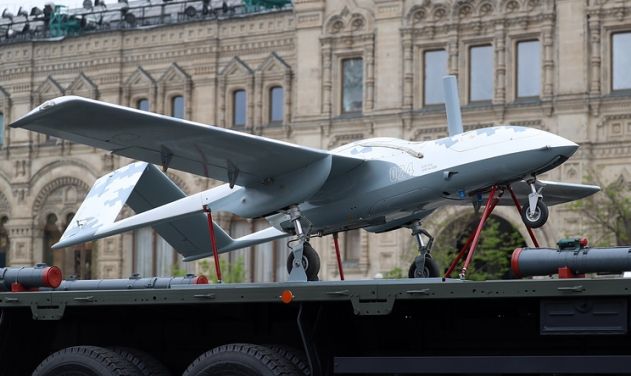
Russian Korsar Fixed Wing Attack Drone
A number of global powers have long made use of attack drones for military operations, which came to symbolise the Obama administration's foreign policy from 2009 and have since proliferated widely as a cost effective and relatively risk free means of launching airstrikes. Today combat drones are primarily produced by the United States, Israel, China and Iran, and have been used in conflicts from West Africa to the Middle East and Central Asia and deployed extensive across the Pacific. Russia's armed forces have been conspicuous in their absence from the list of operators of combat UAVS, and the Russian military has yet to incorporate such platforms into its combat doctrine or find uses for such aircraft. Use of drones has been restricted to the army's unmanned combat vehicles and more recently the navy's nuclear armed submarines. This appears about to change however, as the Russian military is to unveil its first ever combat drone, the Korsar (Corsair), on its May 9th Victory Day parade where new pieces of hardware have often made their first appearances. The drone is not only set to serve in the Russian military, but could well also become a valuable export platform to contend with U.S., Chinese and Israeli products for export.
The Korsar was designed as a 200kg combat UAV with a six and a half meter wingspan, and its airframe makes extensive use of composite materials to reduce its weight and increase its durability. The platform will be able to operate in a strike role, deploying both guided and unguided munitions, as well as highly altitude reconnaissance similar to the U.S. RQ-170. It will make use of existing air to ground munitions deployed by Russia's existing strike platforms, which have been modified to be deployed by the Korsar. The drone is also designed to perform an electronic warfare role, and will have a combat radius of 200km - a relatively short range. While it appears to be somewhat lacking in its combat capabilities compared to costly long range heavy platforms such as the U.S. Reaper and Chinese Sharp Sword, as a low cost and short range light combat drone it may well prove highly effective.
A second variant of the Korsar has been designed with the same fuselage but make use of rotary rather than find wings. This 'helicopter drone' will likely lack the speed and altitude of the fixed wing variant, but will be able to operate without airfields including from the decks of warships. This platform will be ideal from deployment near frontline, as a fast and relatively low cost strike platform capable of carrying advanced munitions. Reports have indicated that the Korsar will be a near disposable weapons system, and with an extremely low production cost could well be deployed to highly contested war zones to perform strikes where the Russian military would not want to risk more advanced and costly combat platforms such as manned aircraft. While the Korsar is the first Russian made drone capable of carrying unguided bombs and fulfilling a strike role, whether Russia is capable of or will seek to produce higher end combat drones remains to be seen. Indeed, the Korsar may well be a stepping stone for Russian military industries as they seek to develop more sophisticated aerial warfare platforms - though whether it will be able to catch up to and contend with highly sophisticated American and Chinese producers remains to be seen.
