
Russia to Build a Next Generation Aircraft Carrier with Electromagnetic Launch Systems
Military Watch Magazine Editorial Staff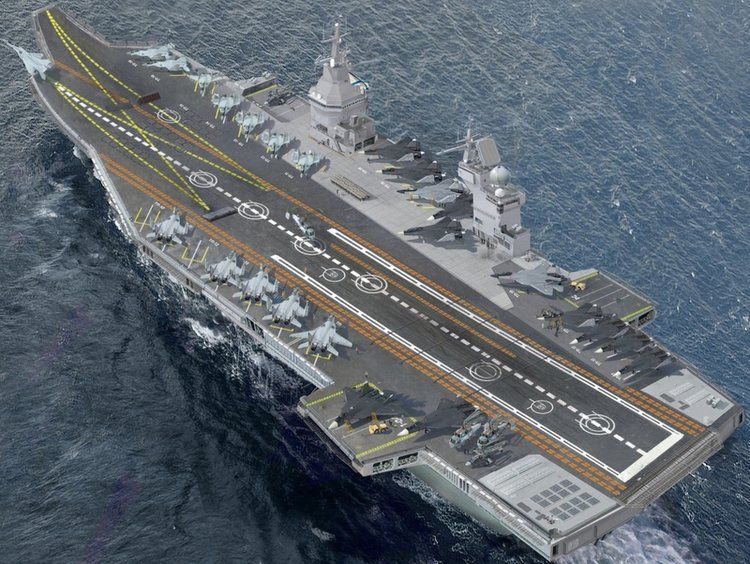
Russian SHTORM Supercarrier Concept Design
With the fate of Russia's SHTORM supercarrier design long uncertain, suspected to have been either postponed or scrapped entirely in favour of more cost effective weapons programs, recent reports have indicated that Russia is set to commence with the commissioning of a new carrier into its Naval fleet. Head of the Russian Defense Ministry's Institute of Shipbuilding and Armament of the Military Training and Research Center of the Navy Nikolai Maksimov indicated that work on a carrier was currently underway. He stated: "The aircraft-building complex is planned to be built, which will include the aircraft carrier itself, the air wing and the location system." He further mentioned the possibility of operating modified variants of the Su-57 from the carrier's deck.
Should Russia pursue the SHTORM design, it is likely to make its carrier the largest and most capable in the world and the only supercarrier in service outside the United States. While the Soviet Union had long planned to induct a fleet of supercarriers, the Ulyanovsk Class for which the first keels had been laid, the state's collapse in 1991 ended the program. Russia's new supercarrier is set to deploy both advanced variants of the MiG-29K light fighter and heavier Su-57 fifth generation air superiority fighters - giving it perhaps the most formidable air wing in service anywhere in the world. While Russia's Kuznetsov Class carrier relied solely on ski jumps, lacking either steam or EMALS to give aircraft extra energy needed upon launch and thus restricting the weight of aircraft operating from deck, the new warship is set to combine an electromagnetic launch system with a ski jump. This will allow far heavier, better fuelled and better armed aircraft to operate from deck, including more capable fighters, carrier based AEW aircraft similar to the U.S. E-2 Hawkeye, and carrier onboard delivery aircraft to facilitate longer operations overseas.
According to Minister Maksimov, the Krylov State Research Center had already submitted a mock up of the new carrier. Additional designs were still under consideration however. It remains possible that the Russian Navy will consider a smaller platform, as with the gargantuan SHTORM Class design set to displace almost double the tonnage of the Kuznetsov Class, a smaller carrier could well be a more cost effective way of deploying a modern carrier without such massive acquisition and operational costs. A carrier displacing approximately 70,000 tons and carrying elite Su-57 fighters for example would still be among the world's most capable able to contend with U.S. supercarriers, which since the cancellation of the carrier based F-22 lack heavy fifth generation fighters of their own. Such a path could well be taken by the Russian Navy in future.
