
Russia Deploys Su-34 Strike Fighters For Glide Bomb Attacks on Ukraine’s Forward Drone Control Points
Military Watch Magazine Editorial Staff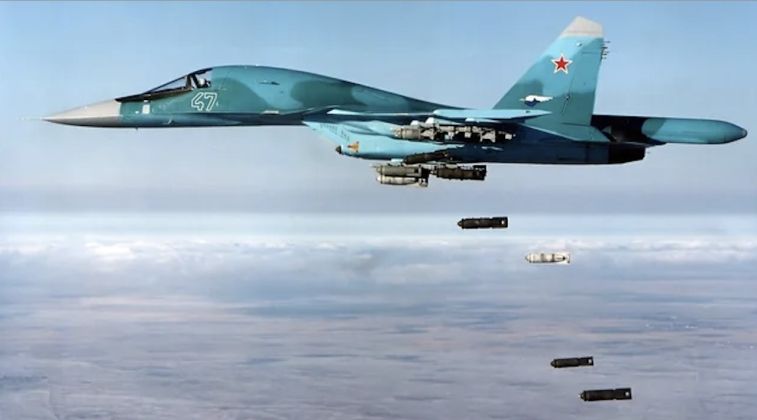
Su-34 Drops Bombs
The Russian Aerospace Forces were on June 20 reported to have deployed Su-34 long range strike fighters for attacks on Ukrainian Armed Forces drone control points, with footage from Russia’s own unmanned aircraft confirming the targets’ destruction. The Russian Defence Ministry reported: "In the settlements of Dobropolye and Kucherov Yar of the DPR [Donetsk], pilots destroyed the control points of UAVs of two separate brigades of the National Guard of Ukraine with FAB-500 aerial bombs. Also, three FAB-1500 aerial bombs equipped with universal planning and correction modules struck the temporary deployment point of the 81st separate airmobile brigade of the Armed Forces of Ukraine in the village of Nikolayevka, DPR.” Su-34s have been responsible for the bulk of strike operations, with their outstandingly high weapons carrying capacities, formidable electronic warfare capabilities, and reduced frontal radar cross sections making them optimal for such roles. Russian forces have prioritised striking drone control points due to the far lower complexity of doing so compared to shooting down large numbers of drones.
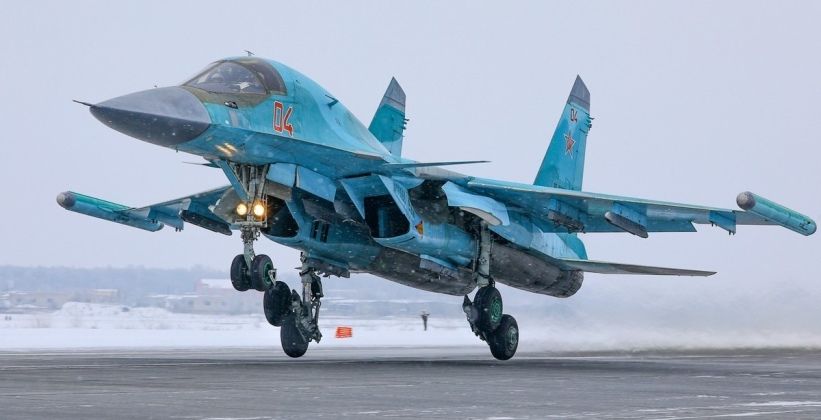
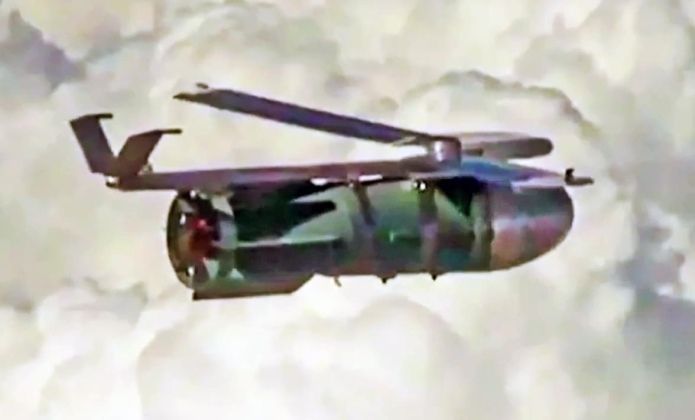
Su-34 units were in October 2025 reported to have begun to utilise a new type of very long range glide bomb, which has been a game changer for the ability of aviation assets to launch low cost mass strikes on targets far deeper behind Ukrainian lines. Commenting on the new weapon’s impact, deputy head of Ukraine’s Main Directorate of Intelligence Vadim Skibitsky stated that it had demonstrated a range of 193 kilometres, stressing that this could fundamentally alter the dynamics on the frontlines. Prior glide bombs which began to be widely utilised from 2023 had previously been restricted to ranges of around 80 kilometres or less. Glide bomb development has been vital to reducing both the risks of launching attacks, and the costs of doing so, providing ranges comparable to many air-to-ground missile types at very small fractions of the cost.
Ukrainian Army frontline personnel speaking to various Western media outlets have widely singled out the effects of mass glide bomb attacks, stressing that such attacks using bombs with up to 500 kilograms of explosives were obliterating their underground bunkers. One serviceman compared their impact to “hell’s gates,” stressing that the Russian Aerospace Forces “would send them two by two by two, eight in an hour… It sounds like a jet coming down on you.” These strikes have reportedly contributed significantly to the extreme casualty rates suffered by the Ukrainain Army, which had in several cases approached 80-90 percent in frontline units. In April 2023 Ukrainian ambassador to the United Kingdom Vadim Pristaiko stated that authorities were concealing the full number of wartime casualties, stating that “it has been our policy from the start not to discuss our losses,” but that “when the war is over, we will acknowledge this. I think it will be a horrible number.” Resulting personnel shortages have resulted in a growing reliance on foreign combatants to support the Ukrainian war effort, including contractor personnel from Brazil, Colombia and Poland.
