
Russia's Su-57 Next Generation Fighter Successfully Flight Tests New Engine
Military Watch Magazine Editorial Staff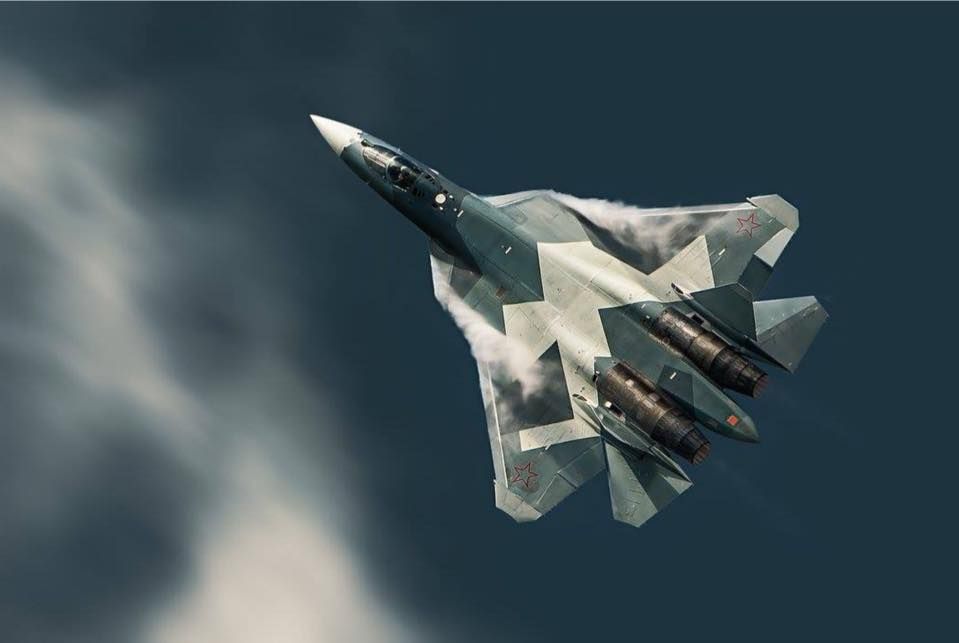
Russian Su-57 Next Generation Fighter
Of Russia's future combat aircraft projects, the Su-57 stealth air superiority fighter is the most prolific. The fighter is speculated to either be a Russian analogue to the fifth generation U.S. F-22 Raptor, or an entirely new type of next generation platform with capabilities far exceeding its U.S. rival. The latter theory is supported by statements from Russia's defence ministry, indications of the integration of sixth generation technologies, and Russia's general lack of need for a fifth generation platform due to the capabilities of its advanced 4++ generation platforms such as the Su-35.
One of the most challenging aspects of developing a new fighter is the development of more powerful engines, something China has particularly struggled with due to its less advanced starting technological base, but which has also proven a challenge for Russia's next generation program. While the initial Su-57 prototypes have used modified versions of the Saturn AL-41F1S engines used by the Su-35, among the most powerful fighter engines in the world, new engines will give the fighter a significant advantage in the air and are necessary to make investment in a next generation fighter truly worthwhile. In early December 2017 the Su-57 carried out its first flight test of a "second stage engine." The 17 minute test flight was carried out by Sukhoi's chief test pilot Sergei Bogdan.
Russian Industry and Trade Minister Denis Manturov stated that the successful test "proves the high potential of the Russian aircraft industry, capable of designing smart and advanced systems - aerodynamic systems, innovative digital components, newest engines." The fighter's engines will also facilitate three dimensional thrust vectoring similar to that of the Su-35 - making it the world's only stealth platform to do so and a far more capable fighter in visual range combat. While the specifications of the new engines are unknown, considering that Russia has pledged to create an aircraft more advanced than the F-22, and designed a next generation engine over a decade later than the United States when its aviation industry is at a more mature stage, the engine finally used on the Su-57 may well be the most advanced on any fighter in the world.
