
Russia's SHTORM Concept Design a Worthwhile Investment? How Moscow Would Deploy its Supercarrier
Military Watch Magazine Editorial Staff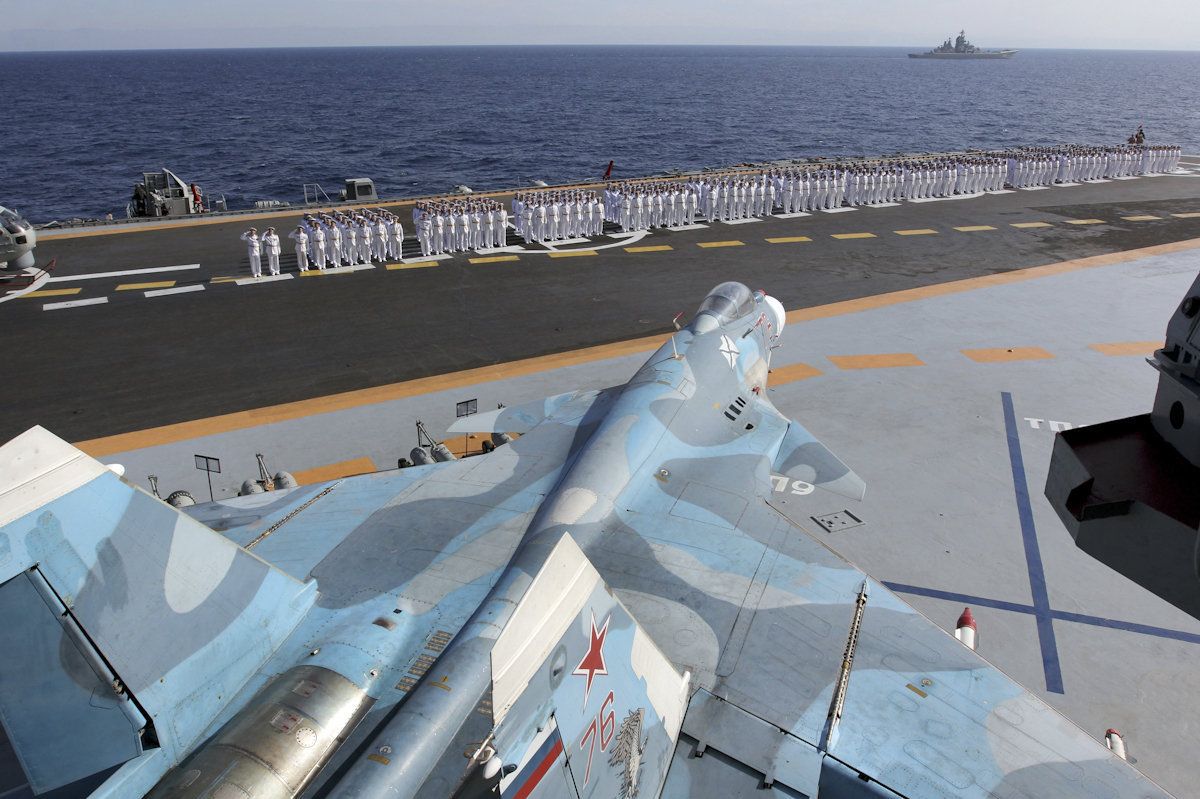
Su-33 Onboard Russian Kuznetsov Class Carrier
Russia's military has revealed plans to commission a supercarrier based on a new design by the Krylovsky Research Center, which could make it the only country other than the United States to operate a warship of such a size. The carrier is to a large extent a 21st century modernisation of the 1980s Soviet design for Ulyanovsk Class carrier warships, the construction of which was cancelled and the foundations scrapped following the dissolution of the USSR in 1991. The Ulyanovsk was set to be the Soviet Union’s first blue water carrier, and only the second Russian carrier design after the Kuznetsov class to be able to launch fixed wing aircraft without short takeoff vertical landing (STOVL) capabilities.
At present Russia's sole aircraft carrier, the smaller 55,000 ton Admiral Kuznetsov aircraft carrying cruiser, is ill suited to blue water operations and has power projection capabilities far inferior to those of the U.S. Nimitz and Gerald Ford class supercarriers. These larger American carriers can deploy approximately twice the complement of aircraft as the Kuznetsov and can launch a fighter every minute, far faster than the Kuznetsov which can launch one every four minutes. Other advantages include steam and electromagnetic launch systems (EMALS) which allow the carriers to deploy far heavier, therefore better armed and longer ranged, fighter jets compared to their Russian counterparts, as well as their ability to deploy fixed wing airborne early warning and control (AWACS) platforms such as the E-2 Hawkeye, a considerable force multiplier to which Russian carriers have no equivalent. Indeed, the Kuznetsov’s only advantages are its superior armament of anti aircraft and anti ship missiles, which allow it to operate more independently than its American counterparts, and potentially the superior combat aircraft it is able to deploy - a result of Russia’s sophisticated military aviation capabilities rather than its shipbuilding capabilities or the carrier itself.
While Russia's carrier struggled to operate in Syria, losing two aircraft to accidents in the process, U.S. Nimitz class carriers have proven highly effective in such power projection exercises against similar adversaries. Russia's SHTORM carrier concept is however set to have capabilities equivalent if not superior to those of the Nimitz class, incorporating modern features today only found on the United States’ sole Gerald Ford class supercarrier commissioned in 2017. The carrier will incorporate electromagnetic launch systems allowing it to deploy heavier aircraft with higher payloads and to launch them more quickly and safely. With a deck set to measure 330 by 40 meters and the capacity to carry 80-90 aircraft, the carrier's commissioning will represent a significant enhancement to the power projection capabilities of Russia's surface fleet.
The USSR never maintained a significant carrier fleet, and due largely to their military doctrine the first blue water carrier program came late in the history of the country's military. The Soviet emphasis on missile technology and submarines as far more cost effective means of launching strikes had a persuasive logic to it. For the cost of constructing an aircraft carrier, at least 1000 if not several thousand cruise missiles could be built - depending on the size of the carrier - and just 100 of these would be more than enough to sink any carrier at range. Advances in missile technology today mean it can take as little as a single missile to reliably sink a 100 ton supercarrier. Carriers remain extremely vulnerable to missile attacks - as opposed to submarines which offered a far more survivable means of projecting power which the Soviet military strong favoured. While aircraft carriers may not be the weapon of choice for projecting power in a major war however, the U.S. naval doctrine does have its advantages. Carriers are invaluable both as prestigious symbols of a country's military might and for their capabilities in smaller conflicts to project power against adversaries with limited military capabilities. While U.S. carriers are vulnerable if deployed anywhere near the North Korea, Russian or Chinese coasts in range of their advanced anti-ship missiles, the ships have proven very useful against less well equipped and organised forces such as those of Iraq, Afghanistan, Islamic State, Libya, Somalia, Panama, Vietnam and Yugoslavia among several others. They are also an invaluable tool to control blue water trade routes far from enemy coastlines.
While a war between major military powers must always be prepared for, capabilities to engage in smaller conflicts can also prove invaluable. Such conflicts are far more frequent than great power wars, which have not occurred since 1953, and the outcomes of these smaller engagements are often of significant strategic importance. While Russia's nuclear submarines and cruise missiles are the weapons of choice to engage the United States military, a supercarrier is exactly what would be needed to engage Islamist militants from Al Qaeda and IS in Syria and to engage in similar power projection operations across the world. The political impact of and prestige gained by deploying a supercarrier, be it to friendly ports in South East Asia or in support of South American states at odds with the U.S., is not to be underestimated.
Continued in Part Two
