
Russia’s Nevskoye Design Bureau Offers New Carrier Warships for Navy's Expansion Program; Are Vertical Takeoff Jets the Future of Russian Naval Aviation?
Military Watch Magazine Editorial Staff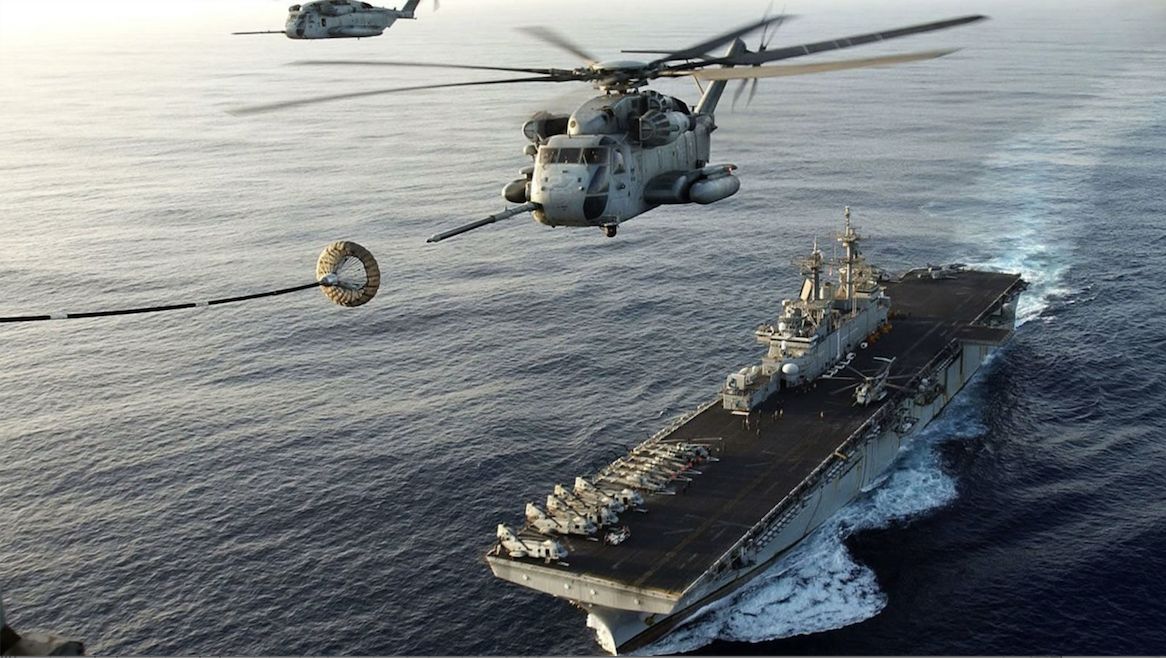
U.S. Navy Wasp Class Amphibious Assault Ship
Russia’s Nevskoye Design Bureau has offered the Navy a new amphibious assault ship design, set to complement plans for new frigates and destroyers as part of the country’s blue water naval expansion program. The Bureau is Russia's prime designed for large surface warships, and has also reportedly been involved in developing a supercarrier design and testing advanced onboard systems for new carrier warships. The amphibious assault ships proposed will have a similar role to the U.S. America Class assault ship used by the U.S. Marine Corps, and are being commissioned as the Russian Naval Infantry, an analogue to the Marines, are undergoing an expansion of their own. With the ships set to deploy over one thousand combat personnel alongside armoured vehicles and aircraft for amphibious landings, they are also designed to deploy many of the latest armoured warfare platforms recently developed for the Naval Infantry. The warships will displace approximately 35,000 tons when loaded, 13% lighter than its U.S. analogue, with a length of over 200 meters.
News of the landing ships’ development has come shortly after the announcement of the development of vertical takeoff and landing (VTOL) capable fighter jets, likely based on the Soviet Yak-141 developed to a late prototype stage before the state’s disintegration to deploy from carrier warships without runways. These warships are expected to deploy some of the latest air to air missiles such as the K-77 and cutting edge anti ship cruise missiles such as the Mach 3 Kh-41 and 300km range Kh-35U and P-800. Approximately a dozen of these fighters may be deployed from carrier decks, possibly over 20 if their aircraft complement sacrifices rotary wing platforms for antisubmarine warfare, transport and attack roles, and due to their lack of requirement for a runway the VTOL fighters are set to form a more effective complement for the small deck than the F-35B deployed by the carriers’ American analogues. The F-35B, lacking VTOL capabilities, is capable of vertical landings but requires a short runway for takeoff.
Head of the Nevskoye Design Bureau Sergei Orlov stated regarding the development of the new warships: "We are still at the research and development stage in this field so far... Today, the entire concept of landing forces has changed. It is necessary to rethink what kind of a ship they need and how many helicopters, paratroopers and weapons this ship needs. Will it be possible to use the ship in civil life if necessary?" Russia has long had an interest an assault carriers, with the Navy having contracted two smaller Mistral Class warships for a similar role and intended to equip them with specialised Ka-52K attack helicopters armed with advanced Kh-35 and Kh-31 cruise missiles. The Bureau noted that it had also offered the Russian Navy a modernized version of the Ivan Gren landing ship, which would also deploy Naval Infantry for amphibious landings. Orlov stated regarding this development: "Having created two ships, the fleet can see the concept of a new large landing ship. Now we have a very clear idea of what we should do with the Ivan Gren.” The new warships are expected to enter service in the mid 2020s.
