
Russia's Latest Missile Drill; A Reminder to Potential Adversaries of the Country's Constant Readiness to Deploy Nuclear Force
Military Watch Magazine Editorial Staff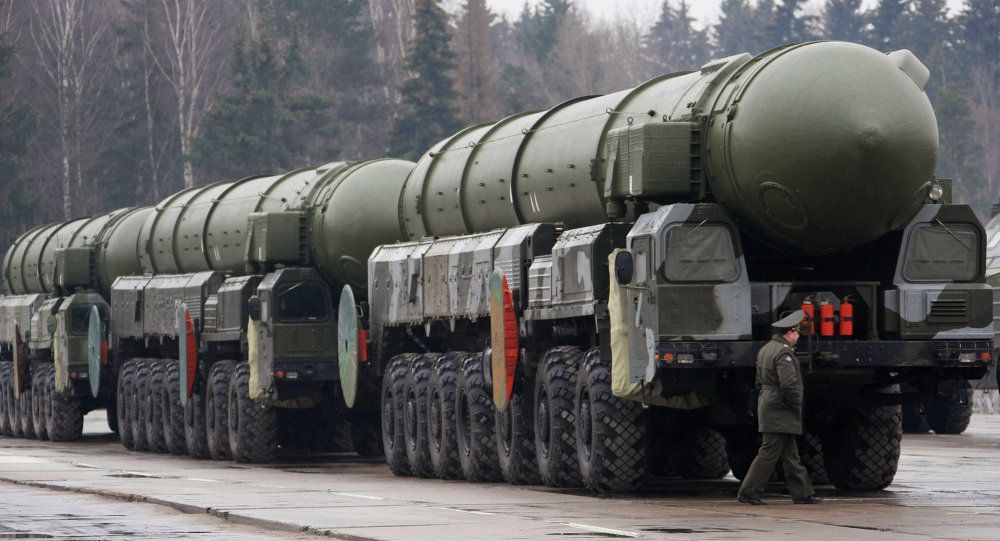
Russian ICBM
Russia has recently conducted a large scale drill to test the capabilities its road mobile intercontinental ballistic missile forces. These forces form the backbone of the country's nuclear deterrent, and allow Russia to deliver nuclear strikes anywhere in the world. Russia has invested heavily in road mobile missile capabilities, which have a significant advantage over fixed missiles due to their ability to rapidly relocate. Indeed, the vulnerability of fixed missile sites was demonstrated during the 1991 Gulf War when Iraq's immobile Scud missiles were effectively sitting ducks for the U.S. Air Force - while its mobile launchers proved far more survivable. With Russia's arsenal of road mobile nuclear ICBMs all capable of delivering nuclear payloads, and with capabilities far eclipsing those of any rival including the United States, the survivability of the country's deterrent force only increases its potency. All of Russia's road mobile ICBMs designs including the Yars, Topol and Topol-M took part in the exercises.
Exercises prepared missile forces for a combat scenario under which Russian territory was compromised by hostile forces, which were attempting to neutralise its missile forces. Anti-sabotage forces making effective use of specialised drones were tasked with protecting the missile systems, which relied heavily on their mobility to evade their attackers. Following the completion of the exercises the Russian Defense Ministry stated: "Today, missile regiments of the Topol, Topol-M and Yars missile systems have carried out a night march. The regiments are located in five regions from the Tver region to Altai Krai. More than 600 piece of hardware including launchers, were operated to ensure combat patrol en-route... Counter-sabotage formations are drilling tasks to detect, block and eliminate mock insurgents. The formations are operating the Typhoon-M Combat anti-sabotage vehicles equipped with drones. It is planned to train passing through a mock contaminated terrain. At the end of the exercise, the troops are to drill simulated launching of missiles."
Amid growing tensions with the Western bloc not only in Eastern Europe and Syria but also on the Korean Peninsula where Russia has deployed its advanced air defences to deter any potential U.S. military action, re-emphasising the readiness, scale and survivability of its nuclear missile forces is an invaluable means of deterring potential adversaries from testing the Russian military. Indeed, at a time when defeat in Syria and strategic failure in Korea have seriously undermined the position of the United States in both the Middle East and the Asia-Pacific, Russia could have timed the drills to show strength to its increasingly hard pressed and even desperate adversary. Russia's ICBM arsenal is a key means of asymmetric warfare critical to deterring the combined forces of the united European and North American NATO powers, which between them spend over ten times as much as Russia on their militaries. Investment in this arsenal is set to continue, with new missiles such as the Satan 2 and advanced hypersonic platforms entering service in the near future.
