
Russia's Kinzhal Hypersonic Missiles Active; Deployed by Repurposed MiG-31 Interceptors with Lethal Effect
Military Watch Magazine Editorial Staff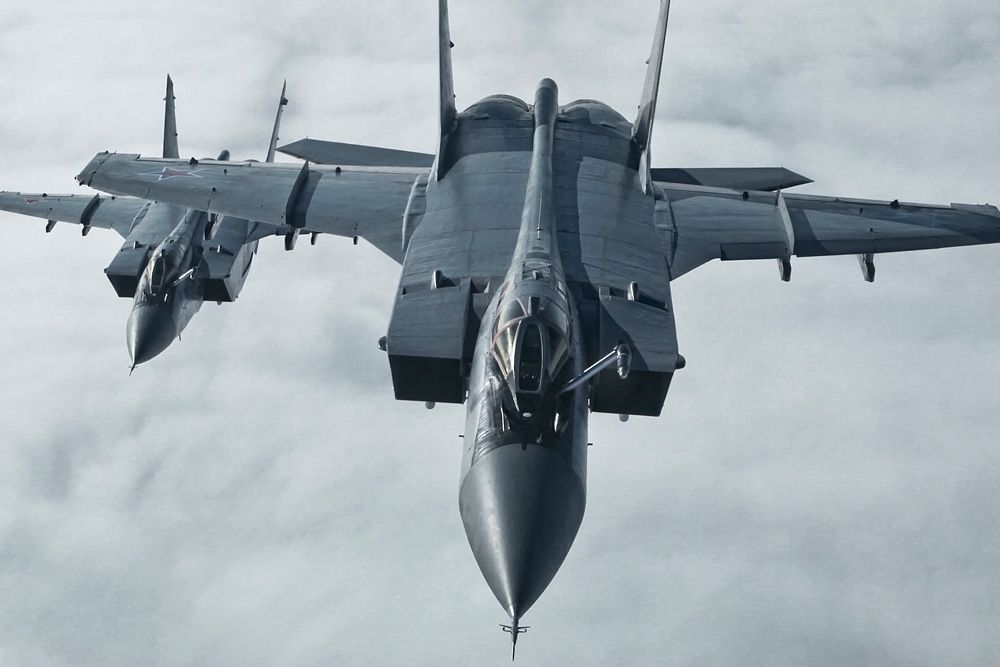
Russian MiG-31 Interceptors
As part of the Russian military's effort to enhance its strike capabilities by integrating a number of new hypersonic attack platforms, the Air Force has repurposed a number of MiG-31 interceptors to deploy Kh-47M2 Kinzhal ('dagger') long range hypersonic missiles and adopt a strike rather than an air to air combat role. While the MiG-31 was designed to protect Soviet airspace from intruders and respond to threats from enemy fighters and bombers, flying at speeds unmatched by any other modern combat aircraft, deploying advanced R-33 and R-37 air to air missiles with 300 and 400km ranges respectively, and attacking from high altitudes of over 20km to maximise its effectiveness in air to air combat, its capabilities have also made it well suited to delivering hypersonic missiles for an offensive air to ground role. The MiG-31's characteristics allow it to respond quickly to threats, while maximising its survivability and allowing it to cover long distances of up to 3000km. The aircraft is optimised to carry extremely heavy missiles such as the R-33, and this high capacity can be put to good use when deploying hypersonic attack missiles. The interceptor's high speed meanwhile is ideal for deployment of the Kinzhal, as it can impart more kinetic energy to the missile upon firing it which avoids the need for a heavy rocket booster.
According to Russian Deputy Defense Minister Yuriy Borisov, ten MiG-31 interceptors have already been refurbished to deploy Kinzhal air to air missiles since the program begun in early March. Photos of the aircraft equipped with the deadly new payload have already emerged, and are a drastic diversion from the aircraft's originally designated role as a dedicated air to air combat platform. The defence minister stated regarding the development: "MiG-31 is the carrier (of the Kinzhal hypersonic missile), this aircraft is the most suitable for speeding up this missile to the required speeds at the right altitudes. To confirm that it is not some kind of exotic thing: today 10 aircraft are on trial combat duty and are ready for use depending on the situation." He stated regarding the capabilities of the new attack platform: "This is a modern weapon: a hypersonic missile of increased range, which, in fact, can penetrate air defense and anti missile defense systems. It is invulnerable and has very serious fighting power and potential."
Minister Borisov had on an earlier occasion stated regarding the Kinzhal's advanced strike capabilities: "This is a class of precision weapons which has a multifunctional warhead capable of striking at both stationary and moving targets." He stated regarding the missile's function that it "takes off into the air, accelerates to a certain speed at a high altitude, and then the missile begins its own autonomous movement." Further elaborating on the Kinzhal's capabilities, the minister noted that the missile was designed: "to approach its target quickly, in contrast to cruise missiles, which fly at an average cruising speed of about 850-900 kilometres per hour." He added that the Kinzhal's aerodynamic control system enabled it to "maneuver during flight, and bypass dangerous zones containing anti aircraft or anti missile defense systems….It is this capability to maneuver in hypersonic flight in particular that makes it possible to ensure (the missile's) invulnerability and to guarantee target penetration." The Kinzhal's ability to strike targets at distances 2000km, well beyond the range of enemy air defences, combined with the MiG-31's high speed and altitude, make the launch aircraft extremely difficult to intercept.
A number of leading figures in the U.S. military have met the deployment of Russia's newly announced hypersonic missiles, which include naval and air launched platforms as well as two intercontinental ballistic missiles, with great apprehension, noting the United States lacks any form of effective defence against such platforms. With existing American air defence platforms unable to intercept missiles travelling at above Mach 3, and frequently failing in recent combat tests against extremely old subsonic platforms such as the Scud B which date back over 50 years, Russia's new attack platforms which can travel at speeds of over Mach 5, some at Mach 10 or even Mach 20 in the case of the Avangard ICBM, pose an existential threat to the U.S. military and to all potential Russian adversaries. The Kinzhal is set to fulfil critical strategic and tactical roles for the Russian military as one of several new hypersonic missiles deployed in 2018.
The range of the Kinzhal, combined with that of the MiG-31, would allow interceptors based in Russia to strike across Western Europe, and grant aircraft based in Russia's Far East coverage across East Asia including the strategically critical and highly contested East and South China Seas. Alongside its air to ground strike role, the Kinzhal is also set to be used as an anti ship platform to neutralise large surface warships such as carriers and destroyers. Indeed, with its payload estimated at over 500kg and the sheer speeds at which it will make impact enough to tear a large warship in half on their own, even the largest enemy surface vessels could well be neutralised by a single shot from this new missile. This the Kinzhal's its wide Pacific coverage particularly significant, and the missile's induction could well enhance Russia's position in the region despite the relative scarcity of military assets deployed there due solely to the sheer power of its new strike capabilities. Large warships, much like hostile ground targets, are set to be effectively defenceless against the new Russian hypersonic platform - a weapon no other military power can yet match.
