
Russia’s Rostec Highlights Significant Further Upgrade Potential of T-72 Tank as Armour Production Expands
Military Watch Magazine Editorial Staff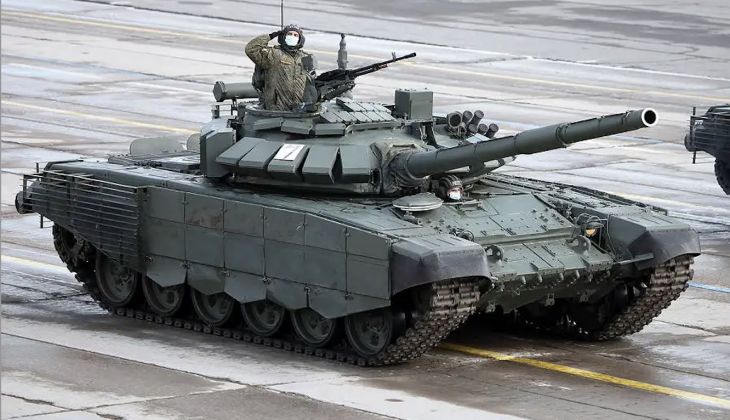
T-72B3M with 2022 Armour Enhancement
Russian state tech corporation Rostec has stated that the T-72 main battle tank which currently forms the backbone of the country’s armoured units has very significant potential for further modernisation. “The higher the upgrading potential, the better the combat equipment. The T-72B3M tank, produced by our Uralvagonzavod Group, is a platform with almost endless capabilities. This combat vehicle is significantly superior to earlier T-72 models thanks to a modern sighting system, new protective equipment, and a more powerful engine,” the firm observed. It noted that the T-72B3M remains a modular tank that can be quickly reconfigured to respond to specific threats and challenges. Although the T-72 first entered service in 1973, it remains one of the two most widely operated tank types in the world, alongside its direct predecessor the T-54/55, with a very wide range of modernisation packages having been developed in multiple countries.
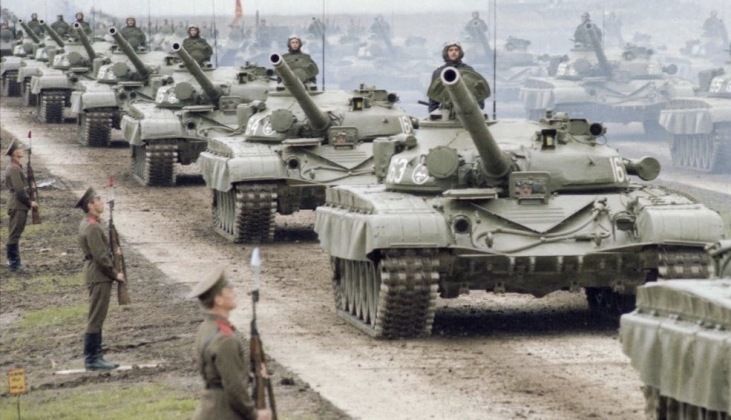
Commenting on the T-72’s performance in the Russian-Ukrainain War from 2022, and the multiple efforts made to customise the vehicle, Rostec observed: "During the special military operation, about 200 different modifications were made to the T-72’s design, aimed at increasing its power, protection, and mobility. However, the upgrading potential is far from depleted.” The corporation stressed that the T-72 is the most used and most combat tested type of main battle tank serving anywhere in the world, adding: “It is not only a tank, but also a highly protected tracked platform for an entire family of special-purpose vehicles: the Buratino and Solntsepek heavy flamethrower systems (TOS), the MTU-72 bridge layer, the BREM-1 maintenance and evacuation armoured vehicle, the IMR-2 military engineering vehicle, etc.”
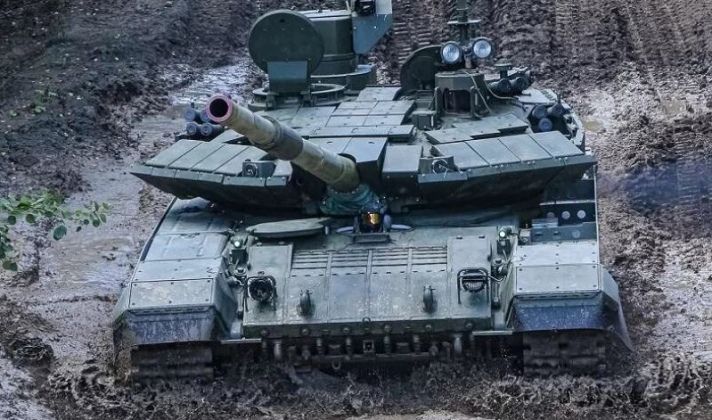
A major milestone in the T-72’s modernisation was the development of the T-72B variant, which first entered service in 1985, and incorporated many features from the newer T-80 tank including a laser rangefinder and much improved armour protection levels. After the USSR’s disintegration, the further enhanced T-72BU variant was redesigned as the T-90 for marketing purposes, with the vehicle today remaining in production at Uralvagonzavod at a higher rate than any other tank type in the world. Although the T-90 represented only a conservative improvement over the late Soviet era T-80UK, and in many respects was less capable with its mobility being far poorer, the new T-90M variant brought into service in early 2020 marked a further major landmark in the evolution of the T-72 design. The tank’s 2A46M-5 125mm smoothbore gun and Kalina fire control system allow it to deploy the wide range specialised munitions, some of which began to be seen in Ukraine in early 2023, while its survivability benefits from the integration of Relikt explosive reactive armour as well as isolation of munitions from the remainder of the vehicle internally.
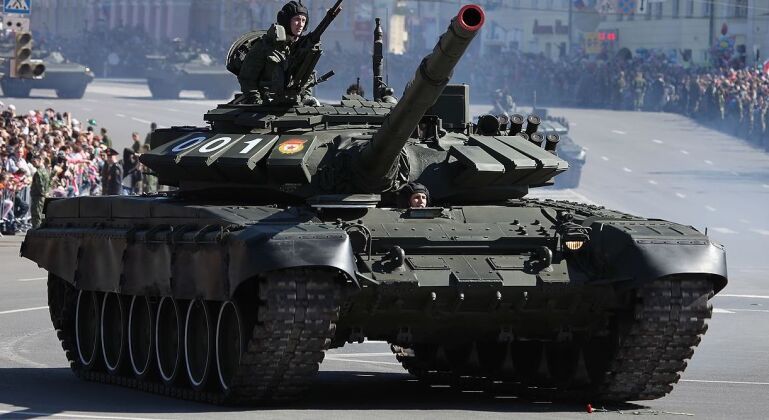
The T-90M’s capabilities improved significantly since the outbreak of full scale hostilities in Ukraine, with a notable example being the integration of Russia’s first hard kill active protection system, Arena-M, from late 2024. It was confirmed in early January that a new variant of the Arena-M system capable of intercepting single use drone and loitering munition attacks had completed development. Production of T-90 tanks has increased rapidly from approximately 90-110 tanks per year in 2020-2021, to an estimated output of 280-300 tanks in 2024, and approximately 400 in 2025. In parallel to the modernisation of the T-90M, the very large inventories of T-72 tanks which Russia inherited from the Soviet Union have continued to be enhanced, primarily by bringing them up to the T-72B3M standard with the integration of third generation thermal sights, Relikt explosive reactive armour, and modern communications and data sharing systems, and the 2A46M-5 smoothbore gun, among other upgrades.
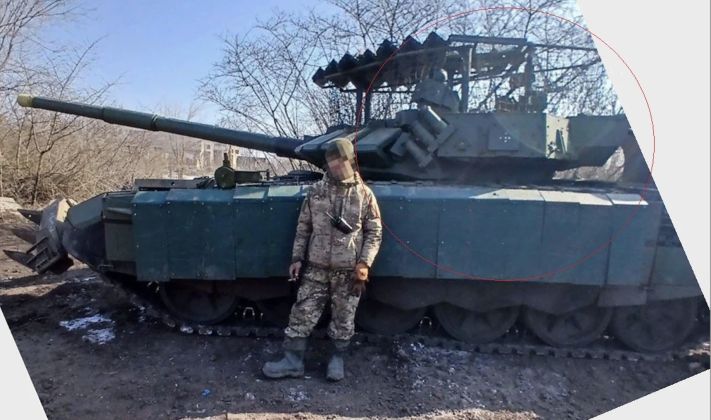
From late 2022 further armour enhancement to the T-72B3M, which mirrored that made to the T-90M, began to be seen on frontline units, as the rate of modernisation of T-72s increased significantly to respond to wartime attrition. Some sources informally referred to this as the T-72B4. From late 2024, T-72B3 tanks also began to integrate hard kill active protection systems in parallel to the integration of such systems onto the T-90M fleet. The firepower of the T-72B3 gained particular attention in the Ukrainian theatre when, shortly after U.S.-supplied M1 Abrams tanks were first deployed for combat operations, one of the enhanced Russian tanks became the first in the world to frontally penetrate it in a tank-on-tank engagement in early 2024. While the T-72 and T-90 were previously expected to be phased out of service from the late 2020s as the T-14 next generation tank was brought into service, failure to complete the program has resulted in continued importance being attributed to enhancing the older Soviet design with the latest available technologies.
