
Russia Deploys Advanced Electronic Warfare Systems to Syria
Military Watch Magazine Editorial Staff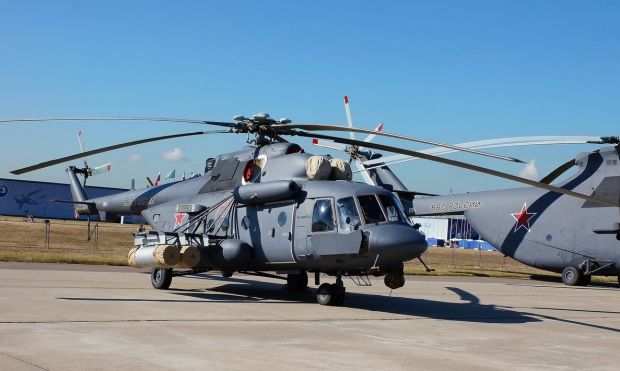
Mi-8 Helicopter
With the near defeat of Islamist insurgent groups operating on Syrian territory by the Russian and Syria armed forces and the collapse of the Islamic State's self declared caliphate, the Russian military has increasingly deployed high end armaments to Syria suited to combating near peer adversaries rather than insurgent militias. This has come at a time of growing tensions in the country between forces deployed by the Western bloc and those of Russia and its allies. Key examples were the deployment of advanced long range surface to air missile systems and the more recent deployment of new air superiority fighters to Russia's airbase in Syria's Latakia province, four Su-57 stealth platforms, both assets to engage enemy combat aircraft and of little use against ground based militants. Following the deployment of these fighters in February 2018, it emerged that Russia also deployed a Mi-8MTPR-1 helicopter to Syria, an advanced electronic warfare platform based on the Mi-8 transport. The aircraft is expected to send a strong signal to the country's potential adversaries regarding the combat readiness and capabilities of Russia's military contingent deployed to the country.
The Mi-8MTPR-1 is designed to blind enemy warplanes and missiles for distances of several hundred kilometres. It is equipped with a Rychag-AV radio electronic warfare system, one of the world's most powerful jammers, which provides Russia with an invaluable asset against the forces deployed by the Western bloc. The system has a range of 400km. While Russia's military contingent in Syria is overwhelmingly outnumbered by Western forces, with U.S. and European bases and carrier strike groups throughout the Middle East and Mediterranean between them able to deploy large fleets of fighters and warships and hundreds of cruise missiles at a moments notice, the deployment of an asymmetric system such as the Rychag-AV could potentially go a long way towards compensating for the West's numerical advantage. The helicopter's deployment is also critical to ensure Russia does not face a disadvantage in its electronic capabilities in light of the U.S. Navy's deployment of its own advanced electronic warfare aircraft, the EA-18G Growler.
While March 2018 marked the first reported sighting of a helicopter mounted Rychag-AV system, the electronic warfare platforms have according to a number of analyst sources been deployed to Syria well before this time. Rychag-AV elements can be installed on ground based mobile air defense systems, several reports indicate that they were used to disrupt U.S. cruise missile strikes on Syria's Ash Sha'irat airbase in April 2017. The Syrian conflict is likely to continue to prove a valuable testing ground for new Russian armaments, and while Russia's military has already demonstrated considerable faith in the Rychag-AV its performance could well lead to modifications and optimisation based on valuable combat experience of its operators.
