
Revolutionary New Russian Aircraft Carrier Design With Navalised Su-35 Fighters Unveiled
Military Watch Magazine Editorial Staff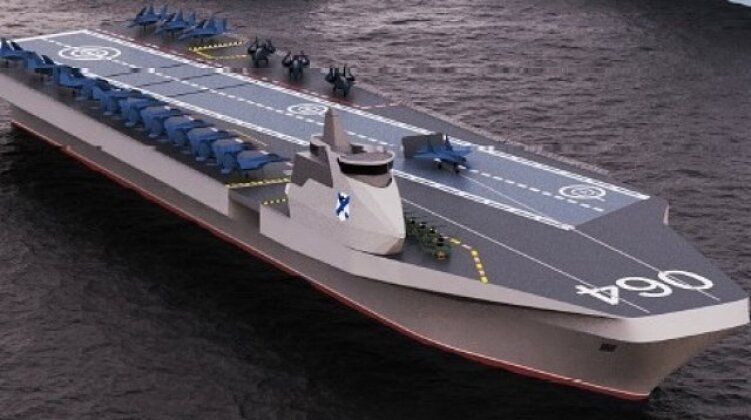
Varan Carrier Design
Amid continuing uncertainty regarding the future of Russian carrier aviation, multiple designs for new aircraft carriers to replace the ageing Soviet built warship Admiral Kuznetsov have been released. These have ranged from the highly ambitious SHTORM nuclear powered supercarrier design to the much more conservative Lamantin carrier. Although the Soviet Union previously laid down a nuclear supercarrier under the Ulyanovsk program, this came at a time when it was the world's second largest economy and the viability of such ambitious programs in Russia today is much more questionable. Most recently, Russia’s Nevsky Design Bureau has developed the Varan carrier design for the Russian Navy. The ship is much lighter than Lamantin design and less than half the size of the SHTORM, but in terms of design could well be more revolutionary than either of them. Displacing just 45,000 tons, the ship will likely be much cheaper but could have similar or even superior capabilities to the Lamantin. The ship’s efficient use of deck space and very small island superstructure allow it to accommodate 50 aircraft - including 24 heavyweight fighter jets, 20 drones and six helicopters. The ship will have a respective length and width of around 250ft and 65ft (76m by 20m), and a speed of up to 26 knots.
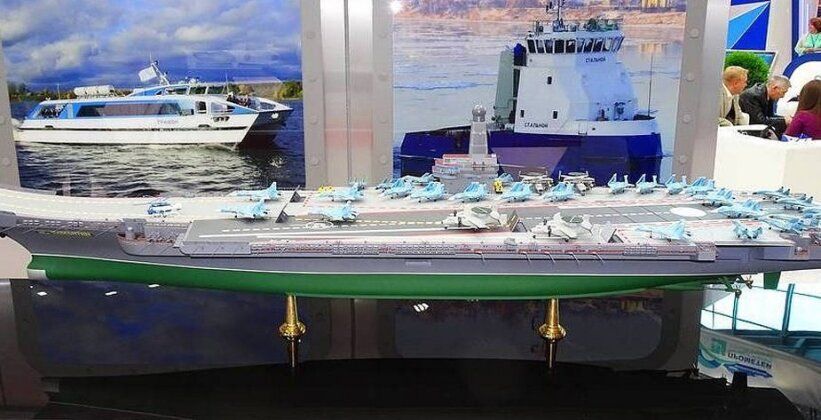
With the Admiral Kuznetsov facing continued issues which have undermined its availability for combat deployments, and the Russian defence budget having contracted making a heavyweight replacement potentially too costly to build and operate, the lighter Varan design could potentially be ideal for the Russian Navy. The design layout released by the Nevsky bureau shows over a dozen fighters of the Flanker design on the ship’s deck — presumably a navalised variant of the Su-35 ‘Super Flanker,’ a ‘4++ generation’ heavyweight fighter. It also appears to integrate a catapult launch system — a key feature which the Admiral Kuznetsov lacks which is likely electromagnetic. Such launch systems are key to allowing fighters to launch with heavy payloads of missiles and full fuel tanks, and the lack of them currently limits the capabilities of MiG-29K and Su-33 fighters deploying from the Admiral Kuznetsov. The possibility has repeatedly been raised that the Russian Navy’s future carried could deploy a navalised variant of the Su-57 next generation fighter, and releasing artwork of the ship using older and cheaper Flanker jets may well have been intended to lower cost estimates for the program and highlight to the Russian Defence Ministry how cheap it could be to commission a new carrier. A final choice of carrier design has yet to be made, but is expected to be confirmed by the end of 2022.
