
Republic of China Army Installs AI-Thwarting Irregular Camouflage to Enhance its New American Abrams Tanks
Military Watch Magazine Editorial Staff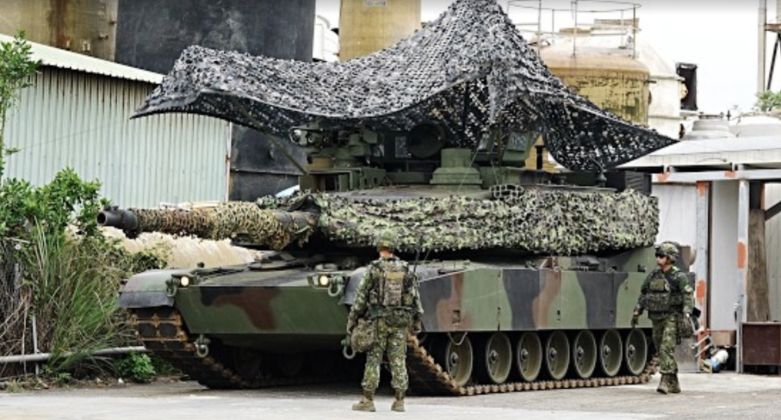
Republic of China Army M1A2T with Top Camouflage
During the first deployment of Republic of China Army M1A2 Abrams main battle tanks for combat readiness exercises it was revealed that the vehicles had been modified with irregularly arranged camouflage netting to provide improved protection against top attack drones and loitering munitions. Unlike the improvised metal top cages pioneered by the Russian Army, and subsequently imitated by multiple armies from Israel to South Korea, this netting does not appear intended to physically intercept drones or munitions. Instead, its primary purpose appears to be to disrupt aerial observation by altering the tank's recognisable outline, shadow, and visual signature, making it more difficult for drone operators and increasingly AI-assisted reconnaissance systems to identify vehicles from above.
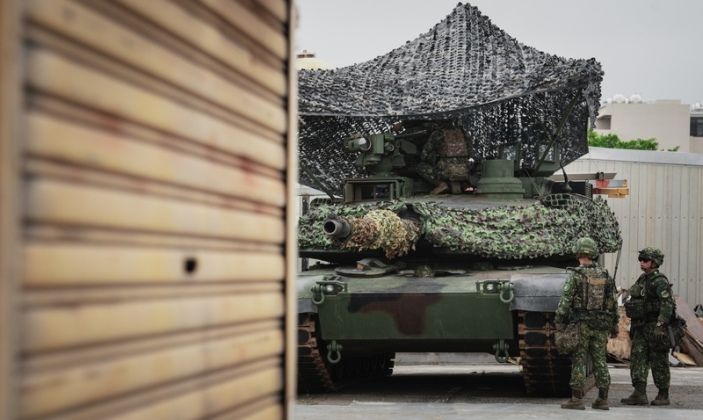
Exercises saw Abrams tanks from the Republic of China Army 584th Combined Arms Brigade occupy concealed firing positions while engineer units established layered roadblocks using concrete barriers, steel hedgehogs, and HESCO fortifications. Rather than emphasising armoured manoeuvre alone, the drill integrated concealment, engineering obstacles, and mobile armoured reserves into a single defensive concept designed to slow an advancing force while preserving the tanks until they could launch counterattacks. It appears that camouflage protection is intended to be installed only when Abrams tanks are deployed defensively to hold ground, as was the case during the latest exercises, with tanks moving on roads having no such protection systems installed.
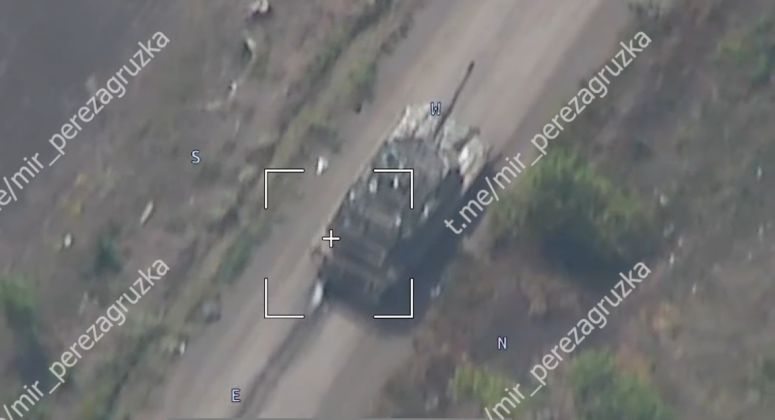
The irregular shape of the camouflage seen on the Abrams tanks is particularly significant. Modern battlefield reconnaissance increasingly relies on automated image-recognition software capable of identifying vehicles from overhead imagery based on their geometry and shadow patterns. By draping netting unevenly over the turret, gun barrel, and hull, crews distort these characteristic features, reducing the likelihood that drones or computer vision algorithms will immediately recognise the vehicle. This reflects the growing realisation that concealment now extends beyond blending into the terrain, and must also complicate machine-assisted target recognition.
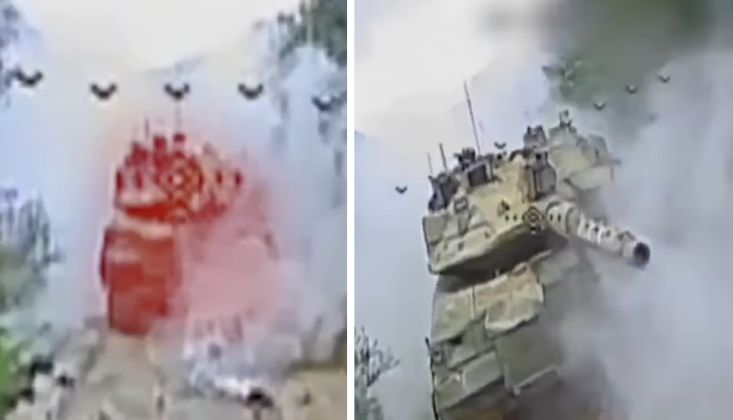
The Republic of China Army’s approach reflects a much broader trend emerging from the Russian-Ukrainian War, and to a lesser extent from the Israeli-Hezbollah War. Persistent surveillance by inexpensive quadcopters, fixed-wing reconnaissance drones, and loitering munitions has made it increasingly difficult for armoured vehicles to remain hidden once they move. As a result, many militaries are shifting their emphasis from relying solely on heavy armour toward multilayered protection systems that combine concealment, active defences, electronic warfare, and tactical dispersion. Camouflage is particularly important for Republic of China Army tanks since they lack any kind of active protection system, leaving their survivability entirely dependant on passive protection and tactical measures such as concealment. As countries in the Western world have not developed their own active protection systems, the U.S. and Germany are both procuring the Israeli Trophy system for integration onto their Abrams and Leopard 2 tank. Active protection systems have been independently developed by the Chinese mainland, North and South Korea, Russia and Israel.
One of the most visible developments in tank protection has been the widespread adoption of camouflage and multispectral signature reduction. Modern camouflage systems increasingly seek to reduce not only visual detection but also infrared, thermal, and radar signatures. Several armies are investing in advanced camouflage nets capable of masking vehicles across multiple parts of the electromagnetic spectrum, making them more difficult to detect by thermal imagers and surveillance sensors in addition to conventional optics. In July 2025 the U.S. Army allocated of over $107 million in funding for the development and operationalisation of stealth-enhancing coatings, passive armour kits, and new laser warning receivers, with GM1912 VPS Signature Management paint is intended to be applied to over 380 vehicles to reduce the probability of thermal detection.
