
Race to the Sixth Generation; The Critical Role of Russia Su-57 Air Superiority Fighter and Why its Induction is Being Held Back
Military Watch Magazine Editorial Staff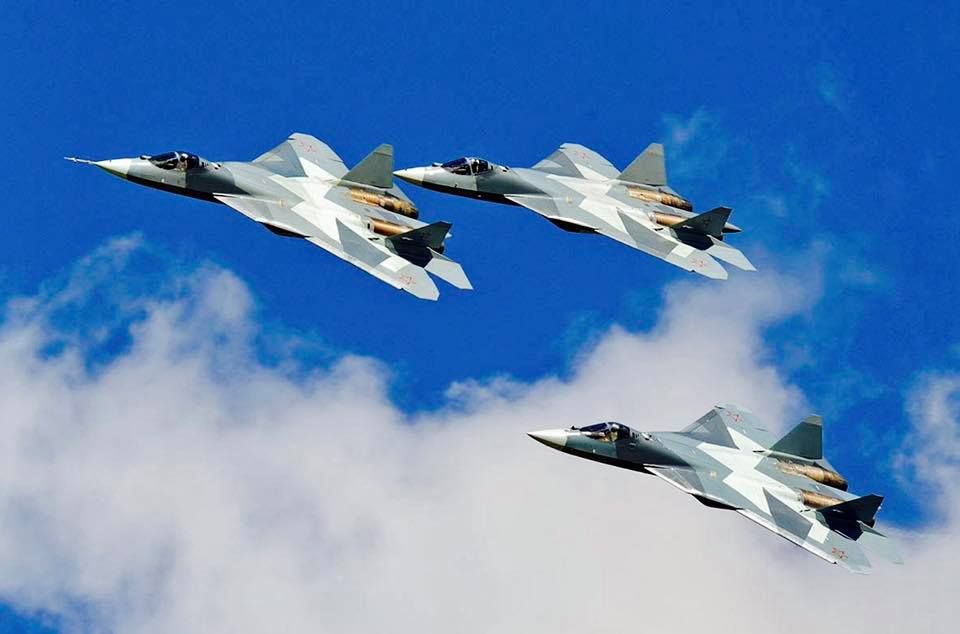
Su-57 Stealth Air Superiority Fighters
It came as a surprise to many analysts when Russia's new state armament plan stated that the country had no plans to induct the Su-57 or enter it into serial production in the next decade. While the United States inducted its first fifth generation air superiority fighter, the F-22, in 2005, and China did so in early 2017 when the J-20 entered service, Russia's Su-57 was expected to be serving in large numbers by the mid 2020s and be available for export by 2030 at the latest. With the new state armament plan running from 2018-2027 however Russia is set to continue to induct only test prototypes of its most advanced air superiority platform until then, while focusing on acquiring more Su-35 and Su-34 air superiority and strike fighters. The MiG-35 multirole fighter, set to enter service in 2018, is also expected to be inducted into the Russian Air Force in large numbers to replace the MiG-29. As Center for Naval Analyses senior research scientist Dmitry Gorenburg stated: "The Su-57 is not expected to enter into serial production until upgraded engines are ready, which is unlikely to happen until 2027. Over the next eight years, Russia will continue to purchase small numbers of these planes for testing." He noted that Russia would rely on the Su-30SM and Su-35 to fill an air superiority role until then.
Russia has demonstrated confidence that its latest fighters are capable of engaging any adversarial platform currently in service. Even the United States, with only 187 F-22 fifth generation fighters stretched thin and deployed globally, just 25% of the number initially requested by the Air Force and 0% of those planned for the Navy's carrier fleet are in service, would struggle to combat Russia's fleet. With these fighters' extreme maintenance requirements allowing them little more than a single sortie per week Russia may not be overly concerned with a slight technological technological disadvantage relative to these platforms. Indeed, the low sortie rate is a tremendous force multiplier for Russia - as should equal numbers of fighters be available but the F-22 be restricted to 1/7th of the sortie rate of the Su-35 or Su-30 due to higher maintenance needs this would give Russia a 7:1 numerical advantage in the air. The Su-35 is for all intents and purposes a next generation fighter, with only the 5th generation's stealth requirement disbarring the platform from a 5th generation designation despite it overall being largely superior to the J-20 or F-35. This combined with the United States' reported pilot shortages and cuts to both conventional and adversary training have left even the elite of its Air Force in a weakened position - meaning that they may well be matched even by less advanced Russian jets in 1:1 engagements. Indeed France's Dassault Rafale, though lacking fifth generation capabilities much like the advanced Sukhoi fighters and in many ways inferior to the Su-35, has successfully defeated the United States' elite F-22 fighters in simulated wargames. This was largely attributed to the huge discrepancy in pilot quality and poor training among US pilots.
Russia's next generation fleet, known in Russia as 4++ fighters, combined with its advanced anti stealth SAM technologies are capable of maintaining parity with the U.S. Air Force and Naval aerial forces. The primary threat to Russian interests instead comes from the sixth generation of U.S. fighters currently under development. Devotion of additional resources to the sixth generation program was cited as a primary reason for the early cancellation of F-22 production, while there are numerous indications from U.S. military leaders involved in the program that the new fighter is expected to be the trump card the regains the United States its formidable aerial advantage. This was formerly held in the second half of the 1960s, when the U.S. third generation F-4 Phantom was unmatched by Soviet second generation fighters. It was held again from 1974-1981 when the induction of the first US fourth generation fighters gave it an advantage over the Soviet third generation fleet - with the latter only inducting fourth generation fighters capable of matching their U.S. counterparts from 1981. The United States has always attempted to stay one generation ahead, and the greatest threat to Russia in the air today would thus be induction of a U.S. sixth generation fighter before Russia has developed adequate countermeasures. The Su-57, hinted by the defense ministry to be armed with sixth generation capabilities, may well be Russia's silver bullet to counter a next generation U.S. fighter.
With Russia having little need for the Su-57 at present, focusing resources towards developing the fighter to peak potency until serial production for the military is deemed necessary may well be the most suitable role for the next generation platform. For the time being there is little need to rush the Su-57 into production, and further developing its capabilities to combat future threats is a more sensible and cost effective strategy. This is a strategy France has also chosen to undertake, as while it is also confident of its 4+ generation Rafale's ability to counter 5th generation fighters it has concentrated its recourses towards developing a 6th generation platform to counter future threats. Between it's '4++' generation fleet of highly modern fighters, first inducted into service as recently as 2014, and its world leading anti stealth SAM technologies, Russia can focus on developing the Su-57 to be as lethal as possible rather than rushing it into service when it is not yet needed. The Su-57 alongside the sixth generation MiG-41 are likely to be relied on heavily in future to counter or preempt the induction of the United States' sixth generation fighter - which based on reports from its US developers looks to be a truly lethal platform far surpassing the capabilities of the F-22.
