
Qatar and Israel Conduct First Joint Air Force Exercises: New F-15QA on Show
Military Watch Magazine Editorial Staff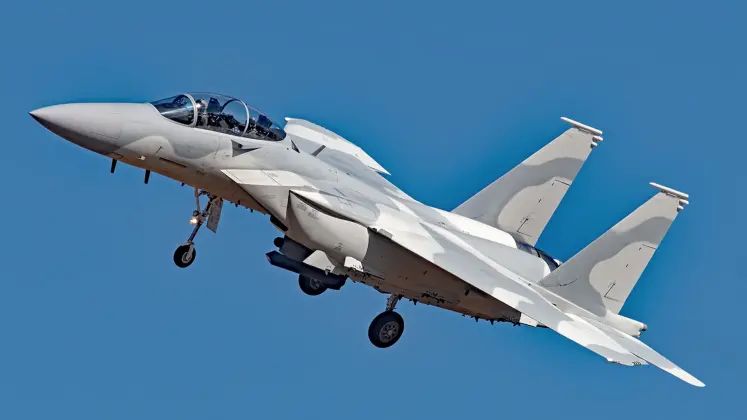
Qatar Emiri Air Force F-15QA
The Qatar Emiri Air Force has for the first time participated in joint aerial warfare exercises with the Israeli Air Force, dispatching new F-15QA fighters to the Iniochos 2025 drills hosted in Greece. Although they do not maintain diplomatic relations, Qatar and Israel have remained close strategic partners in the Middle East, with the two having played central roles in supporting Islamist insurgents against the Syrian state from 2011-2024 to oust the ruling Ba’ath Party. Qatar has also provided the primary regional basing location for the U.S. Air Force as it has intervened in conflicts in the Middle East in support of Israel, primarily in the Syrian theatre. Qatari media, which has over the past two decades become highly influential in the region, has also played critical roles in turning regional opinion against Western and Israeli adversaries, namely Syria and the Lebanese paramilitary group Hezbollah. The confirmed participation of the two states in joint exercises follows leaks referred to as “Qatargate” which have revealed close ties between the Qatari state and the current Israeli administration of Prime Minister Benjamin Netanyahu, and high level cooperation to improve Qatar’s image abroad. Joint participation in Iniochos 2025 represents a landmark in the strengthening of ties between the two states, and makes Qatar the third country in the Arab world to hold major aerial warfare exercises with the Israeli Air Force following the United Arab Emirates and Bahrain.
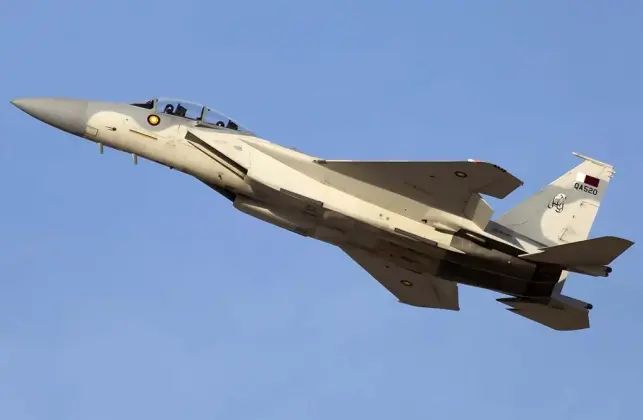
The Qatar Emiri Air Force’s contingent at Iniochos 2025 has been built around the F-15QA fighter, which forms the backbone of the country’s fleet with three squadrons of twelve aircraft in service. Qatari orders for F-15s placed in 2016 provided key financing for research and development efforts to improve the design, allowing the U.S. Air Force and later the Israeli Air Force to then procure an enhanced derivative of the fighter, the F-15EX, at a significantly lower cost. New Israeli F-15s are not expected to begin deliveries before 2027, however, with the F-15QA currently boasting a more powerful primary radar and a longer range and higher weapons carrying capacity than any other fighter fielded by a Middle Eastern state. The only exception is the Royal Saudi Air Force’s F-15SA fighter that has very similar capabilities. The F-15EX ordered by Israel improves on the F-15QA in a number of ways, most notably in its use of the AN/APG-82(V)1 AESA radar to replace the significantly older AN/APG-63(V)3. Despite the country’s very limited ground and naval capabilities, the Qatari fighter fleet remains a significant partner for Western-aligned states in the region including Israel, Turkey and the United States. Qatar’s importance has continued to grow in recent years as relations between Washington and the United Arab Emirates, which was previously a primary basing location, have at times soured.
