
Preventing War on the Korean Peninsula; China and Russia Launch Large Scale Military Exercises Near Korea Coinciding with U.S. Anti-Pyongyang Drills - Part Two
Military Watch Magazine Editorial Staff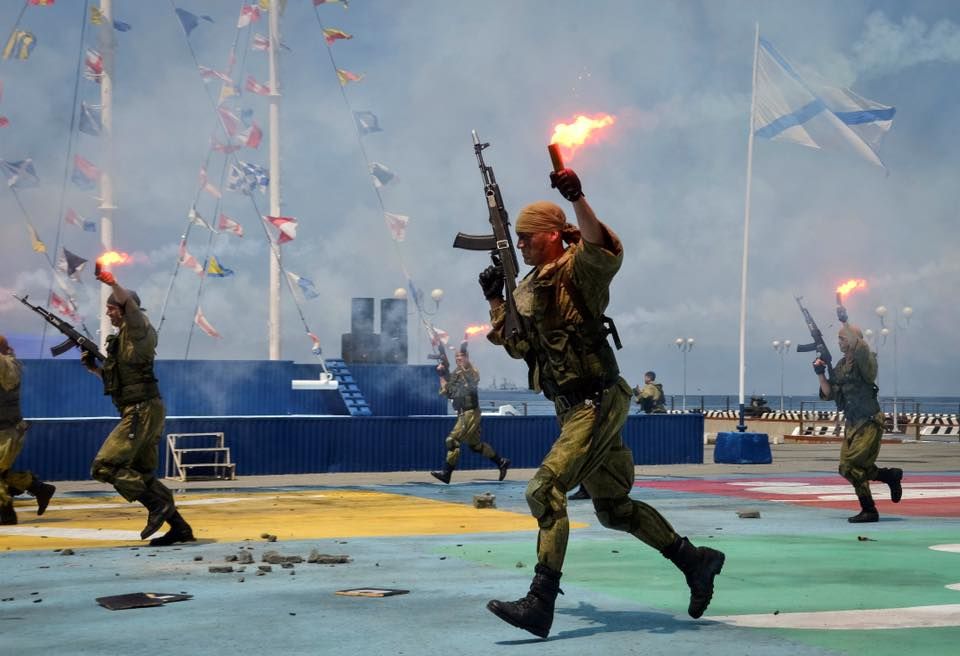
Russian Marines
China and Russia have both responded to U.S. threats against North Korea and the launching of the unscheduled Vigilant Ace military exercises with massive displays of their own military power near the Korean Peninsula. Russia has conducted large scale military exercises for its elite Marines near its North Korean border coinciding with the American Vigilant Ace drills - a clear sign that while it has stated it will not tolerate an attack on Pyongyang, it stands ready to back this with lethal force. China on its part has conducted colossal naval and aerial drills coinciding with Vigilant Ace near the Korean Peninsula. Over 40 Chinese Navy vessels took part in exercises in the East China Sea to demonstrate their growing anti missile and emergency response capabilities. Chinese aircraft meanwhile conducted drills over the Yellow and East China Seas near the Korean Peninsula, flying routes the PLA Air Force has not flown before. Reports have also emerged of Chinese J-20 fifth generation air superiority fighters with advanced stealth capabilities being flown over South Korean airspace undetected, with other combat aircraft having been detected flying near the Korean Peninsula. China has also flown numerous reconnaissance missions to prepare its readiness for any potential conflict on the peninsula. These developments came in the wake of extensive surface to air missile deployments near the Korean borders of both countries, giving them coverage of all of North Korea's airspace and allowing them to intercept U.S. attacks on the country.
While the United States may well be willing to risk war with North Korea to secure its dominance of East Asia and prevent the country from gaining any form of nuclear parity, the demonstrated readiness of China and Russia, both military superpowers, to enter a war to protect their small neighbor's sovereignty could well prove a decisive factor in deterring Washington from risking war should Pyongyang's own considerable military might and weapons of mass destruction. Indeed, the military assets deployed near the Korean Peninsula by both powers would if entering the war change the balance of forces entirely. The Russian Marines, a battle proven force with advanced amphibious landing capabilities, would be lethal if deployed against U.S. forces based in South Korea and an excellent complement to North Korea's own special forces trained for a similar role. This would force the U.S. to devote much of its already overstretched resources to defending its military facilities from Russian counteroffensives.
While North Korea almost entirely lacks a surface Navy, relying on its submarine fleet, air to surface strike capabilites and KN-19 ground based cruise missiles to counter the U.S. Navy, the intervention of a large Chinese Naval contingent would force the U.S. Navy onto the defensive at sea as well as on land. Combined with long range land based anti ship missile systems such as the DF-21D, these Naval assets could potentially be used to impose a blockade of South Korea to prevent U.S. reinforcements from landing - thus potentially bringing a quicker end to the war. The deployment of the J-20 and potential deployment of other Chinese and Russian advanced air superiority platforms such as the J-11 and Su-35, as well as the extensive deployments of air defense systems near the Korean border, further undermine the U.S. advantage in the air. By deploying forces and demonstrating their capabilities near the Peninsula, China and Russia may well between them be the decisive factor that prevents the United States from launching a destructive war on the Korean Peninsula. Ultimately all East Asian nations, Russia, Japan, and South Korea included, have only to lose from a war in East Asia - and deterring the United States from launching any military action where it may seek to gain an advantage is key to maintaining regional stability and strongly in the interests of all regional powers.
