
President Moon's Calls For Wartime Operational Control; Why South Korea Still Doesn't Have Command Over its Own Army
Military Watch Magazine Editorial Staff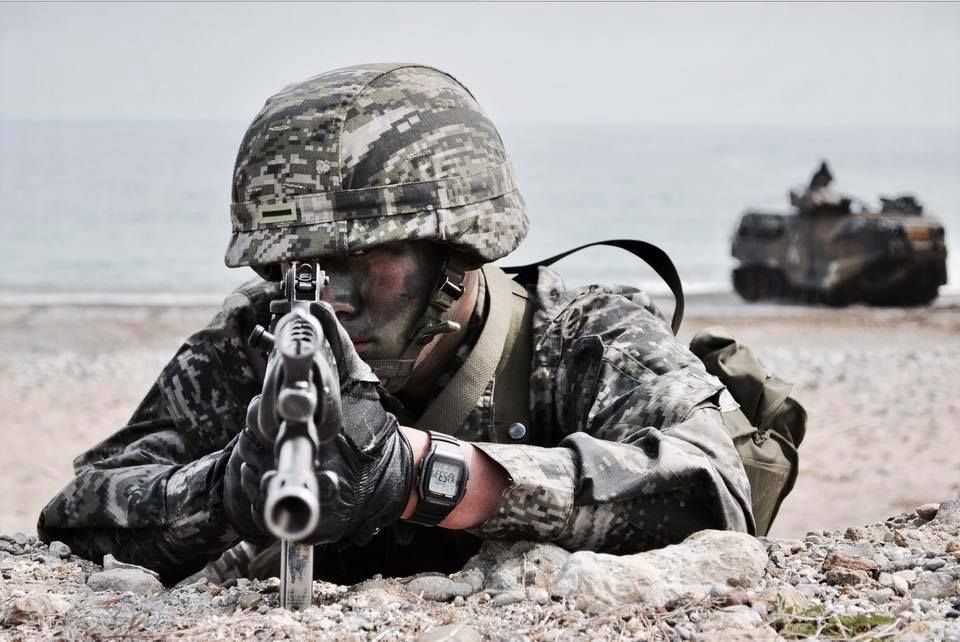
South Korean Soldier
Though the United States' direct military rule over South Korea officially ended in 1948, one crucial legacy of this period remains in effect until today. The South Korean military is, should war ever break out on the peninsula, placed under the authority not of its own military or civilian leadership but instead directly under the U.S. military command. This means that after war breaks out - should the U.S. commanders see fit - they could command South Korean troops to cross the border and attack Chinese targets, shell civilian targets in Pyongyang, or carry out any other operation in accordance with U.S. military interests - regardless of how they may compromise those of the south. As a result of this, South Korea's new President Moon Jae In stated his intention to retrieve wartime operational control from the United States as is fitting with his country's status as a sovereign and independent nation. Moon called for this transfer of control in a speech at an Armed Forces Day ceremony on September 28 2017 stating: "retrieving wartime operational control will boost military development and place South Korea at the centre of East Asian security, based on independent defence capabilities."
Moon's proposal sparked fierce debate among the Korean leadership. Those supportive of U.S. control of their military believed that putting the Korean army under Korean control would weaken their alliance with the United States. Baek SeungJoo, an assemblyman for Liberal Democratic Party put forth this view, stating that it was "questionable whether the President's public remarks on the early retrieval of wartime operational control during the Armed Forces Day ceremony was appropriate for the U.S.-ROK alliance to operate properly." Minjoo Party of Korea assemblyman Woo Sang-Ho similarly put argued that "the destabilising factor here is the perception that the retrieval of wartime operational control may weaken the U.S.-ROK alliance." Several assemblymen claimed that it was "premature" to transfer operational control to Korea - despite control already having been in the hands of the US for 69 years.
Ultimately it remains a significant asset to the United States to retain control of the South Korean military in times of war. With a highly trained conscript army numbering in the millions, and technologically advanced air, ground and naval forces operating some of the world's most sophisticated tanks and warships, the value of operational control over the South Korean military to the United States cannot be overstated. Peacetime operational control had also been in the hands of the US until 1994, before which the Korean government had needed US permission to even deploy its forces put down domestic uprisings. Should South Korea regain operational control however, it could well pave the way towards an entirely new security relationship, one in which the U.S. would play a less dominant role. Indeed there are several signs that the country, in light of both growing trade relations and mutual interests with China and, critically, the threat that the United States could unilaterally start a war on the peninsula which would devastate the country, is looking to reduce its exclusive reliance on the U.S. as a military partner. Gaining operational command over its own military would be a critical first step towards doing this.
