
Preparations for a Carrier Based Drone Fleet? U.S. Navy Successfully Tests Remote Piloting System For F-18E Super Hornet
Military Watch Magazine Editorial Staff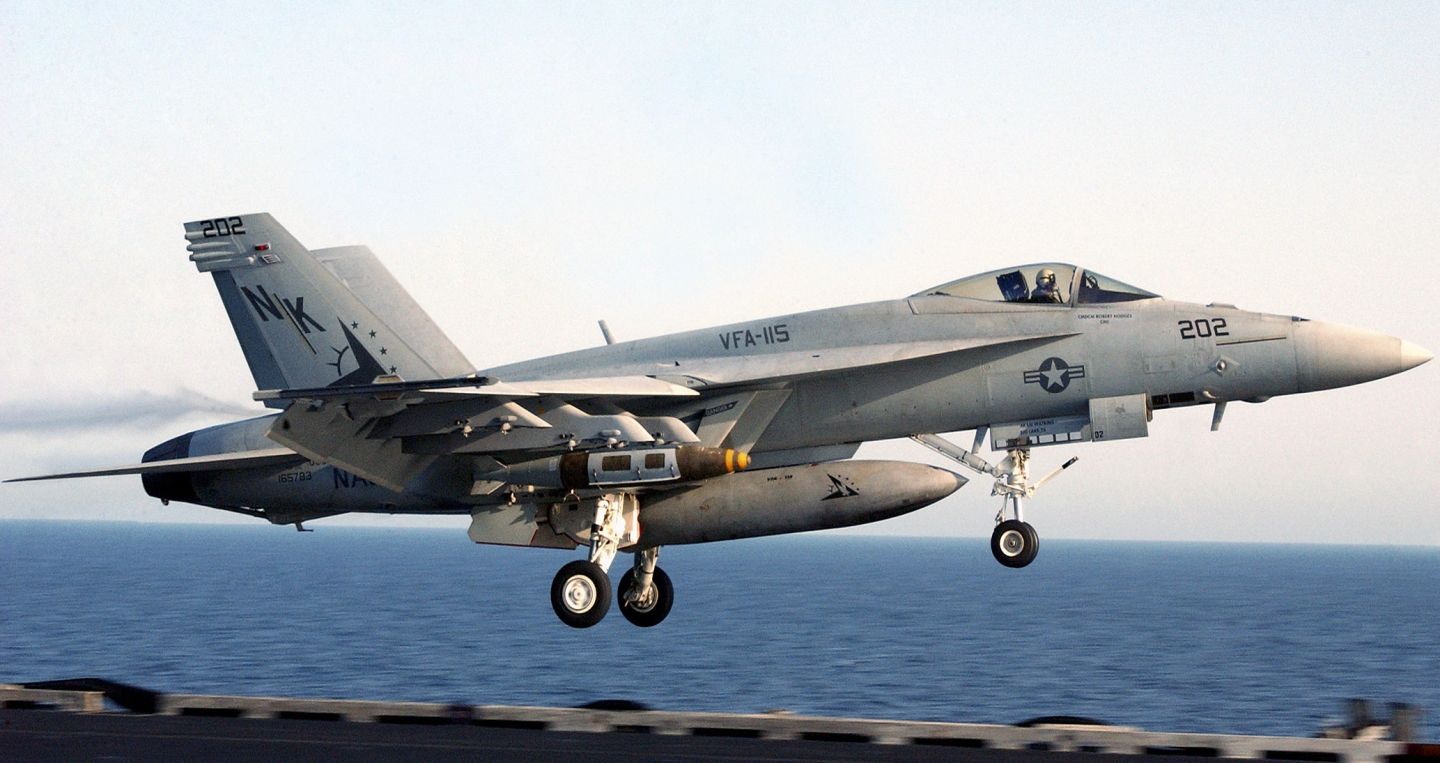
U.S. Navy F-18E Super Hornet
Wikimedia Commons
The U.S. has successfully tested its ATARI remote piloting system which allows deck officers to operate fighter jets from the ground and even perform carrier landings. Sailors on the USS Abraham Lincoln Nimitz Class supercarrier had successfully used ATARI to land an F-18E Super Hornet on the warship's deck, conducting a touch and go landing, a training routine for naval aviators learning to fly carrier based fighters, which entails touching down on the carrier's deck and ascending back into flight without stopping. When making use of the ATARI system, a landing signal officer (LSO) can take control of the fighter up to five miles away from the warship and direct it to the carrier's deck.
Creator of ATARI and senior engineer at Naval Air Systems Command Buddy Denham stated regarding the performance of the system during testing: "you're effectively using little joystick controllers to guide a 40,000-pound airplane, and it's almost like playing a video game." Lt. John Marino, the first naval aviator to test ATARI for a touch and go landing, stated regarding the system' capabilities: "I was really impressed with LSO's ability to get me to touch down. The conditions were really (poor), and it was really impressive the system worked the way it did. On a calm date, it would have been a little bit boring, but this was definitely more challenging."
Modifying combat aircraft for remote piloting is hardly a new phenomenon, with both China and North Korea having modified older fighters such as the MiG-15 and J-5 to operate as entirely unmanned ground attack platforms - a valuable asset which avoids risking pilots' lives. Using such systems to land carrier based fighters as ATARI does however appears a new innovation - though its potential usefulness for fighters such as the F-18 as of yet remains unknown. It is likely that testing using the Super Hornet was meant to demonstrate the system's capabilities to be applied to future unmanned fighters and other aircraft. As Naval Air Systems Command (NAVAIR) air vehicle engineer Dan Shafer said following the ATARI system's successful test: "We don't have unmanned carrier-based vehicles in the fleet today, but they are coming soon... This is a potential alternative landing method and our system performed well." The U.S. Navy is set to induct an MQ-25A Stingray remotely piloted carrier based aircraft in future, on which technologies developed for ATARI could have useful applications. The Stingray is designed as a tanker to refuel fighters in midair and thus provide the U.S. Navy with a much needed extension of its strike range - particularly valuable when operating over the vast distances of the Pacific theatre. The Stingray is a stealth platform with far greater survivability than current U.S. tankers.
