
Pakistan Seeks Closer Energy and Defence Ties with Russia - Foreign Minister
Military Watch Magazine Editorial Staff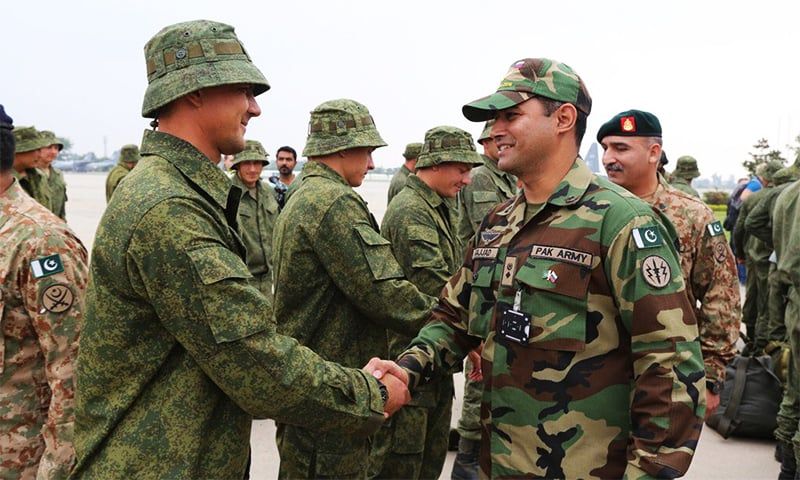
Pakistani and Russian Military Personnel During Joint Exercises
Amid a sharp decline in their longstanding Cold War era partnership, Pakistan's souring relations with the Western bloc have led it to seek alternative partnerships. Russia has emerged as a reliable partner in a number of fields for those parties at odds with the West, and the country has in the past two months seen Sudan and Myanmar, both states with longstanding tensions with the Western bloc, take significant steps to strengthen military and economic relations. Pakistan too appears to be seeking both Russian investment in its energy sector and cooperation in counterterrorism. Pakistani Foreign Minister Khawaja Muhammad Asif stated in regards to this: “Our military cooperation with Russia has definitely improved in the last 4 years. As a former defense minister, I have the first knowledge of that. But there is still a lot of room for improvement, what we have is not enough and can be multiplied in many times. We look forward to increasing our cooperation in the military area, especially for counter-terrorism purposes, and we also look forward to the Russian investment in energy sector also, in oil and gas and electricity."
The defence minister noted that the two countries held several common interests including fighting terrorism, drugs and human trafficking and maintaining stability in Afghanistan - a country bordering both Pakistan and Russia's sphere of influence in Central Asia. During the Cold War Pakistan supported the Islamic Mujahideen in Afghanistan, predecessors of the Taliban and Al Qaeda, alongside the Western bloc to undermine stability in the Soviet sphere of influence. Though Pakistan was a close partner of both the Western bloc and China, deteriorating relations with the West and China's rapprochement with Russia following the end of the Cold War paved the way for significantly improved Pakistani-Russian relations. The two countries today hold joint military drills on a regular basis, and Russia has begun limited arms sales to Pakistan. Diplomatic and military ties have long been improving, with Pakistan taking part in Russia's Army War Games, purchasing Mi-35 helicopters and currently holding talks for the purchase of Su-35 air superiority fighters. Russia has also provided key components for Pakistan's indigenous JF-17 Thunder light fighter including RD-93 engines. Pakistan in turn appears to have diverged from the Western bloc and its previous support for Islamic insurgent groups, and has supported the Russian aligned government of Syria in the face of a Western backed Islamic insurgency bearing many similarities to that in Afghanistan targeting the Soviet aligned government there in the 1980s.
Defence Minister Asif noted that Pakistan's declining relations with the United States in particular under the Trump administration which cut the country's longstanding military aid to the South Asian state. He stated: “The point is that we can survive without their so-called financial assistance. That is not a problem. It definitely affects our relationship. It increases the trust deficit between the two states. Reliability of the United States in our eyes is definitely going down." He refuted U.S. President Donald Trump's claims that Pakistan was providing "safe haven to the terrorists." The United States has also particularly drawn the ire of the Pakistani military by violating its airspace to conduct air strikes within the country without its permission. Ultimately Russia will need to balance its relations with its strategically critical new partner with its longstanding partnership with India. Delhi could otherwise respond negatively to the formation of such ties and in turn be driven further into the Western bloc’s sphere of influence - an outcome Moscow will take measures to prevent by ensuring that its ties to Pakistan take place in the context of enhancing regional stability and combatting common threats to peace in South and Central Asia rather than undermining Indian interests or eroding its military advantage over its neighbour.
