
Pakistan's New JF-17 Fighters to be Equipped with Next Generation AESA Radar
Military Watch Magazine Editorial Staff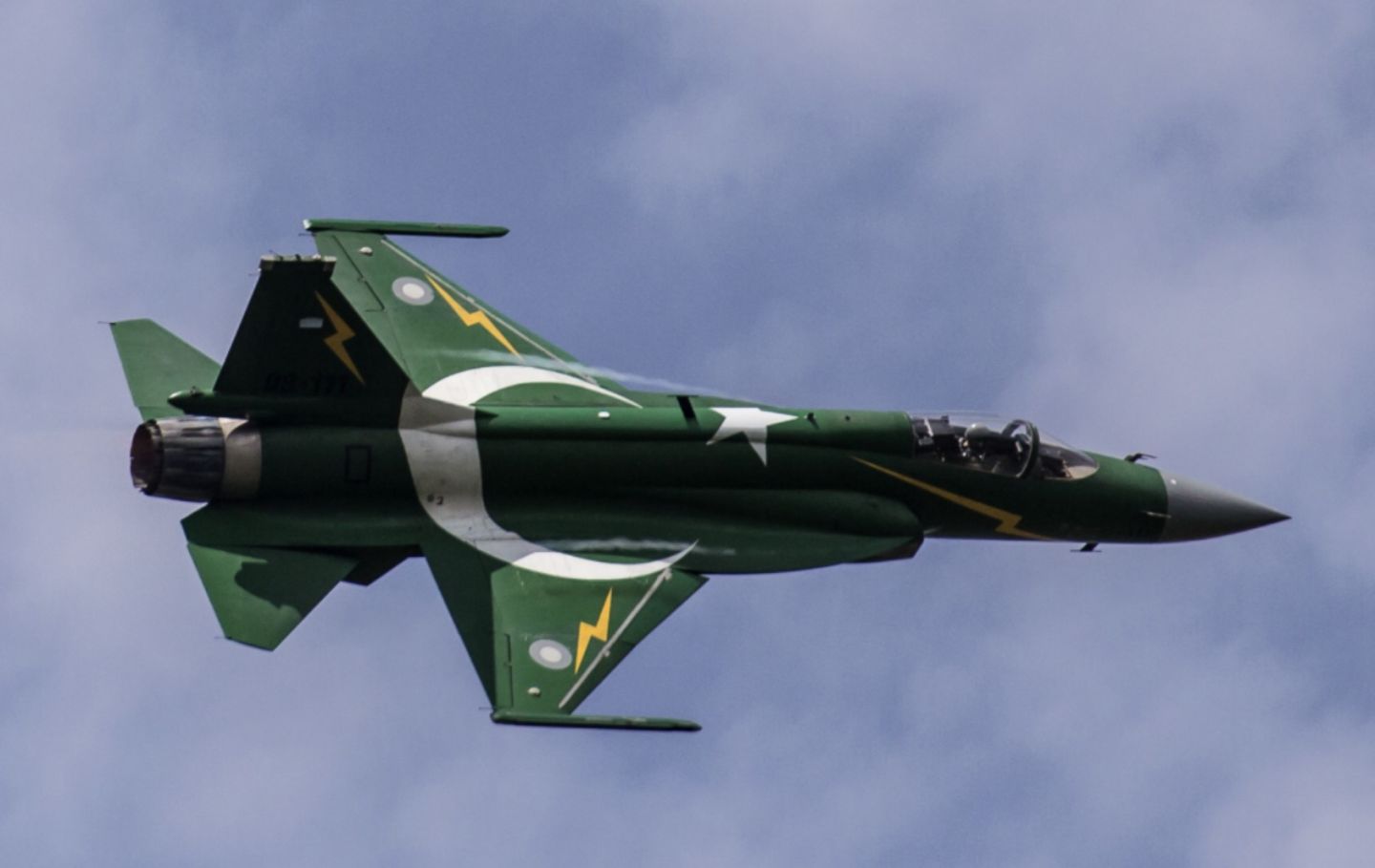
Pakistani JF-17 Fighter
Shortly after Pakistan's military announced that the design for the JF-17 Block 3 fighter was complete, it emerged that new fighters would receive a significant upgrade to their beyond visual range combat capabilities with the installation of a new radar system. The jointly manufactured fighters, set to enter service in their hundreds with the Pakistani Air Force, are to deploy China's advanced KLJ-7A active electronically scanned array (AESA) radar. The radar was developed by the Nanjing Research Institutie of Electronics Technology (NRIET), and a mockup was displayed at the 2016 Zhuhai air show by China Electronics Technology Group. The KLJ-7 is a highly sophisticated X band fire control radar with capabilities surpassing those of radars deployed by numerous other fourth generation platforms such as the F-16C and Mirage 2000.
A significant shortcoming of early JF-17 fighters was their lack of sophisticated beyond visual range combat capabilities, a weakness the Block 3 variant will do much to address. While the fighter can deploy some of the world's most advanced air to air missiles such as the Chinese PL-12, only with a capable radar can the fighter make full use of its long range strike capabilities. Hu Mingchun, head of NRIET, states regarding the KLJ-7A's ability to enhance the JF-17's beyond visual range combat capabilities: "Our product will tremendously extend the fighter jet's detection range, giving it a much longer sight that will help it detect the enemy's aircraft before they do, and this is very important because in real combat if you see first, you fire first... The radar is capable of tracking dozens of targets and engaging several of them simultaneously. It also has a good jamming-resistant capacity that keeps the plane away from enemy's electronic interference."
As an X band radar the KLJ-7A will use shorter wavelengths to provide the JF-17 with higher resolution imagery for superior target identification and discrimination. As a purpose built fire control radar, it is purpose built to provide targeting information to direct weapons towards their targets. As an AESA radar the KLJ-7A can compete with some of the most advanced radar systems deployed by rival light fighters such as the J-10, MiG-35 and F-18E - outperforming those of platforms such as the F-16C and MiG-29. The KLJ-7A can radiate multiple beams of radio waves at multiple frequencies simultaneously and spread its signal emissions across a wider range of frequencies, making the JF-17 more difficult to detect over background noise. AESA was developed for fifth generation stealth aircraft, and this provides the JF-17 with a key advantage over rival platforms in beyond visual range combat.
The deployment of an advanced AESA radar is set to increase the cost of the JF-17 Block 3 variant over its predecessors, but could also significant increase demand for the fighter internationally. The KLJ-7A is set to make the new JF-17 the lowest costing aircraft ever developed with next generation radar capabilities, and with the radar's fire control systems reportedly able to operate non Chinese missiles such as the AIM-120 it could well be widely exported to a number of clients. States such as Argentina, Morocco, Egypt and Saudi Arabia which have shown interest in the JF-17 but are accustomed to operating Western munitions incompatible with the Block I and Block II variants could well be more receptive to the Block III as a result.
