
North Korean Air Force Conducts Drills as the United States Deploys its Third Aircraft Carrier to the Peninsula
Military Watch Magazine Editorial Staff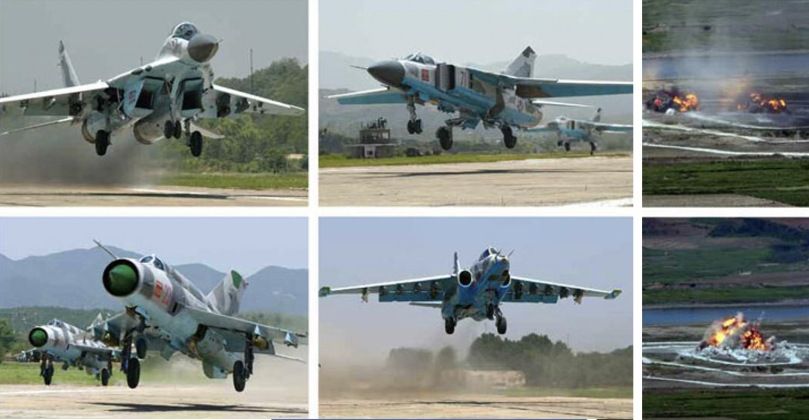
MiG-29, MiG-23, Su-25 and MiG-21 During Exercises
North Korea's air force, officially the Korean People's Army Air Force (KPAAF), has initiated exercises to demonstrate its combat capabilities amid simmering tensions with the United States and neighbouring South Korea. Fighters from across three generations were seen participating including second generation MiG-19s, third generation MiG-23ML and MiG-21BiS jets and fourth generation MiG-29s, as well as Su-25 close air support aircraft. The exercises notably focused on using unguided weapons in ground attack roles, which is the primary mission of most Korean fighter classes due to their age such as the MiG-19s and older MiG-17s, which are still prized today for their low operational costs and the significant firepower deployed by their cannons. The Korean fleet was acquired primarily from the Soviet Union, although a lack of access to more modern classes since the 1990s has led to a decline in the burden for defence that the air force could shoulder relative to other services which are less reliant on imported equipment. While North Korea produced its most modern fighter the MiG-29 domestically under license from the 1990s, these were reliant on inputs from Russia the status of which remains uncertain. The country has recently compensated for its lack of more modern fighter classes by producing large numbers of mobile long range air defence systems to protect its airspace asymmetrically.
With over 700 combat aircraft in service, many of them operating from hardened emplacements including airfields reportedly dug into mountains, engaging the North Korean Air Force over the country's territory would prove a difficult task for even for more capable of adversaries. The fleet has seen combat operations over Korean skies, including during the 1960s when multiple American F-4s and other fighters were shot down, as well as over Vietnam, Egypt and Syria to support Cold War allies, at a time when it was technologically in a more favourable position compared to its adversaries due to its greater access to the latest Soviet warplane classes. While the future of North Korea's fighter fleet remains uncertain, and its status has diminished since the 1980s, it cannot be discounted entirely as tensions continue to rise in the region, and in defensive roles could potentially provide a valuable complement to other more modern assets such as the country's surface to air missile batteries and ballistic missiles.
