
North Korea's Satellite Program in 2018; A Potential Force Multiplier Coordinating Ballistic Missile and Special Forces Operations
Military Watch Magazine Editorial Staff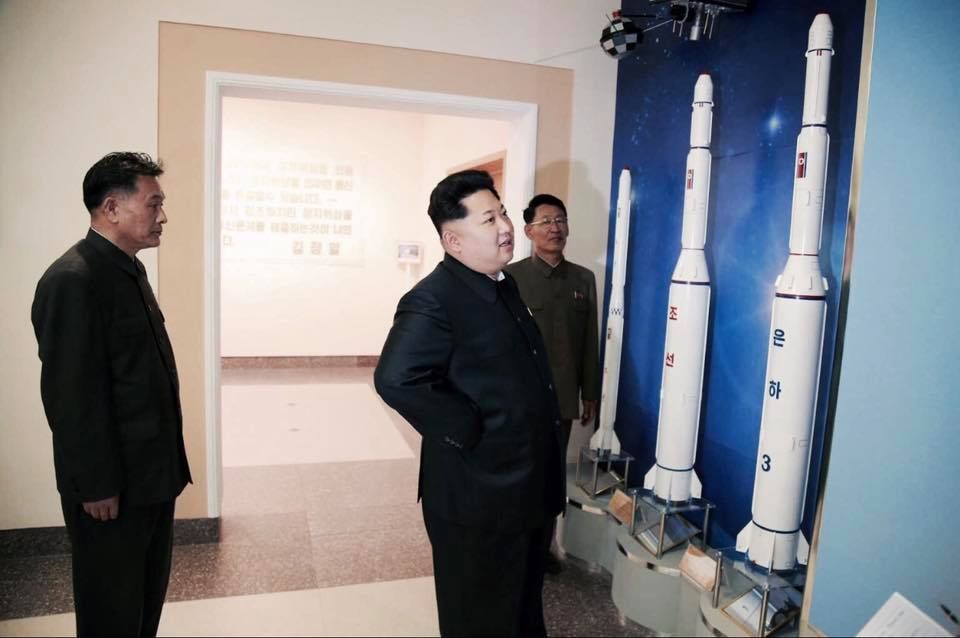
North Korean Leader Kim Jong Un Inspects Satellite Launcher Designs
KCNA
Following substantial advances made in its ballistic missile program in 2017 with the successful testing of the all new Hwasong-12, Hwasong-14 and Hwasong-15 platforms, North Korea has declared its intention to devote further resources to its space program in 2018. While the country's previous satellites were launched for weather observation purposes, future platforms could have surveillance and military uses. The planned Kwangmyongsong-5 Earth observation satellite, set to be equipped with high-resolution scanning capabilities, is speculated to be launched alongside at least one communications satellite. The platforms, set on fixed geostationary orbits over the Asia-Pacific, could serve as a highly effective force multiplier for Korea's submarine and missile platforms allowing them to target U.S. military facilities from Busan and Okinawa to Guam and Hawaii with far greater accuracy - thus potentially reducing the number of missiles needed to neutralise various targets. Investment in satellites could as a result prove highly cost effective, reducing the number of ballistic missiles the country requires.
As well as providing invaluable targeting information for missiles, satellites could prove an invaluable means of coordinating attacks particularly for units such as special forces operating away from the mainland for which support from satellite surveillance and communications capabilities would prove invaluable. With special forces from the United States, Russia and other modern military powers able to coordinate with satellite networks, such capabilities if provided to North Korea's already lethal 180,000 man body would provide it with one of the few essential assets it currently lacks. With U.S. special operations groups recently being equipped with invaluable 'mini satellites', small low cost platforms (under $30,000) tasked with "tagging, tracking, and locating" enemy forces and targets, similar such light and simple satellites could well be operational in support of North Korean special forces in the near future. North Korea's special operations forces make extensive use of light aircraft and submarines for infiltration, and could prove lethal against U.S. military targets across in South Korea, Japan and potentially even further afield. Should the satellite program be diverted towards providing these forces with invaluable additional support from the air, this already formidable threat to U.S. forces in the Pacific will grow substantially.
