
North Korea Plans to Further Advance its Space Program; Why Future Satellite Launches May Well Indicate the Program's Peaceful Nature
Military Watch Magazine Editorial Staff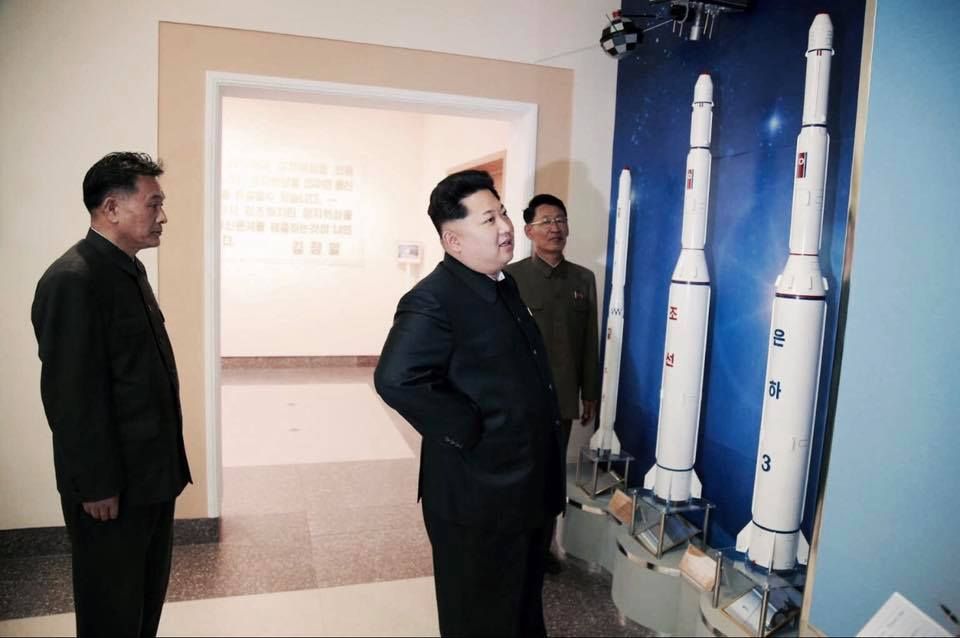
North Korean Leader Kim Jong Un Inspects Satellite Launcher Designs
KCNA
According to North Korean's state newspaper Rodong Sinmun the country intends under its upcoming five year plan to carry out more satellite launches. This would include the launch of geostationary satellites, which can orbit the Earth over a fixed position by revolving at a speed synchronized to that of the planet's rotation. Such satellites usually orbit at a high of approximately 38,000 kilometers, and are useful for collecting data on a particular area such as weather data for the Korean Peninsula or surveillance data over a specific hostile country. North Korea has already successfully launched two satellites into space for weather monitoring purposes, as the country has been prone to natural disaster with often catastrophic effects since the 1990s. The most recent was the Kwangmyongsong-4 Earth observation satellite launched in February 2016.
North Korea's state news agency Rodong Sinmun reported that the country's satellite program "can contribute to improving the economy and people's lives" and that it was part of "a global trend to seek economic development through space programs." Previous launches used launch vehicles almost indistinguishable from the Taepodong-2 intercontinental ballistic missiles, and incorporated many of the same technologies. The Taepodong series were early liquid fueled ICBM models which, in light of the more advanced systems recently developed such as the Hwasong-14, are increasingly obsolete. Western analysts and U.S. state representatives have repeatedly accused North Korea of using its satellite launches as covers for which to develop its intercontinental ballistic missile capabilities. Indeed, considering the similarity between the relatively primitive Taepodong missiles and the satellite launch vehicles, this was a highly plausible theory at the time.
Unlike the Taepodong missiles, the latest Korean ICBMs are far more advanced and use sophisticated technologies which would have little value for a satellite program. While primitive ICBM programs may well benefit from technologies shared with missile programs, the North Korean Taepodong series and the Soviet Union's R-7 in the 1950s being key examples, once missile programs develop as that of North Korea now has - satellite launches lose their role as technology testers and demonstrators for ICBM capabilities. If North Korea's future satellite launches employ such technology, then it will be clear that these allegedly peaceful launches are being used to test missile technologies. If however they continue to use basic technologies mastered long ago by the country's missile program to launch satellites - those found on the Taepodong 2 rather than the Hwasong-14 for example - then the claim to a peaceful satellite program unrelated to the ICBM program will be given further credibility. Indeed, considering that North Korea's ICBM program has reached a state where its primary challenge is the design of the reentry vehicles - technologies never employed on satellite launchers, and also considering that the country does not shy away from admitting its testing of missiles, it is highly unlikely that satellite launches are used as a cover for missile testing or will be in future.
