
New Upgrades for Russian Tu-160 Bombers Include Stealth Coatings and a 1000km Range Increase
Military Watch Magazine Editorial Staff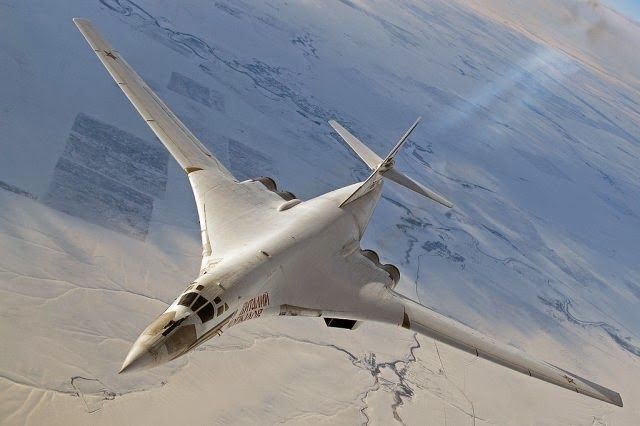
Tu-160 Strategic Bomber
Russia's armed forces are currently upgrading and expanding their fleet of Tupolev Tu-160 'White Swan' heavy bombers. As long range strategic platforms, the Tu-160 form a key part of Russia's nuclear triad alongside the older Tu-95 'Bear' heavy bombers. Russia is one of just four countries in the world today which fields heavy bombers, alongside the United States, China and North Korea, and its White Swan is arguably the most capable bomber in service anywhere in the world. Other than the U.S. B-1B Lancer, the Tu-160 is the only supersonic bomber in the world, the fastest of its kind capable of reaching speeds of over Mach 2. Despite its size weight, this allows the bomber to outrun many modern fighter aircraft including the widely used French Rafale and U.S. F-16, F-35 and F-18E.
Amid a massive modernisation program for the Tu-160, the bomber is to be fitted with new NK-32 engines which increase its range to 13,300 km - an increase of 1,000 km. This is particularly considerable when taking into account the range of the advanced variants of the Kh-55 cruise missile the bomber operates, which are capable of launching precision strikes on targets 3000km away. This gives the Tu-160 an effective strike range of over 16,000km, a near global reach when launched from Russia's widespread airbases. Alongside the Kh-55, the bomber is also capable of deploying shorter ranged AS-16 missiles with nuclear warheads. The Tu-160's reliance on long range cruise missiles is a critical measure to increase the platform's survivability, allowing it to strike targets well beyond the range of air defences or fighter aircraft. Modernised variants of the Tu-160 are expected to receive new weapons systems with even greater ranges.
Russia's deputy Defence Minister Yuri Borisov, on a visit to Samara city's Kuznetsov Plant on March 21st, confirmed that engineers had succeeded in improving the efficiency of the Tu-160's engines by 10%, which facilitated the aircraft's range increase. The Kuznetsov plant is a leading manufacturer of advanced aircraft and rocket engines for Russia's military, and has also worked on engines for Russia's Tu-95 and the Tu-22 bombers. Minister Borisov stated regarding the upgrade program: "The plant is now finishing its work, and providing us with four experimental engines, which must confirm these technical characteristics. This year, Tupolev will conclude a long-term contract on the series delivery of the engines for aircraft which are to be delivered to (the military) beginning in 2021." Minister Borisov further noted regarding the extent of the upgrades applied and how they would revolutionise the bomber's performance: "We cannot compare the Tu-160 with the Kh-55, X-555 and even X-101 missiles with an airplane which we hope to receive in the series by the 2030s with new airborne weapons of completely different ranges." The new upgraded variant of the Tu-160 is set to be designated Tu-160M2, which Borisov noted had a combat effectiveness 60% higher than its predecessor.
Another key upgrade set to be applied to existing bombers, as well as installed on platforms produced in future, will be stealth coatings to enhance the platform's survivability at long range. The bomber's fuselage and profile already have a minimal radar cross section, though still far greater than that of dedicated stealth platforms such as the American B-2 Spirit, and stealth coatings are set to further enhance these radar evading capabilities. Minister Borisov noted regarding the upgrades: "The bomber will have only the fuselage from the former (variant). All on board radio electronic equipment and engines will change. The new Tu-160 will become more invisible to radars than its predecessor, due to special coatings." Alongside new engines modernised variants of the Tu-160, known as the Tu-160M2 will feature enhanced weapons, new avionics and superior communications and control systems. The extend of the upgrades have lead some analysts to claim the M2 variant is in fact an all new bomber in all but name, far surpassing the capabilities of its already formidable predecessor.
Alongside modernisation of existing bombers to M2 specifications, Russia's armed forces have placed large orders for new platforms which will leave the production lines with Tu-160M2 specifications - thereby avoiding the need for upgrades. The Russian Air Force currently has ten Tu-160M2 bombers on order. Further orders are expected in future. The scale of the orders has led the Kuznetsov Plant to expand its production capabilities. Minister Borisov stated regarding the expansion upon his visit to the Kuznetsov Plant: "the current production production capacity to meet all our needs is not enough. Therefore the Ministry of industry and Trade and the United Engine Building Company developed a plan to increase the capacity of the plant by about three and a half times." The possibility of producing a civilian airliner based on the chassis of the Tu-160 has also been raised.
