
New Iranian Carrier Killer? Al Mobeen Solid Fuelled Ship Hunting Ballistic Missile Slated for Deployment to the Persian Gulf
Military Watch Magazine Editorial Staff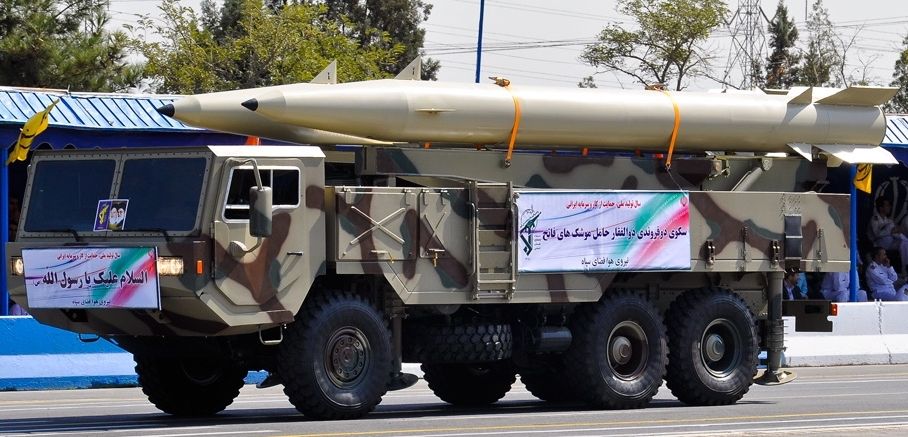
Iranian Fateh-110 Ballistic Missiles
The Iranian armed forces have unveiled a new heavily modified variant of the Fatah-313 solid fuelled ballistic missile specialised for a ship hunting role. With the original Fateh-313 unveiled in August 2015, itself a more sophisticated derivative of the Fateh-110 with a vastly increased range of 500km, the development of a ship hunting variant represents the growing threat Tehran perceives from a potential attack by sea - in light of both growing tensions with the United States and American war plans’ heavy emphasis on the deployment of carrier strike groups near Iranian waters for an offensive role. The missile is a very basic single stage design, thought to have been developed with North Korean assistance as part of the East Asian state’s decades long technological support for the Iranian ballistic missile program and based on the successes of a number of similar Korean designs including KN-02 Toksa. With North Korea having unveiled an unnamed new solid fuelled ballistic missile of its own in February 2018, a more sophisticated platform with possible ship hunting applications, the country’s technological assistance remains an invaluable asset to Iran’s weapons programs.
Dubbed the Al Mobeen, meaning the Divide Conquest in Farsi, Iran’s new ship hunting missile was unveiled on August 12th by Defense Minister Brigadier General Amir Hatami. The missile reportedly inherits the high levels of precision of the Fateh-313, and makes use of advanced radar evading capabilities to improve its survivability against enemy air defences. The missile is set to pose a considerable threat to U.S. warships at long ranges from the Iranian coast - particularly in light of the recent combat record of U.S. made air defence platforms against far more basic ballistic missile designs. The new missile was referred to by Iran's Defence Minister as a ‘Defensive Deterrent,’ and represents part of Iran’s efforts to gain a lethal strike capabilities capable of deterring hostile military action without necessitating the deployment of weapons of mass destruction. Investment in such highly asymmetric weapons systems has allowed Iran’s armed forces to retain parity with a number of potential adversaries which spend several times as much on their armed forces, Israel, Saudi Arabia and the United Arab Emirates among them, and to pose a serious challenge for even the United States military and those of its Western allies in the event of war. It is as a result of the way this weapons program has undermined the formerly strongly Western favouring balance of power that Iran has come under immense pressure from Europe and the United States to curtail its development of ballistic missiles.
The Al Mobeen’s mobility and compact size are invaluable attributes which allow it to be redeployed quickly to evade enemy air attacks. The use of solid fuel allows the missile to be stored fully fuelled and reduces the weapon’s launch time considerably, thus further enhancing the survivability of the missile and its launch vehicles. With analysts long predicting that Iran could attempt to modify its ballistic missile designs for an anti ship role, Iran’s development of the Al Mobeen has become part of a growing trend towards countries relying on ballistic missiles for ship hunting. China’s long range DF-21D ‘carrier killer’ ballistic missile, based on the basic DF-21 nuclear delivery vehicle, has been the most prolific example of this - with Russia’s air launched Kh-47M2 Kinzhal being another prolific example. While the relatively basic Iranian missile cannot compare to these cutting edge assets deployed by its allies, lacking their immense speeds and ranges or the ability to disable large warships with a single strike, the Al Mobeen nevertheless remains one of several critical assets that Iran is set to rely on to wage an was asymmetrically against the United States Navy should hostilities break out. Examples of other assets including stealth drones, air launched cruise missiles, advanced North Korean and Russian designed attack submarines and a vast fleet of several hundred attack speedboats. The development of the new ship hunting missile represents the Fateh-110’s and its derivatives’ emergence as an effective staple of Iranian short range strike capabilities - platforms being mass produced in large numbers and reportedly also being manufactured in Syria - a valuable staging ground given the country’s proximity both to Iran’s key ally the Hezbollah militia and to its major Western aligned adversary Israel. Whether Iran will in future seek to developed longer ranged ship hunting ballistic missiles, possibly based on the Korean Rodong-1 design which it has also mass produced indigenously in considerable numbers, and whether such missiles would fit into the country’s defence doctrine, remain to be seen.
