
NATO Report Seriously Questions Alliance's Ability to Contest Air Superiority; How Developments Abroad Undermine Western Power Projection
Military Watch Magazine Editorial Staff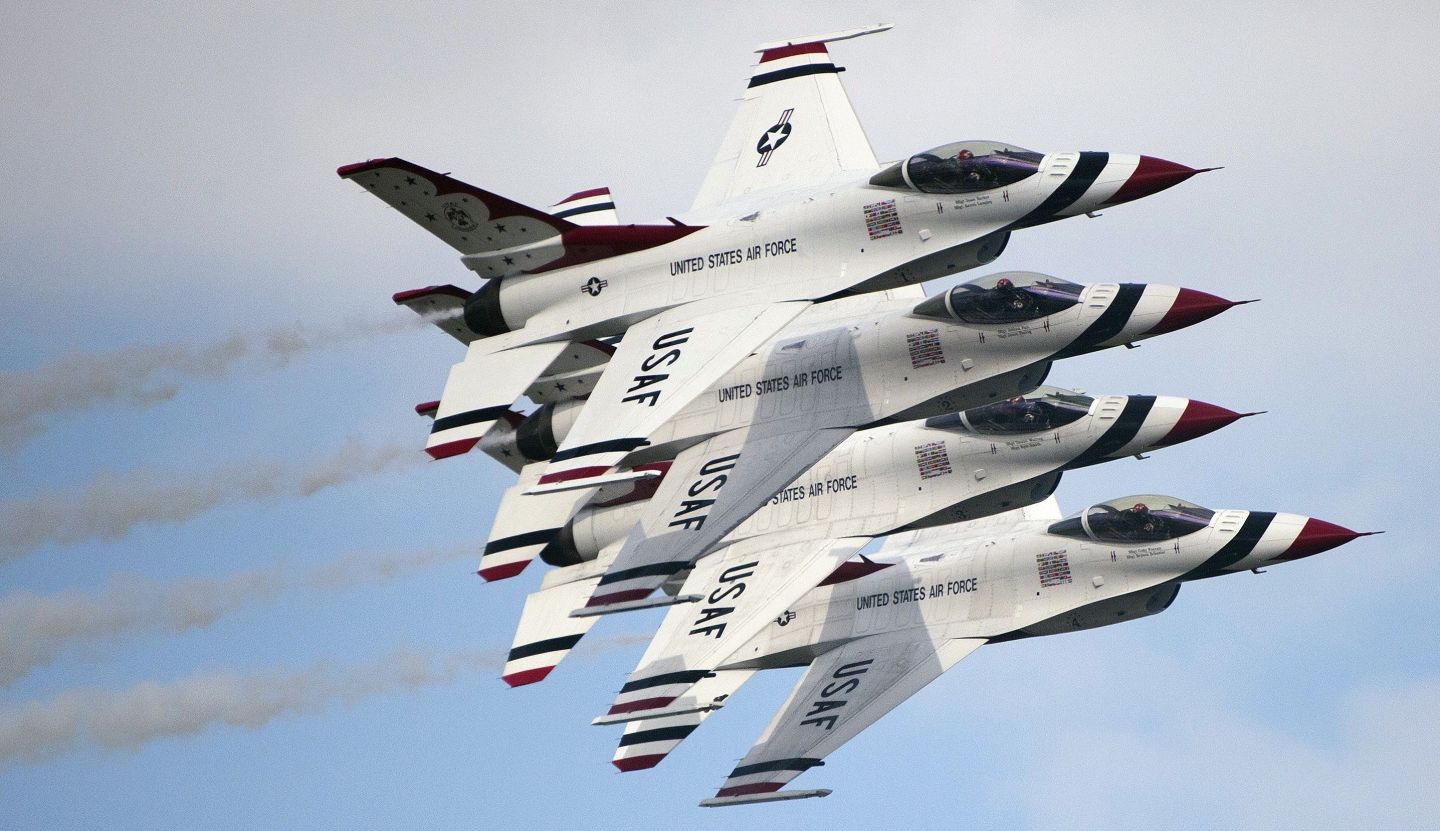
U.S. Air Force F-16 Fighting Falcons in Formation
According to NATO's new airpower strategy, the alliance of Western powers is uncertain of it its ability to claim air superiority in future wars. While NATO military interventions in Libya, Yugoslavia and Afghanistan among others saw their forces enjoy almost completely uncontested control of the skies, the Western powers’ ability to project power with their aerial assets is increasingly restricted due to the proliferation of advanced air defence systems and combat aircraft to a number of potential adversaries. Indeed, this was most recently demonstrated by the joint military intervention of the alliance’s three leading powers, the United States, France and Britain, which saw their air forces strike Syrian territory from hundreds of kilometres beyond its airspace - a measure taken to avoid coming into the crosshairs of the country’s advanced air defence network. Such measures were a far cry from Western interventions against Iraq, Libya, Somalia and other states which retained negligible air defence capabilities. The effects of this strike were reportedly seriously blunted by Syrian air defences’ successful interception of the incoming missile strikes - highly significant considering that the country primarily relied on upgraded Cold War era systems and lacks state of the art air defences available to a number of other potential Western adversaries.
NATO’s new Joint Airpower Strategy (JAP), the alliance’s first ever aerial warfare blueprint of this kind, has sought to keep Western air power relevant in the 21st century by contending with the many challenges to the alliance's aerial power projection capabilities. During the Cold War NATO forces relied heavily on aerial and naval warfare to offset the Warsaw Pact’s massive advantage in ground forces. The two blocs were in most stages of the war well matched in their aerial warfare capabilities - though the Western Bloc retained a considerable advantage in its naval warfare capabilities and could exert better control of the seas. JAP notes that the proliferation of anti access area denial systems are a key inhibitor to the Western Bloc’s ability to project power, while advancing cyber warfare capabilities also put key command and control links at risk. It states: "The development, proliferation and integration of adversary ballistic and cruise missiles, advanced layered air defense, cyber and electronic warfare systems will change the dynamics of Alliance air operations, which have more recently been conducted in permissive conditions… Forces will need the ability to operate despite the existence and further proliferation of such capabilities, which may result in threat environments ranging from permissive to highly-contested." The document concludes that the days of near unrestricted Western power projection throughout the air and little contested air superiority are over.
JAP’s conclusions were strongly supported by a number of concerns recently raised by military officials of a number of Western powers. In February 2018, speaking before the U.S. House Armed Services Committee, General Joseph Votel stated that the United States military faced growing challenges from the proliferation of Russian anti access area denial (A2AD) which threatened America’s ‘ability to dominate airspace’ abroad. Proliferation of long range air defence platforms, particularly the S-400 system, have been cited as a key concern - capable of denying even the most advanced Western stealth fighters access to a country’s airspace and thus limiting the possibility for offensive action. With the Western Bloc having long relied on near unrestricted access to the airspace of potential adversaries and enjoyed near unchallenged control of the skies, this represents a major blow. Indeed, it is largely as a result of this that extensive measures have been taken to stop the proliferation of Russian made air defence systems, including the passing of the Countering America’s Adversaries Through Sanctions Act (CAATSA) under which nations such as Iraq, Turkey and India which have shown interest in acquiring the S-400 have been threatened with harsh economic penalties by the Untied States.
It is not only the proliferation of Russian platforms which threaten Western aerial power projection however. China and North Korea for their part have also developed cutting edge surface to air missile platforms on par with those fielded by Russia in the early 2000s. The Korean KN-06 and Chinese HQ-9B are both highly formidable in protecting these East Asian nations’ airspace from Western air attacks, and are likely to proliferate abroad in future. These long range systems combine with other complementary platforms to form highly fortified multi layered networks which are extremely difficult for enemy aircraft to penetrate, and which in China's case also extend into the surrounding seas with deployments of cutting edge air defence systems to islets and warships far from its coasts. As for the European theatre, while NATO has absorbed most of the Warsaw Pact and much of former Yugoslavia, even parts of the former Soviet Union, its ability to dominate airspace in the theatre remains limited. Between them NATO member states’ air superiority fleets are still considerably smaller than that of Russia alone, with only the United States fielding high end heavy air superiority fighters such as the F-22 Raptor and F-15C and most European nations instead investing in lighter and less capable platform such as the F-16 or Rafale. The United States is also the only NATO member fielding specialised, heavy and highly survivable strike platforms such as the F-15E and the B-1B and B-52 heavy bombers, which are key to degrading enemy air defences at standoff ranges. With European powers providing minimal support in these fields, the United States military is forced to shoulder the vast majority of the burden.
Russia’s advanced multi layered air defence network, considerably more capable still than those of North Korea or China, can target Western combat aircraft at extreme ranges deep into European airspace and makes waging a successful campaign against Russia an extremely costly if not impossible prospect. While a single Russian S-400 system can simultaneously engage up to 80 targets, and is well within its limits to target the fourth generation fighters relied on to form the vast majority of NATO’s air fleets at extreme ranges, these asymmetric weapons platforms and others like them are capable of causing massive losses to Western NATO fighter fleets operating near Russian territory. Kaliningrad meanwhile gives Russia's air defences coverage much of Scandinavia and even part of Germany, while Iskander ballistic missiles recently deployed to the outlying province give coverage of airfields across this region. The S-400 is also capable of targeting stealth fighters, which currently make up a small elite of NATO forces, at intermediate and short ranges - with the air defence platform having been designed to provide a defence against the U.S. F-22 Raptor fifth generation platform. The upcoming S-500 system is set to be yet more capable still, while the S-400 continues to be produced in ever greater numbers and is seeing fast growing foreign demand. Russia’s advanced multi layered air defence network combined with its air superiority fleet make the projection of Western air power effectively impossible. Whether the United States will be able to remedy this situation with the induction of an upcoming sixth generation air superiority fighter, set to replace the F-22 Raptor, remains to be seen.
