
MiG-29 vs. F-16; Slovakia to Retire Soviet Built Fighters for a $2.9 Billion Deal to Aquire American Falcons
Military Watch Magazine Editorial Staff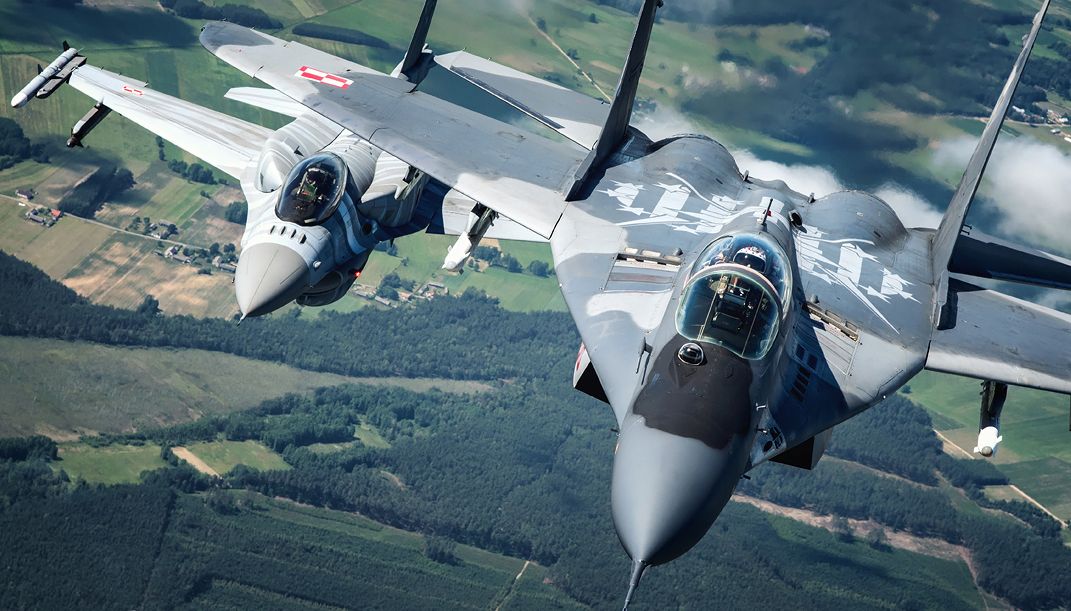
MiG-29 (front) and F-16
HESJA Air Art Photography
Near the end of the Cold War, a number of Warsaw Pact states were provided by the Soviet Union with MiG-29 fourth generation light fighters to modernise their aerial warfare capabilities and better contend with NATO’s newer F-15 and F-16 platforms. While the USSR never exported its elite MiG-31 interceptor and Su-27 heavy air superiority fighter, more capable and heavier fourth generation platforms which it initially reserved for its own defence needs. With the collapse of the Warsaw Pact and NATO’s rapid expansion Westwards, a number of Eastern European NATO members operated former Soviet fighters, the MiG-29 included, which served the alliance alongside the European and U.S. made arms operated by Western European states. While the MiG-29 has a number of capability advantages over its U.S. analogues, the F-16 Falcon and F-18 Hornet light fighters, due to political considerations and NATO’s growing animosity towards Russia a number of operators of Soviet fighters have sought to phase them out in favour of Western made aircraft. Though Russia has proven willing to aid NATO members in modernising their Soviet made hardware, most recently modernising Bulgaria’s own MiG-29 fleet, such cooperation with Moscow is highly frowned upon within the Western alliance.
With the U.S. unwilling to export its advanced F-15 heavy fighters to all but its closest partners, and with European fighters far less cost effective and price competitive than their American made counterparts, the F-16 and F-18 have become the fighters of choice for former Warsaw Pact members. Slovakia is set to become the latest Eastern European state member to phase out its MiG-29 fighters, which it is set to replace with U.S. made F-16 Block 70/72 fighters. Fourteen of the light fighters are set to be acquired for $2.91 billion (two and a half years worth of the country's entire military expenditure), though this hefty sum will also include modern ordinance for the fighters, parts for maintenance and training for fighter crews. The F-16 is increasingly considered a heavily dated platform, having entered service 40 years ago and currently being phased out of the U.S. military and the Air Forces of a number of Western and U.S. aligned states in favour of more advanced alternatives such as the F-35A - the platform’s fifth generation replacement. In a potential conflict in Europe, where elite heavy fighters such as the F-15C and F-22 will be deployed alongside far more capable light fighters such as the Dassault Rafale and F-35, a small unit of F-16 fighters will have a likely negligible impact despite the immense cost of Slovakia’s acquisition.
Comparing the F-16 to the MiG-29, it is clear that the more modern Russian made platform retains considerable advantages over its U.S. analogue - which it was designed specifically to overcome in a potential conflict. The MiG-29 is capable of extreme levels of manoeuvrability, exceeding even that of the F-15. According to its German operators who used the fighter alongside Western made platforms it retains a distinctive advantage in visual range combat over all Western fighters currently in service (though it was never tested in a dogfight against the F-22). German Luftwaffe Oberstleutenant Johann Köck stated regarding the results of visual range combat tests carried out by the German military between early variants of the MiG-29, which the lieutenant himself flew, and advanced variants of the F-16: “Inside ten nautical miles I’m hard to defeat, and with the IRST, helmet sight and ‘Archer’ (NATO designation for the R-73 missile) I can’t be beaten. Even against the latest Block 50 F-16s the MiG-29 is virtually invulnerable in the close-in scenario. On one occasion I remember the F-16s did score some kills eventually, but only after taking 18 ‘Archers.’ They couldn’t believe it at the debrief, they got up and left the room!”
The MiG-29 is capable of higher speeds, can reach far higher altitudes and has a superior climb rate than the F-16. The armaments of modern variants are considerably superior - deploying missiles such as the R-27 with a 130km range which the F-16’s 75km range AIM-120B cannot hope to match. Both the United States and Israel, which have engaged Iraqi and Syrian operated MiG-29 fighters in the past, have notably avoided engaging these fighters with their own F-16s - relying instead on elite F-15 heavy air superiority fighters which combined with a superior calibre of pilots could be relied on to overcome the much lighter Soviet made fighter in a way the F-16 could not.
The F-16 retains a superior range to the MiG-29, and its ability to be upgraded and use weapons produced by an allied Western state rather than Russia, widely seen to be Slovakia’s most likely potential adversary, is a significant bonus. MiG-29 fighters delivered during the 1980s notably lack the modern radars, avionics and other systems which make modern variants of the fighter such as the MiG-29SMT and MiG-29M so lethal in beyond visual range combat, and a modernised F-16 does retain such capabilities over the Soviet era platforms. New variants of the MiG-29 have also been modified to expand their fuel storage capacities and allow them to refuel aerially, addressing the issue of a limited range which earlier models suffered from. While an upgraded and modernised MiG-29 will outmatch the F-16 by a significant margin, as such upgrades for the Slovak fleet are not feasible due to the country’s political concerns and unwillingness to commission upgrades from Russia, the Slovak Air Force has instead chosen the arguably far less cost effective U.S. made F-16.
