
Lightning Over Tel Aviv; What the F-35 Can Do for Israel and Why Its Induction Has Been Controversial - Part Two
Military Watch Magazine Editorial Staff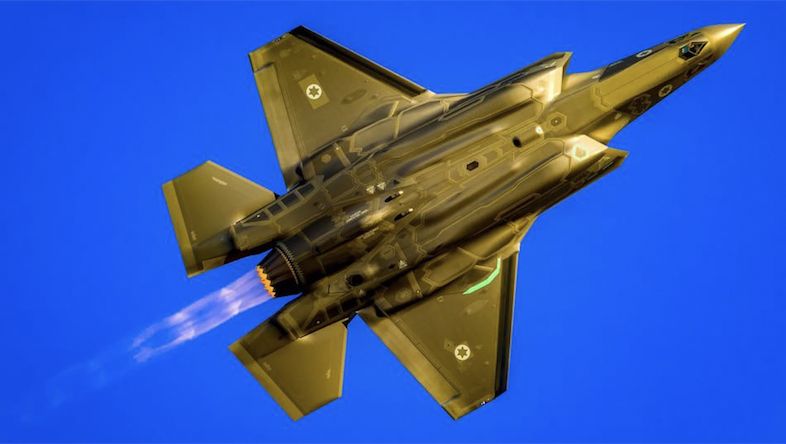
Israeli Air Force F-35I Single Engine Light Fighter
While costly, a number of key figures in Israel’s military leadership have expressed considerable faith in the capabilities of the F-35 as exactly what the country needs to counter emerging security threats. Israeli Defence Minister Ehud Barak stated regarding the fighter’s capabilities and its place in the future of the country’s armed forces: “The F-35 is the fighter plane of the future that will allow Israel to maintain its aerial superiority and its technological advantage in the region... The F-35 will give the IAF better capabilities, both near and far, to help strengthen Israel's national security.” Aside from the fact that the F-35 was never designed for air superiority, as repeatedly emphasised by key figures in the U.S. military leadership, which leaves it poorly placed to handle threats from dedicated air superiority fighters such as the Su-35 and in many ways less capable in air to air combat than even the ageing F-15, a number of key figures in the Israeli leadership have been highly critical of the new fighter. Israeli Finance Minister Yuval Steinitz has scrutinised the decision to acquire the F-35 due to its cost, arguing that a purchase which would have such serious implications on the country’s economy should not be left in the hands of the defence ministry alone. He further drew attention to the considerable additional costs of pilot training, hangar construction and maintenance.
A more outspoken critic, for reasons of performance rather than cost, has been Moshe Arens, formerly three time Israeli Defence Minister, Foreign Minister, ambassador to the United States and aeronautical engineer, who stated regarding the country’s planned acquisition of the F-35: “The F-35 development program has been plagued by frequent delays and mounting cost overruns. The design compromises that have to be made to accommodate its goal of serving as a joint strike fighter that will be acquired by the U.S. Air Force, Navy and the Marines have limited its performance capabilities. In the meantime, anti-stealth technology is being developed and may yet neutralise what is being advertised as the aircraft's major advantage before delivery or within its operational lifetime. Russia and Indian are developing a more advanced aircraft, the Sukhoi T-50 (Su-57), which is certain to be sold to Arab air forces and to face the IAF's aircraft in the future.” With the F-35’s speed, range, altitude, manoeuvrability and payload all far surpassed by Russian Sukhoi air superiority fighters, and even by the older F-15, there is much apparent logic to Aerns’ criticism. The F-35’s extremely limited capabilities against modern air defence systems such as the S-400, designed with advanced capabilities to target far more survivable stealth jets such as the F-22, means its advantage may well be marginal over older fighters when operating in enemy airspace.
Ultimately Israel’s armed forces have already indicated that aquiring large numbers of F-35 jets is far from a priority, instead preferring to acquire F-15I Ra’am strike fighters which - flying faster, higher, with more munitions and over longer ranges than the F-35 at a considerably lower cost, appear a better choice for its Air Force despite their age. While the future of the Israeli Air Force and the F-35’s place in it remans unclear, and largely depends on developments elsewhere in the region including the proliferation of advanced aircraft and air defence systems to the country’s potential adversaries such as Iraq, Egypt, Syria and Iran, it remains a considerable possibility that the costly stealth jet will not replace the F-16 entirely as the country’s main multirole fighter. A greater emphasis both on acquiring more advanced variants of the F-15 such as the F-15X air superiority fighter and on upgrading later variants of the F-16, the last of which were delivered in 2006, are potential means of reducing reliance on the F-35 and allowing the Air Force to modernise its combat capabilities without purchasing the new jet in large numbers.
